


Students can apply to up to 20 colleges on the Common App, and to more through other platforms, but it rarely makes sense for students to apply to that many schools: The student’s goals, academic profile, financial needs, and what each college offers, how likely admission is, and what it will cost, are all significant factors in determining the right number of applications for any student.
How Many Colleges Should You Apply To?
A reasonable number of colleges to apply to often falls between 8 and 14, with about ten as a typical number for most students. That list often includes:
- 3 to 4 colleges where the student is very likely to be admitted (“Likely”)
- 3 to 5 where the student meets the admission criteria yet admission remains uncertain (“Target” or “Possible”)
- 2 to 5 aspirational schools where the student’s profile falls short of the criteria or the college’s selectivity makes admission unlikely
These three categories, Likely, Target, and Reach, form the planning framework McMillan Education’s college admissions consultants apply to every college list, drawing on more than 70 years of college placements, and the same benchmark is set out in the W.I.S.E. Admissions Playbook™.
In the college planning process, the number of applications is the last decision made, reached only after each college on the list has been researched, costed, and classified against the applicant’s academic and personal profile. A good number of colleges to apply to therefore depends on the student’s goals, the competitiveness of the schools and universities under consideration, and the options the family will need to hold in the spring, each of which can move the count in one direction or the other.
It’s entirely possible for a student to apply to twelve colleges and still end up with only one or two acceptances in April, usually because most of the list was made up of Reach colleges. What’s on the list matters more than its length, and a strong college list includes enough Likely and Target colleges to give the student real choices in the spring.
An experienced educational consultant reviewing a list will usually start with a simple question: if every decision came back today, would this student have several acceptances at colleges they’d be glad to attend, at a price the family can afford?
The Average Number of Colleges Students Apply To
Many students applying to college want to know how their list compares with what other applicants are doing. According to Common App, the average number of colleges applied to per applicant rose 4%, from 6.79 to 7.06, between 2024–25 and 2025–26, compared with 4.73 a decade ago. The real number for many students is higher, since the metric excludes applicants who use platforms outside Common App, such as the University of California system or colleges with their own applications.
The average number of colleges students apply to is useful context, though it says little about what any one student should do. As students apply to more colleges, selective colleges receive more applications for the same number of seats, which makes admission at those colleges harder to predict and can push families to add even more applications.
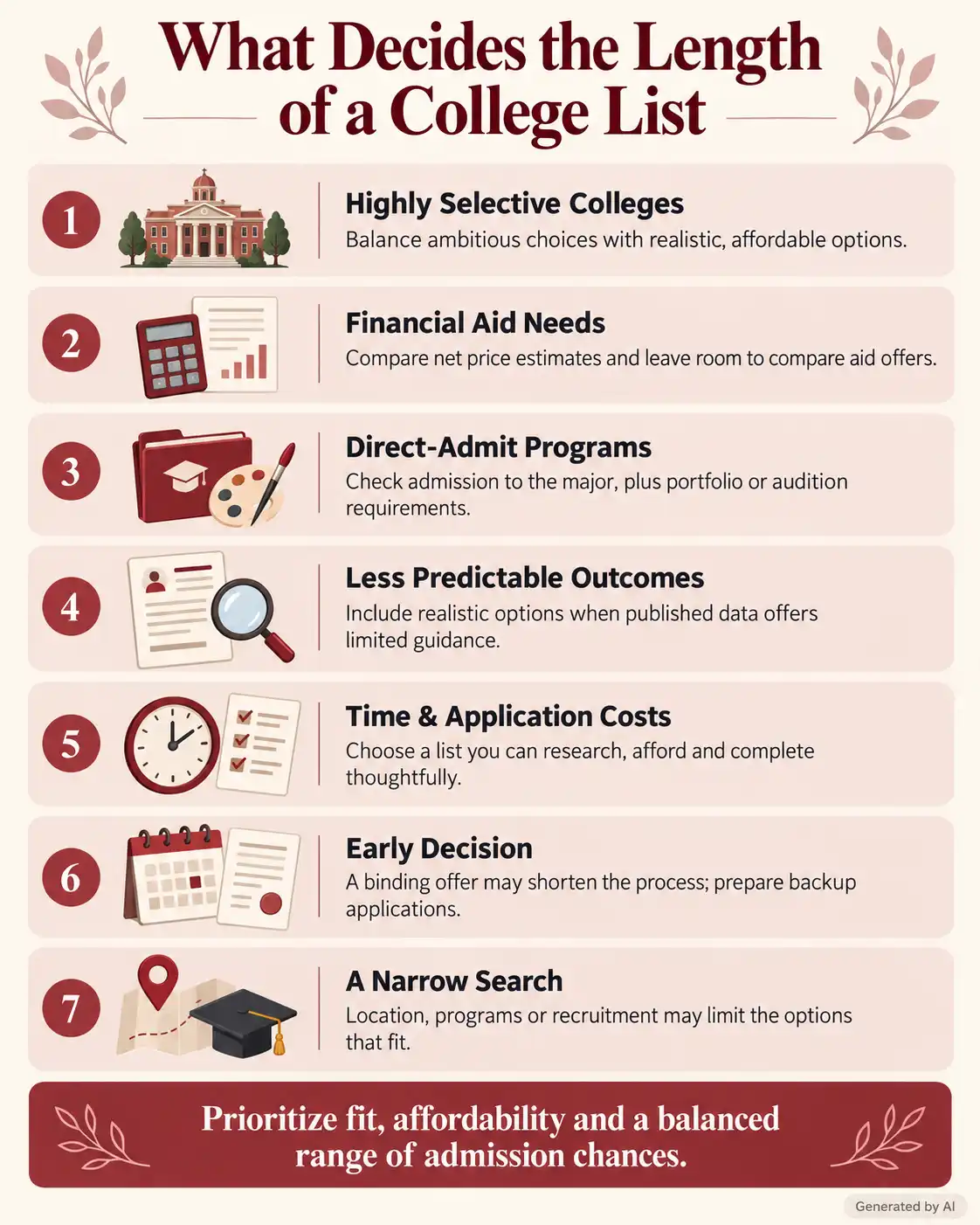
What Decides the Length of a College List
The 8 to 14 range is a starting point, and where a particular student falls within it usually comes down to a few practical factors that experienced consultants see again and again. Two students with similar grades can end up with very different lists, and most families will recognize their own situation in at least one of the factors below.
1. Applying to Several Highly Selective Colleges
Students often become attached to several highly selective colleges and add each one without adding colleges where their chances are stronger. A useful check is to count how many colleges on the list the student is very likely to be admitted to and could realistically afford. If the answer is fewer than two, the list needs rebalancing, either by adding colleges where the student is a likely or realistic admit, or by replacing some of the most selective colleges with them.
2. Relying on Financial Aid
Families who will need financial aid or merit scholarships to make college affordable may benefit from a slightly longer list. Aid offers can differ by thousands of dollars between colleges with similar prices, and at colleges that offer academic merit scholarships, strong grades and test scores can improve a student’s chances of receiving one.
Running each college’s net price calculator before the list is final gives families an estimate of what each college is likely to cost. Adding a few colleges where the student would be among the stronger applicants improves the odds of a generous offer, and having several offers to compare in the spring makes the real cost of each option much clearer.
3. Applying to Direct-Admit Programs
Students planning to study engineering, nursing, or the arts, where many programs require a portfolio, audition, or interview, should check early whether each college admits students directly into the major. At some universities, a student can be admitted and still be turned down for the program, and switching into it later isn’t always possible.
Before adding a college, it is worth looking at the program’s own admission numbers where the university publishes them, and at whether the application asks for a second-choice major. A college where the student looks like a solid candidate on paper can be much harder to get into for that particular program, so it usually makes sense for these students to apply to a few more universities.
4. Applying When Admission Is Harder to Predict
For students applying test-optional, with an uneven year on their transcript, or from a homeschool or international curriculum, outcomes can be harder to predict from published admissions data, even though colleges have well-established ways of reviewing these applications.
At test-optional colleges, for example, the published score range includes only students who chose to submit scores, so it represents primarily the scores of only the top testers in the class scores of the full class.
When a student’s chances are difficult to predict, it usually makes sense to add a few more colleges where the student looks like a realistic candidate. The application itself can also do some of the work: the Common App’s additional information and Responsibilities and Circumstances sections are the right places to explain anything that genuinely needs context, and where a school counselor’s letter is part of the application, it can add that context as well.
5. Weighing the Time and Cost of Each Application
Every college on a list adds work. Many selective colleges ask for at least one supplemental essay, and the strongest supplements show that the student has researched what that particular college offers, which takes real time. Many colleges charge application fees of roughly $45 to $100, while others charge less or nothing at all, and official score reports can add to the cost where a college requires them. Fee waivers are available for students who qualify.
A practical test before finalizing the list is to read each college’s supplemental essay prompts: if the student can’t write a specific, well-researched response for a college, that college may not belong on the list yet.
6. Applying Early Decision
Early Decision can shorten the list a student ultimately submits, since an acceptance in December ends the process for a student with a clear first choice and a family comfortable with a binding commitment. A student applying Early Decision I may have an answer by mid-December, though it’s wise to have Regular Decision applications mostly written by then, so that a deferral or denial doesn’t leave the student rushing through supplements over winter break. Families who want to compare financial aid offers before committing should weigh whether Early Decision suits that goal, since an acceptance is binding.
7. Searching Within a Narrow Focus
Students searching within a specific region, for a particular academic program, or through athletic recruitment may find that fewer colleges offer what they are looking for, which can lead to a shorter list. The priority in these cases is making sure the list still includes colleges where admission is likely, since a narrow search often leaves fewer of them.
For recruited athletes, a coach’s interest does not by itself guarantee admission, so it is worth confirming where the student stands both with the coach and in the college’s admissions process.
How to Pick Colleges to Apply To
Knowing how to pick colleges to apply to is where most of the real work in list building happens. Families often start with names they already know, from rankings, friends, or a campus they once drove past, and the list grows from there.
McMillan Education’s consultants recommend starting from the other end, with what the student wants from college, and testing each college against those criteria and against an honest read of the student’s chances.
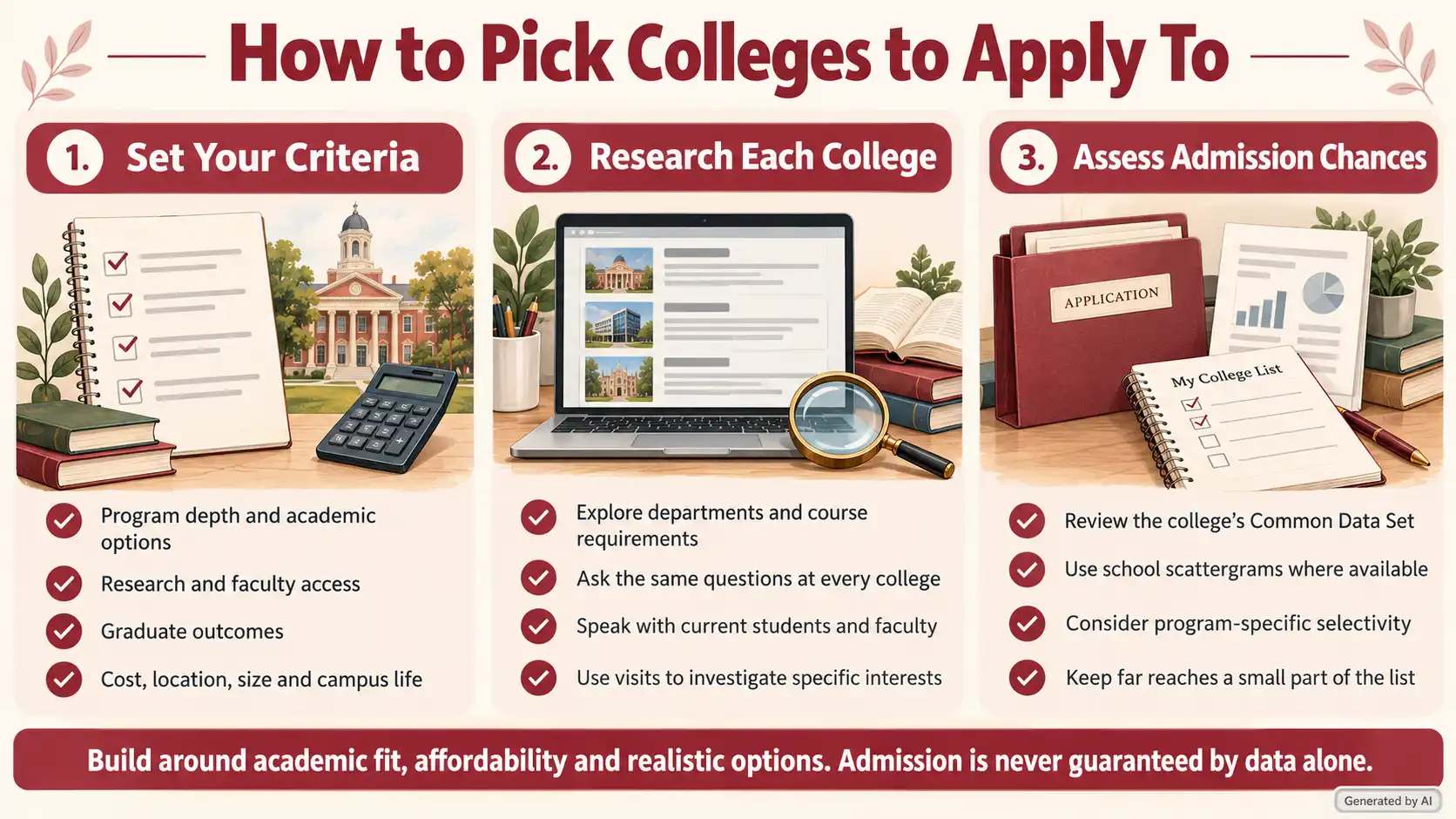
1. Start With Criteria Before College Names
The most useful criteria are about what students actually gain from a college. For a student with a major in mind, that means looking at:
- how deep the program goes beyond introductory courses
- whether undergraduates get research opportunities and real time with faculty
- where graduates end up, both in graduate school and in their first jobs, which many colleges report in first-destination data on recent graduates
Students still deciding on a major can start with how to choose a college major and an overview of the types of colleges in the US, since a research university, a liberal arts college, and a specialized institute offer very different academic experiences.
Location, size, and campus life come next. They shape a student’s daily life for four years, and they are easier to judge once the academic criteria have narrowed the field. A fuller breakdown is in what type of college is right for me.
Cost belongs among the criteria from the start, for the reasons covered in the financial aid section above.
2. Researching Each College
Once the criteria are set, they work best as a set of questions asked of every college on the list. Asking each college the same questions makes the answers comparable, and it quickly shows which colleges stand out and which ones were on the list mostly because of their name.
Good research goes well beyond a college’s homepage. Families who click five to ten pages deep, into department pages, course listings, and program requirements, usually find answers the admissions brochure leaves out. They also arrive at a campus visit or interview with better questions. Asking which minors pair well with a college’s international business major, for example, shows real research and produces a far more useful answer than a question the website already covers.
Opinions from friends and relatives are worth hearing, though they rarely tell the whole story. A friend’s experience or an older sibling’s story from years ago can be vivid and persuasive, but it reflects one person’s view of a college that may have changed since.
Information published by the college, along with conversations with several current students and faculty, tends to give a more up-to-date picture, and the more voices a family hears, the less any single story shapes the decision.
3. Assessing the Student’s Chances at Each College
The most reliable admissions data for most colleges is in the Common Data Set, a standardized report that many colleges publish each year. Section C shows:
- how many students applied, were admitted, and enrolled
- the middle range of test scores and GPAs for enrolled students
- how much weight the college gives to factors such as course rigor, essays, recommendations, and an applicant’s level of interest
High school scattergrams, available through the college planning platform many high schools provide, add another layer, showing how applicants from the student’s own school have done at each college.
Data shows only part of the picture. A student who meets a college’s criteria can still be turned down, because colleges build each class around priorities that shift from year to year, such as a balance of intended majors, regions, and talents. No single admission at a college where the student is a strong but uncertain candidate can be predicted, which is why a list needs several of them.
Many colleges also notice how engaged an applicant has been, through visits, information sessions, and the supplement. A student who skips all three at a college where admission looks likely can read as a backup choice.
A few colleges admit such a small share of applicants that even a student with an exceptional record can’t count on an offer. McMillan Education’s college planning consultants call these Far Reach colleges, and on a well-built list they make up only a small part of the whole.
When to Build and Finalize Your College List
Junior year is a useful time to begin building a college list, with a near-final decision on how many colleges to apply to ready before the student’s earliest application deadline. Finishing most of the research on each college before senior fall leaves more time to write thoughtful supplements. The months below are a guide, and the timing can shift with the student’s schedule.
- January to May of junior year: Build a broad research list from the student’s criteria. At this early college planning stage, the list can be longer than the final one, which leaves room to explore colleges beyond the familiar names.
- March to August: Visit campuses over spring break and the summer, in person or through virtual tours and information sessions, and talk through each one while impressions are fresh. Summer visits show less of ordinary student life, since many classes are out of session, so a spring visit is worth planning for colleges the student is seriously considering. A visit that takes a college off the list is a useful result, since it lets the student focus research and application work on the colleges that remain.
- August: Narrow to a working list close to its final length. The new Common App application cycle launches August 1, though students can start the main essay earlier, since the prompts are published in advance. Supplemental essay prompts are worth confirming on each college’s own site before drafting.
- September to October of senior year: Finalize the list before the student’s earliest application deadline, usually an Early Action or Early Decision deadline, which falls in October at some colleges and on November 1 or November 15 at many others. Before finalizing, it’s worth checking that the list includes enough colleges where admission is likely, and that the student would be glad to attend every college on it.
Some changes in the fall are normal, such as a late campus visit, a net price estimate that comes in higher than expected, or first-quarter grades and test scores that shift the student’s chances. Whether new grades or scores reach a particular college depends on its deadlines and review process. Adding several new colleges late in the fall is harder to manage, especially when those colleges have deadlines coming up soon or require several supplemental essays.
Build a College List With an Educational Consultant
A strong college list starts with a clear read of the student: their academic record, their interests, and the strengths that set them apart in an applicant pool. McMillan Education’s college admissions consultants draw on more than 70 years of placements to assess where each student stands, identify the colleges where that profile is most competitive, and plan how the application presents the student at each one.
Schedule a free consultation to start that planning, or work through the same process independently with the W.I.S.E. Admissions Playbook™.
Frequently Asked Questions
1. How many colleges can you apply to on the Common App?
The Common App allows students to add up to 20 colleges. Colleges with their own applications fall outside that limit, including the University of California, where students can apply to all 9 UC undergraduate campuses using one application.
2. Can you apply to more than 20 colleges?
Yes, by combining the Common App with other platforms and colleges’ own applications. Each additional college adds its own research, supplemental essays, and fees, so a list longer than 20 is worth reviewing college by college before submitting.
3. Should you apply to multiple colleges?
Yes. Applying to a single college leaves the student with no alternatives if the answer is no, or if the financial aid offer doesn’t work for the family. A list that combines colleges where admission is likely, where it is uncertain, and a few that are a stretch gives the student options in the spring.
4. Is applying to 15 or more colleges too many?
It can be, depending on what the extra colleges add to the list. The factors that make a longer list worthwhile, such as aid comparisons and direct-admit programs, are covered in the section on what decides the length of a college list above.
5. Can you apply Early Decision to more than one college?
No. Early Decision is binding, so a student can hold only one Early Decision application at a time. A student who is denied or deferred in Early Decision I can apply Early Decision II to a different college, since ED II deadlines generally occur after ED I decisions have been released, and a student can usually pair one Early Decision application with non-restrictive Early Action applications elsewhere.
6. Can you change your college list after starting applications?
Yes, until an application is submitted. Colleges can be added or removed on the Common App dashboard before submission, but submitted colleges cannot be removed. A student who no longer wants to be considered after submitting can contact that college’s admissions office. Colleges with rolling admission can be added later in the year.
7. Do colleges know where else you applied?
Not through the FAFSA. The Department of Education stopped sharing a student’s FAFSA college list with colleges beginning with the 2016-17 FAFSA. The Common App does not show colleges the rest of a student’s list either.
8. How many universities can you apply to in the UK?
UK undergraduate applications go through UCAS, which allows up to five courses: all at one university or a mix. There is no order of preference to your choices, and for students who use all five without an offer, UCAS Extra is a free service you can use to add more choices to your UCAS application if you have used all five choices but haven’t received any offers. Students applying to UK universities need to plan the two lists separately, since UCAS limits the number of UK choices.