
Rolling admission is available at hundreds of colleges and universities across the United States, from large public flagships to regional institutions and graduate programs. The process works differently from Early Action and Regular Decision in ways that affect admission odds, financial aid, and application sequencing.
This article covers what rolling admission is, how it compares to other application types, what the timing means for scholarships and financial aid, and how to build a coordinated strategy around the rolling calendar.
What Is Rolling Admission?
Rolling admission is an admissions model in which applications are evaluated continuously as they’re received, with decisions issued on an ongoing basis rather than all at once after a fixed deadline. Colleges and universities are the most common context, but the same model appears in K-12 private and boarding school admissions, graduate and professional programs, and continuing education.
At the college level, where the term is most widely used, the application window typically opens in late summer or early fall and remains open for several months, closing either at a published date or when the incoming class reaches capacity.
Several related terms appear across university websites and are worth distinguishing:
- Rolling basis: Applications are read and decided in the order they become complete, rather than held until a cutoff date.
- Rolling application: Students may submit materials at any point within an extended window, rather than against a single deadline.
- Rolling enrollment: Most common in community colleges, online programs, and professional adult education. Students apply continuously and can also matriculate and begin coursework at staggered intervals throughout the year.
- Rolling deadline: True rolling admission institutions do not impose a hard final cutoff for general consideration, yet many enforce internal priority dates for merit scholarships, honors programs, or competitive majors. These dates carry real consequences and are discussed in detail later in this article.
In all four cases, the date an application is completed determines the institutional conditions under which it is reviewed.
How Rolling Admission Works in Practice
Rolling admission works by evaluating applications continuously in the order they become complete, issuing decisions individually rather than releasing them in a single batch.
1. Submission and File Completion
The operative word is “complete.” The four-to-eight-week evaluation window that most institutions cite begins on the day the final required document clears the university’s tracking system, not the day the student clicks submit. A student who submits the application in September but whose transcript arrives in November has effectively applied in November.
2. Committee Review
The timing of completion determines the competitive landscape the application enters. Files completed in September and October are reviewed against an incoming class that is largely empty. Admissions officers are evaluating each applicant against the institution’s historical standards and its enrollment targets for the cycle, with the full inventory of seats, housing, competitive program slots, and merit aid still available. At large public universities, the committee has often already extended thousands of offers and allocated a significant share of its scholarship budget by January. The academic threshold required to secure one of the remaining seats rises as the class fills. The same transcript that produced an acceptance in October can produce a deferral in February.
3. Decision Outcomes
Decisions from rolling institutions generally fall into four categories: admission, denial, deferral, or an alternative offer such as admission to a branch campus, a spring start term, or a different academic program than the student’s stated preference. At several large public universities, deferrals specifically indicate that the committee wants to review first-semester senior year grades before rendering a final decision. In a rolling system, a deferral pushes the applicant into a later, more competitive phase of the cycle.
Rolling Admission vs. Early Action: What’s the Difference?
Rolling admission and Early Action are both non-binding, and both can produce decisions well before the spring notification period. That shared profile is where the confusion originates, and where it should end. The two pathways operate on entirely different institutional mechanics.
|
Feature |
Early Action |
Rolling Admission |
|
Deadline |
Fixed (typically Nov 1 or Nov 15) |
Ongoing window, no single cutoff |
|
How applications are reviewed |
Read as one batch, around and after the deadline |
Read individually, in the order each file becomes complete |
|
Decision timeline |
Released on one unified date, typically mid-to-late December |
4–8 weeks after the file is complete, on a rolling basis |
|
Does submission date within the window matter? |
No — an application from Nov 1 and one from Nov 14 are reviewed together |
Yes — an application complete in September is evaluated under different conditions than one complete in December |
|
Binding? |
No |
No |
Early Action imposes a fixed deadline, most commonly November 1 or November 15. All applications submitted by that date are held, then read as a single batch after the deadline closes. Candidates are evaluated against one another within that pool, and decisions are released on a unified date, typically in mid-to-late December. The committee reviews the cohort comparatively.
Rolling admission has no batch. Applications are read individually, in the order they become complete, and decisions are issued continuously across the cycle. An applicant whose file is complete in September is evaluated against the institution’s admissions standards and enrollment targets at that moment, not against the applicant whose file arrives in December. The two files never sit on the same desk at the same time.
For a broader overview of how binding and non-binding early application rounds compare, see our guide to Early Decision vs. Early Action.
Advantages and Disadvantages of Rolling Admission
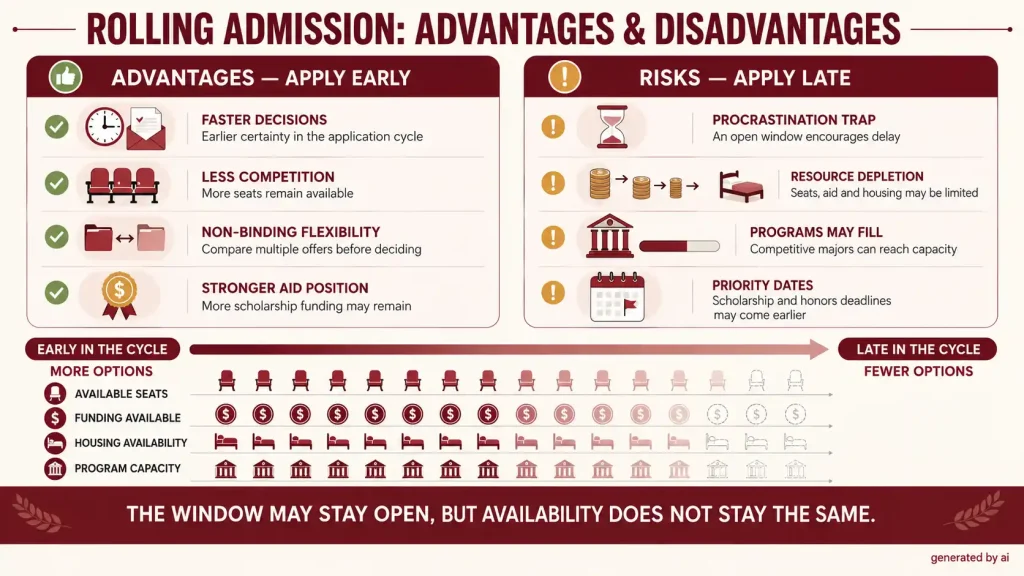
Rolling admission offers structural advantages that no other application type replicates, but those advantages are time-dependent. The same system that rewards early applicants with certainty, resources, and favorable review conditions works against those who treat the open window as an invitation to delay.
1. Benefits
1.1 Faster Decisions
Rolling admissions colleges typically issue decisions within four to eight weeks of receiving a complete application. A student who submits in September can hold a verified acceptance by late October, before the Early Decision and Early Action deadlines at other institutions have even passed. That early acceptance functions as an institutional floor for the remainder of the cycle. Every subsequent application is submitted from a position of certainty rather than speculation.
1.2 Less Competition Early in the Cycle
Applications completed in the early months of the window are reviewed when the incoming class is largely empty. Admissions officers are evaluating each file against the institution’s historical standards and enrollment targets, with the full inventory of seats still available. By midwinter, thousands of offers have already been extended and the committee is filling remaining gaps rather than building a class. The same academic profile can produce different outcomes depending on where in the cycle it is reviewed.
1.3 Non-Binding Flexibility
Rolling admission carries no enrollment commitment. A student accepted in October can hold that offer without submitting a deposit and wait until the May 1 National College Decision Day to compare it against Early Action, Early Decision II, and Regular Decision outcomes from other institutions. This allows families to accumulate multiple offers and financial aid packages before making a final enrollment decision.
1.4 Stronger Financial Aid Positioning
Merit scholarships and institutional aid at rolling admissions colleges are disbursed continuously alongside acceptances, not reserved for a single spring notification. Early applicants access the full scholarship budget. As the year progresses and the budget is allocated to admitted students, the institution has progressively less to offer. The financial aid section later in this article examines this mechanism in detail.
2. Risks and Considerations
2.1 The Procrastination Trap
The open application window creates a false sense of available time. Rolling admission extends into the spring at most institutions, and that flexibility reads as permission to delay. The institutional reality runs in the opposite direction. Every week between September and March narrows the available seats, depletes the scholarship budget, and can raise the academic threshold for admission. A student whose profile would have produced an acceptance and a merit award in October may be waitlisted with an identical transcript in February.
2.2 Resource Depletion
The disadvantage extends beyond the admissions decision itself. At many large public universities, housing assignments, competitive program admissions, and financial aid packaging all operate on the same continuous timeline as acceptances. A student admitted in March may find that the engineering or nursing cohort has closed, that preferred housing is fully assigned, and that the discretionary merit budget has been exhausted by applicants admitted months earlier.
2.3 Priority Deadline Ambiguity
Rolling admission institutions frequently enforce internal priority deadlines for scholarships, honors programs, and competitive majors, often falling between November 1 and December 1. These dates are not always communicated with the same visibility as a fixed Early Action or Regular Decision deadline. Missing them does not disqualify the application, but it can significantly reduce what the institution has left to offer upon acceptance.
When and How to Apply for Rolling Admission
The strongest outcomes go to applicants who are ready to submit as early in the cycle as their materials allow. The calendar below maps what that looks like in practice, along with what actually needs to be in place before an application counts as submitted.
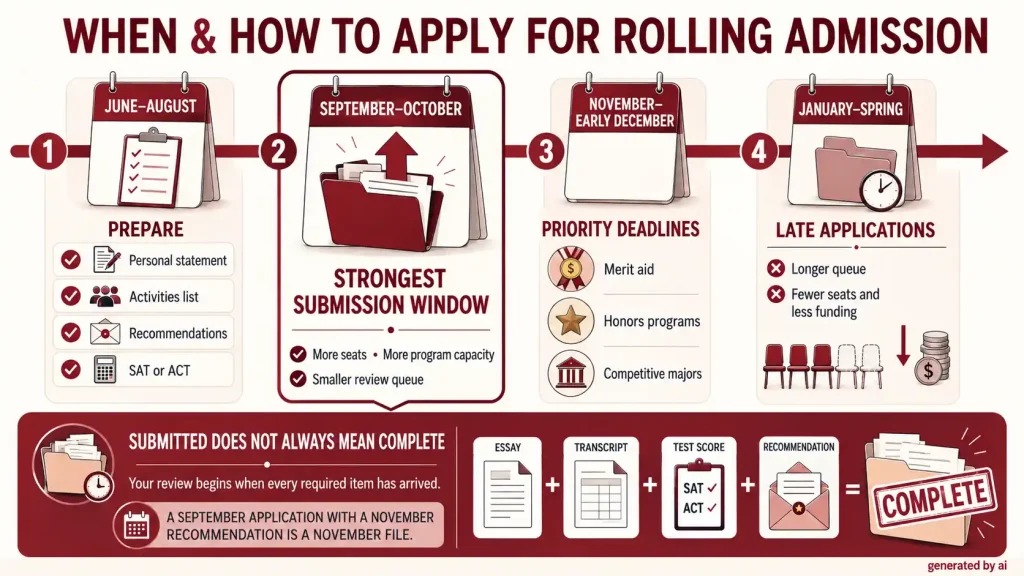
1. June through August: Prepare
Most rolling admissions applications open in August, though the exact date and platform vary by institution; some use the Common Application, others the Coalition Application, and many rely on their own institutional portal. Whichever platform applies, the months before the window opens are for assembling every component that determines an application’s completion date, since a file isn’t reviewed until the last required piece arrives, not the day it’s submitted:
- Draft and revise the personal statement
- Finalize the extracurricular activities list
- Request recommendation letters from junior-year core academic subject teachers
- Complete SAT or ACT testing, leaving the summer for a retake if needed
A student whose materials are ready when the window opens can submit within its first weeks. Confirming with each recommender that their letter is in before hitting submit matters just as much as finishing the essay, since a September application with a November recommendation letter is, in practice, a November application.
For families beginning this work earlier in high school, McMillan Education’s early college planning consultants map out that preparation sequence years in advance.
2. September through October: Submit
This is the strongest window for submission. The incoming class is largely empty, competitive program slots are open, and admissions officers are working through a smaller volume of completed files. A complete application submitted in September can produce a verified acceptance by late October, clearing the calendar for the supplemental essays required by selective Regular Decision schools during the winter.
3. November through Early December: Priority Deadlines
Many rolling admissions colleges enforce internal priority dates during this window. These rolling deadlines govern eligibility for:
- Merit scholarships and institutional aid
- Honors college admission
- Direct admission to competitive majors (business, engineering, nursing)
Applications submitted after these dates are still reviewed on a rolling basis, but the resources attached to acceptance narrow considerably. Priority dates typically fall between November 1 and December 1. Check each institution’s admissions page for exact dates.
4. January through Spring: Late Applications
The reading queue is long, the class is substantially filled, and the financial aid budget has been largely committed. Late applicants are reviewed for whatever capacity remains.
Rolling Admission, Financial Aid, and Scholarships
Financial aid at rolling admissions colleges is distributed continuously alongside acceptances. Three mechanisms drive this.
1. Merit Aid Mechanics
University financial aid offices operate with fixed annual budgets. In a rolling admission environment, these funds are disbursed as offers are made:
- A strong applicant admitted in October receives a competitive merit package built to secure enrollment.
- By midwinter, a significant share of the discretionary merit budget has been committed to students admitted earlier in the cycle.
- The total amount available to the institution does not change. The amount available at any given point in the calendar does.
2. Yield Modeling and Scholarship Strategy
Institutions rely on predictive enrollment management platforms to forecast yield, the percentage of admitted students who will ultimately deposit and enroll. These algorithms score applicants on variables including:
- Academic profile
- Demonstrated interest
- Geographic origin
- Timing of application
Students who apply early in the rolling cycle tend to register as higher-yield prospects. The institution’s investment logic follows: the most aggressive scholarship offers go to applicants the model identifies as most likely to enroll, and early application is one of the strongest signals in that model.
3. Need-Based Aid and FAFSA Timing
State-level grants and institutional need-based funds at rolling admissions colleges are packaged sequentially alongside the admissions cycle. Students who submit the FAFSA early and pair it with an early rolling application access these pools before they are drawn down. The W.I.S.E. Admissions Playbook™ covers the full financial aid timeline and how to sequence these filings within a broader college planning strategy.
In all three cases, the mechanism is the same: the budget is finite, the disbursement is continuous, and the calendar determines what is available at the moment of the decision.
What Happens After a Rolling Admission Acceptance
No immediate commitment is required. Rolling admission is non-binding. A student accepted in October can hold that offer until the May 1 National College Decision Day, comparing it against Early Action, Early Decision II, and Regular Decision outcomes as they arrive through the winter and spring.
Early offers create financial leverage. A merit scholarship from a rolling institution, received months before other schools have issued decisions, gives families a concrete baseline for comparing net cost of attendance. That early offer can also be used when appealing for additional institutional aid at competing universities.
Housing and program deposits may operate on a separate timeline. At many large public universities, preferred residence halls and living-learning communities fill on a continuous, space-available basis. Honors college acceptances and competitive major admissions may also require action well before May 1. Students should read acceptance materials carefully for secondary deposit deadlines that run ahead of the general enrollment commitment.
International students should begin visa processing immediately. An early rolling acceptance allows the student to submit proof of financial solvency and trigger issuance of the I-20 Certificate of Eligibility, which typically takes two to four weeks. The I-20 is required before scheduling an F-1 visa interview at a U.S. embassy or consulate. Government processing times and embassy appointment availability are unpredictable, and U.S. regulations permit entry no earlier than 30 days before the program start date listed on the I-20. Starting this sequence in the fall rather than the spring eliminates the logistical risk that delays a student’s arrival on campus.
Rolling Admission Across Education Levels
Rolling admission is most associated with undergraduate college applications, but the same continuous-review model operates at other stages of education, each with its own mechanics and timing pressures.
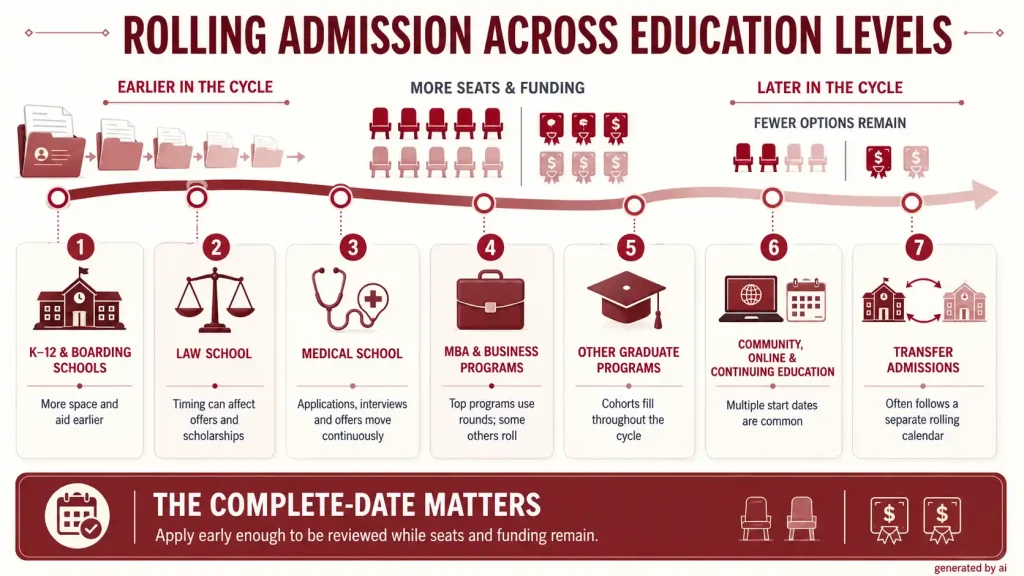
1. K-12 and Boarding Schools
Offered alongside fixed-deadline processes at many US boarding schools, often to accommodate mid-year transfers, international applicants, or families beginning the search later than the typical fall cycle. Earlier applicants generally have access to more available spots and a wider range of financial aid.
2. Law School
Operates through LSAC on a strict rolling basis. Applicants with identical academic profiles routinely see different outcomes and different scholarship amounts depending on when their file is complete.
3. Medical School
Many medical schools run through centralized systems such as AMCAS, with secondary applications, interview invitations, and acceptances all issued continuously once a primary application clears verification.
4. MBA and Business Programs
Most top programs use a round-based system, closer to Early Action than true rolling admission, though later rounds have fewer seats and less funding. Regional business schools and specialized master’s programs are more likely to run genuinely rolling timelines.
5. Other Graduate and Professional Programs
Master’s programs in nursing, public health, education, social work, and engineering commonly admit on a rolling basis, with cohorts filling continuously throughout the cycle.
6. Community Colleges, Online Programs, and Continuing Education
Rolling admission is often the default model rather than an alternative, since many of these programs are built around multiple start dates rather than one fall intake. This is where rolling admission and rolling enrollment typically overlap.
7. Transfer Admissions
Many colleges run a separate rolling admissions for transfer applicants, frequently on a different calendar than first-year admission, and often tied to spring-semester openings.
Across every context, the same principle holds: the date a file becomes complete determines the conditions under which it’s reviewed, and those conditions grow less favorable as the cycle progresses.
Plan Your Rolling Admission Strategy
Sequencing rolling admission alongside Early Action, Early Decision, and Regular Decision requires managing several institutional timelines at once, each with its own priority dates for admission and financial aid.
Speak with McMillan Education’s college admissions consultants to build a coordinated application strategy around your student’s institutional priorities and timeline.
Frequently Asked Questions
1. Is rolling admission binding?
No. Rolling admission is completely non-binding. A student who receives an acceptance can hold it until the May 1 National College Decision Day, comparing it against offers and financial aid packages from other institutions before making a final enrollment decision.
2. Are rolling admissions first come first serve?
In practice, yes. Applications are reviewed in the order they become complete, and seats, housing, competitive program slots, and scholarship funds are all allocated continuously. Qualified applicants who submit early access the full range of institutional resources. Late applicants compete for what remains.
3. When is the best time to apply for rolling admission?
The strongest practical window is September through November. Seats and aid dollars are most plentiful earlier in the cycle, but this window balances that advantage against realistic time to prepare a complete application. Where a school publishes a priority deadline, typically November or early December, that date should be treated as the real deadline rather than the outer edge of the rolling window.
4. Does applying rolling admission improve my chances of getting in?
Applying early within the rolling window improves the statistical probability of acceptance. Early in the cycle, the admissions committee is evaluating applicants against institutional standards with the full incoming class still to fill. As the class reaches capacity, the academic threshold for admission rises and the same profile that produced an acceptance in October can produce a deferral in February.
5. How long does it take to hear back from a rolling admission school?
Most rolling admissions colleges issue decisions within four to eight weeks of receiving a complete application. During the early weeks of the cycle, some institutions process decisions in as little as two to three weeks. Application volume spikes later in the fall can push the timeline closer to the full eight-week window.
6. Can I apply to multiple rolling admission schools at the same time?
Yes. Rolling admission applications are non-binding and operate on independent institutional timelines. Submitting to multiple rolling institutions simultaneously is a standard and strategically sound approach, particularly for securing early acceptances and building a foundation of financial aid offers before Regular Decision outcomes arrive.
7. What if I apply late in the rolling admission cycle?
Late applications are still reviewed, but the institutional conditions are significantly less favorable. The majority of the incoming class has been filled, the merit scholarship budget has been largely allocated, and competitive programs and preferred housing may have reached capacity. The same academic profile that would have produced an acceptance and a scholarship in the fall may result in a waitlist or a reduced financial package in the spring.