

College visits are where families find out whether the academic culture is the right one, whether the campus environment suits the student, whether the people and the place feel like somewhere worth four years.
This article covers how to plan visits, what to look for and who to speak with on campus, the questions to ask during a college tour, and how to evaluate institutions once you return home.
What Is a College Visit and How Can You Do It?
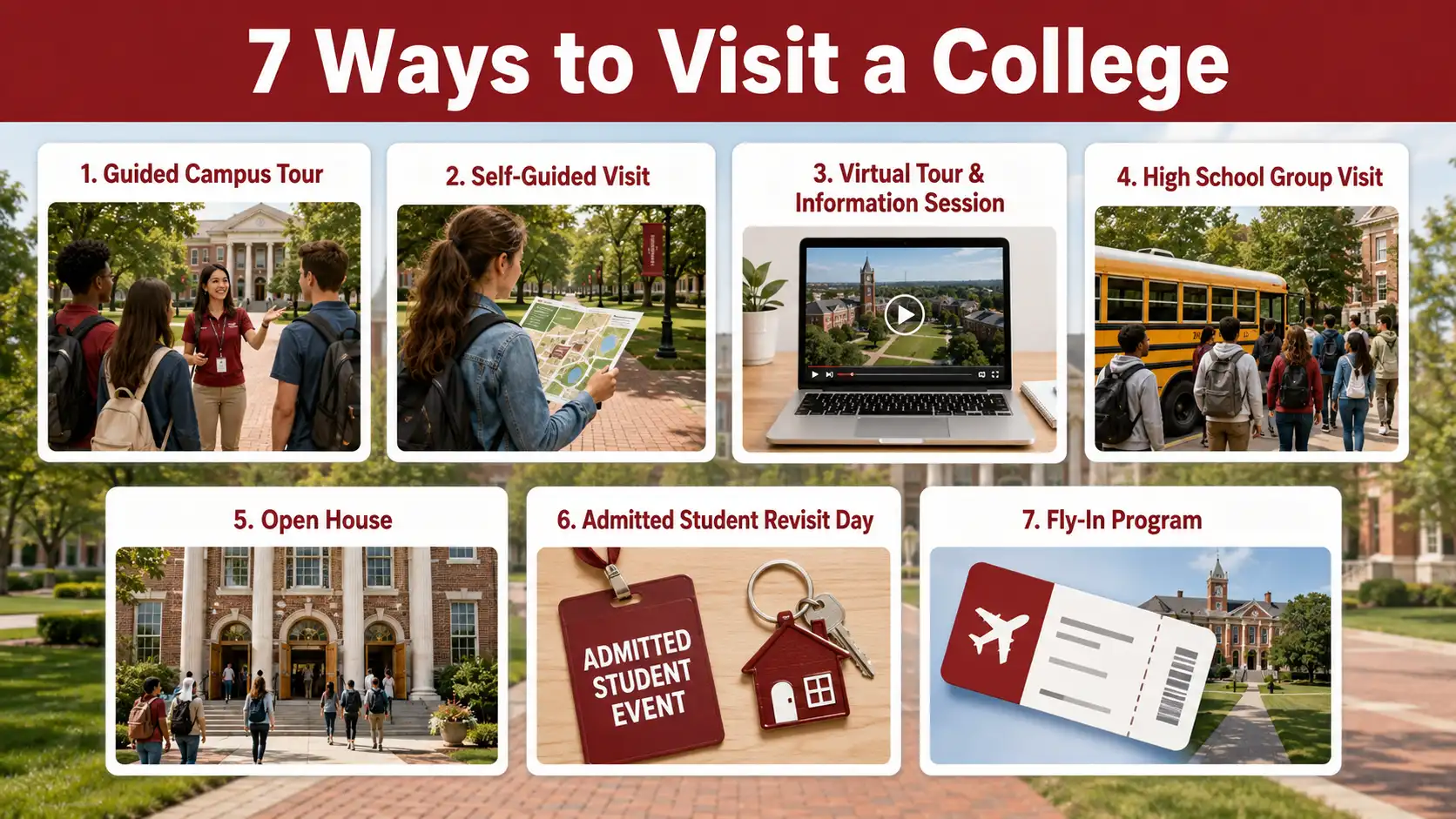
A college visit is a student’s first real look at an institution: the campus, the people, and the day-to-day academic environment. Most visits follow a standard format of an information session and a guided campus tour, but there are several other ways to visit depending on where a student is in the admissions process.
1. Guided Campus Tour
The guided campus tour is the standard format for a registered college visit: a current student ambassador leads a group of prospective students and families through key campus buildings, facilities, and outdoor spaces over approximately one hour. It is the baseline visit format and the most widely available option.
2. Self-Guided College Visit
A self-guided visit is an unregistered, self-directed walk of a college campus. Students explore academic buildings, dining facilities, libraries, and common areas at their own pace without a tour guide. It provides an unfiltered view of daily campus life outside the structured tour route.
3. Virtual Tour and Information Session
A virtual tour is an online version of the standard campus visit, offered by most institutions as a preliminary research tool. It typically includes a recorded or live campus walkthrough and an admissions information session. It is useful for narrowing a college list before committing to travel.
4. High School Group Visit
A high school group visit is a campus tour organized through a school counselor and attended by a group of students together. It is more structured and less personalized than an individual visit, and is most useful for students early in the college planning process who are still forming their college list.
5. Open House
An open house is a large, institution-organized campus event held on specific dates, typically in fall or spring. Multiple sessions run simultaneously across departments, giving families broader exposure to academic programs and faculty than a standard tour provides.
6. Admitted Student Revisit Day
An admitted student revisit day is a campus event offered to students after admission decisions are released. It typically includes departmental sessions, financial aid presentations, and housing tours. It is the visit that carries the most weight for final enrollment decisions.
7. Fly-In Program
A fly-in program is a fully funded campus visit offered by select institutions to promising students from underrepresented or first-generation backgrounds. Travel, accommodation, and meals are covered by the institution. It is competitive to access, but among the most immersive visit formats available.
How to Plan Your College Visits
The following covers the decisions that make college visit season productive: which schools to visit, when to go, how to schedule, and how to prepare before setting foot on campus.
1. When to Visit Colleges
Visit timing should map to the stage of the college search. Freshman and sophomore year visits serve an orientation function: a student who has spent a morning on a large research university campus and an afternoon at a small liberal arts college has a concrete reference point that no amount of reading produces. These early visits are most productive when kept geographically accessible, without the pressure of serious evaluation.
Junior year is when college visits carry real decision weight. By junior fall, most students have enough academic history to identify realistic institutional targets, and the college list is actively forming. This is the year to prioritize.
Senior fall visits serve a narrower purpose: confirming choices before applications are submitted. A student weighing whether to apply Early Decision to a particular institution benefits from a fall senior visit before the November deadline. Admitted student revisit days in the spring operate differently again. They are not research visits but decision visits, held after offers have been extended, designed to help a student choose between schools that have already said yes.
2. Which Colleges to Visit
A visit list is most productively built as a parallel exercise to building an application list. The same framework applies: a distribution across reach, realistic, and likely institutions, selected on genuine grounds rather than general name recognition.
The most productive visit lists are built after a student has done baseline research into the different categories of American colleges and universities: liberal arts colleges, technical institutes, regional universities, research universities. Students who understand the structural differences between institution types make visit decisions that are considerably more purposeful.
3. How to Schedule a College Visit
Scheduling the standard registered college visit and information session begins on the admissions section of a college’s website, where most institutions list available tour and information session times. Sessions typically run two to three times a day throughout the year, including summer, though availability varies by institution size and season. High-demand periods, spring break in particular, tend to fill well in advance, so early registration is worth prioritizing.
Scheduling visits when classes are in session, rather than during breaks, exam periods, or summer, gives a considerably more accurate picture of daily campus life and the texture of the student body.
Attending both the information session and the guided campus tour is worth the additional time. Each covers different ground:
- The information session, typically led by an admissions officer, covers the application process, academic programming, and institutional priorities
- The guided tour, led by a current student, covers the physical campus and provides a different register of institutional information
Registration also carries a secondary function worth noting. Many selective institutions track demonstrated interest: the documented evidence that a candidate has made direct contact with the admissions office, attended events, and visited campus. A registered campus visit may be the most direct and verifiable form of demonstrated interest available.
4. How to Prepare for a College Visit
Preparation before a campus visit tends to determine the quality of observation during it. A student who arrives having reviewed the faculty in their area of interest and identified specific programs to ask about is generally better positioned to evaluate rather than simply absorb what the tour presents. To prepare for a college visit, students should:
- Research the institution’s academic programs, departmental strengths, and recent developments
- Review faculty in the student’s area of interest
- Identify specific programs or offerings to follow up on during the visit
- Prepare questions in advance, since the volume of information delivered on a single visit makes it easy to lose track of what mattered most
A structured recording tool, such as a campus visit evaluation form with consistent categories across schools, may make it considerably easier to compare institutions accurately months after the visits occurred. Without a consistent framework, the details that distinguished one campus from another can dissolve into a general sense of the place.
McMillan Education’s College Planning Course includes a dedicated campus visit evaluation form built for exactly this purpose.
What to Do on a College Visit
The campus tour covers the institutional highlights. What a student does around it, and what they observe beyond the tour route, tends to produce better information.
1. What to Observe on a Campus Tour
The guided tour is a curated presentation of the institution’s strongest assets. Observing it critically means paying attention to what is shown and what is not. Beyond the highlighted buildings and signature facilities, the details worth noting include:
- The condition of academic buildings, libraries, and study spaces outside the main tour stops
- Laboratory access hours – labs open past 8pm indicate a culture that accommodates serious academic work
- The density and quality of informal study spaces: benches, quiet reading areas, open common rooms, smaller branch libraries
- The cleanliness and upkeep of shared facilities including bathrooms, laundry areas, and dining halls
- Outdoor spaces available for informal gathering, particularly covered or sheltered options for inclement weather
- Bulletin boards, posted flyers, and announcements throughout campus buildings and common areas: these reflect what students actually organize, attend, and care about, and give a more unfiltered read on campus culture than the tour route typically provides
These spaces matter because students spend the majority of their time not in class but in the spaces between it.
2. What to Do Beyond the Campus Tour
The guided campus tour typically runs an hour. A productive college visit extends well beyond it. The time before and after the official tour may yield more useful information than the tour itself:
- Walk areas of campus the tour does not include, particularly residential buildings, off-the-route academic departments, and student centers
- Observe students between classes: how they move through campus, whether the atmosphere feels animated or subdued, what the general energy of the place communicates
- Visit a smaller branch library or departmental reading room, which tend to reflect the academic culture of specific programs more accurately than the main library
- Attend an information session if one runs alongside the tour, as the two sessions cover meaningfully different institutional ground
- Note what is happening on campus that day: posted events, visible student organization activity, anything that reflects the texture of ordinary campus life
3. Who to Speak With on a College Visit
Different people on campus produce different categories of institutional information. A tour guide, as a selected student ambassador, represents the institution’s preferred narrative. Current students encountered outside the structured session tend to offer a less curated account. Faculty, where accessible, speak to the academic environment at a level admissions presentations rarely reach.
Worth seeking out during a visit:
- Students encountered informally, outside organized sessions, for a less filtered view of daily academic and social life
- A counselor or wellness staff member at the student health center, where a brief conversation about available support groups, mental health resources, and wellness programming can clarify how seriously an institution takes student wellbeing
- A learning differences coordinator or disability services advisor, for families specifically evaluating colleges with learning differences support
- Faculty in the student’s area of interest, where a short meeting or even an office hours visit may be arrangeable in advance
- The admissions representative assigned to the student’s region, asking which officer covers the student’s school during the information session, and introducing oneself or collecting a business card, creates a direct point of contact for follow-up
Questions to Ask on a College Visit
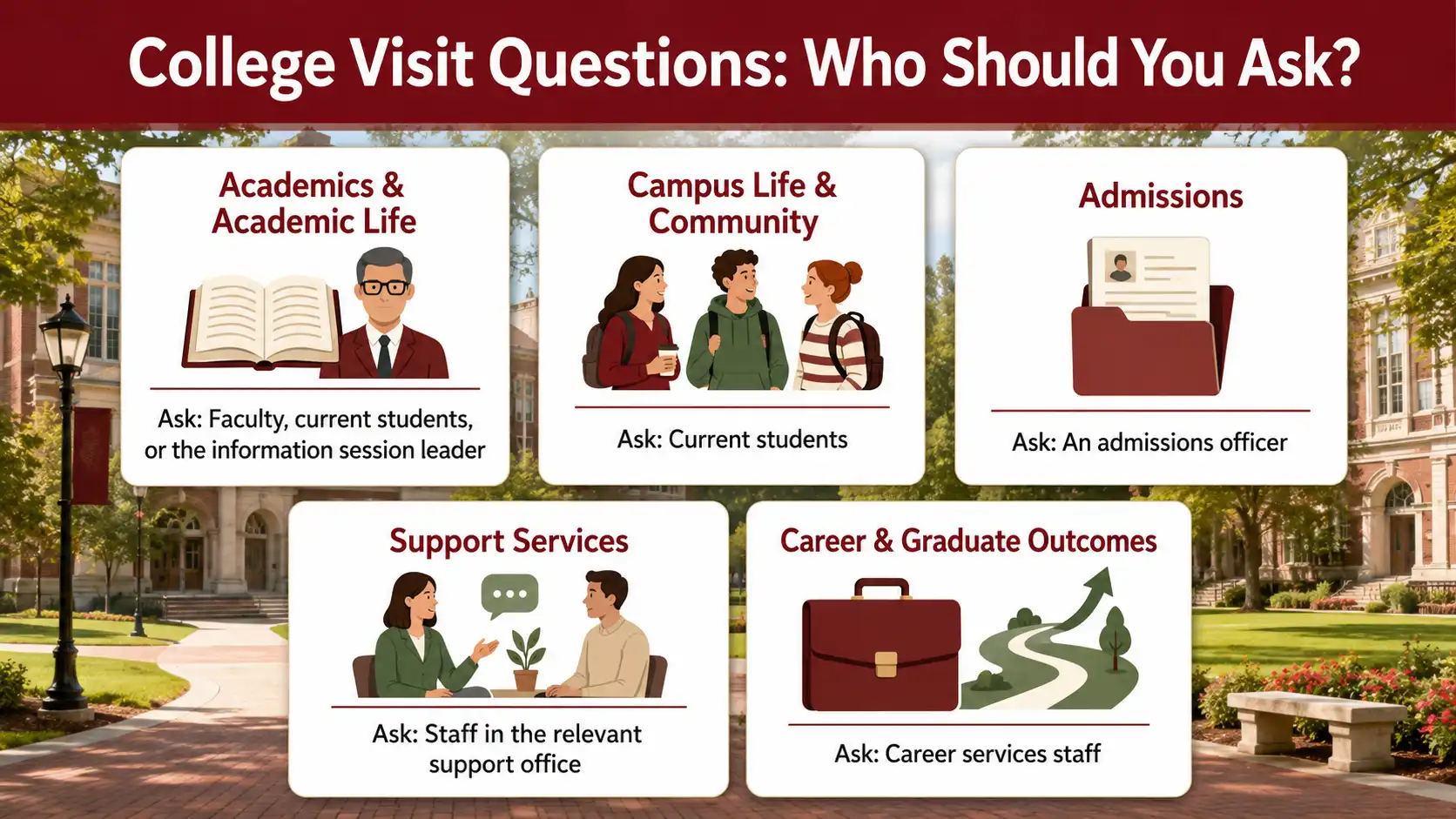
The quality of a college visit depends largely on the questions asked during it. The following questions are organized by subject area, with a note on who is best positioned to answer each category.
The list below can be printed out or copied and brought along to campus as a reference during the visit.
1. Questions About Academics and Academic Life
Best directed at faculty, current students, or the information session leader rather than the tour guide.
What is the average class size in the first and second year, and at what point do students access smaller seminars?
How accessible are professors outside of class through office hours or research opportunities?
What proportion of undergraduates participate in faculty research, and how early in the program does that access typically open up?
How is academic advising structured, and who is responsible for a student’s academic planning?
What academic support resources exist outside the classroom?
2. Questions About Campus Life and Student Community
Current students outside the structured session tend to give the most candid answers here.
What does a typical weekday look like outside of class hours?
Where do students spend time between classes?
What non-competitive social outlets exist for students who want regular activity without the commitment of a varsity or club team?
How would a student describe the general social atmosphere: competitive, collaborative, or somewhere between?
How do students typically make friends, particularly in the first semester?
3. Questions About Admissions
These belong in the information session, directed at the admissions officer leading it.
How is demonstrated interest weighted in the evaluation process?
What distinguishes a competitive application in the current cycle?
How does the institution evaluate students from competitive high school environments relative to those from less resourced schools?
What advantage, if any, does applying Early Decision or Early Action carry at this institution?
4. Questions About Support Services
Worth directing to staff at the relevant offices directly rather than to the tour guide.
How many licensed counselors are on staff, and what is the typical wait time for a first appointment?
What structured support groups are available through the student health center?
For students requiring academic accommodations, what is the process for establishing and maintaining those accommodations across all courses?
What mental health resources are available outside standard office hours?
5. Questions About Career and Graduate Outcomes
Career services staff are the most reliable source for this category. Outcome data from admissions presentations tends to be aggregate; career services can speak to program-level specifics.
What internship infrastructure exists, and how early do students typically access those opportunities?
Which employers recruit directly from this campus, and in which fields is the network strongest?
How does career services structure its relationship with students: is engagement proactive or primarily student-initiated?
What is the graduate and professional school placement record for students in the programs under consideration?
How to Evaluate Colleges After a Campus Visit
A campus visit produces a significant volume of impressions. Without an approach to capturing and evaluating them, the details that distinguish one institution from another tend to compress into a general sense of the place within days. The following covers how to record and evaluate colleges systematically once the visit is complete.
1. What to Record Immediately After a Campus Visit
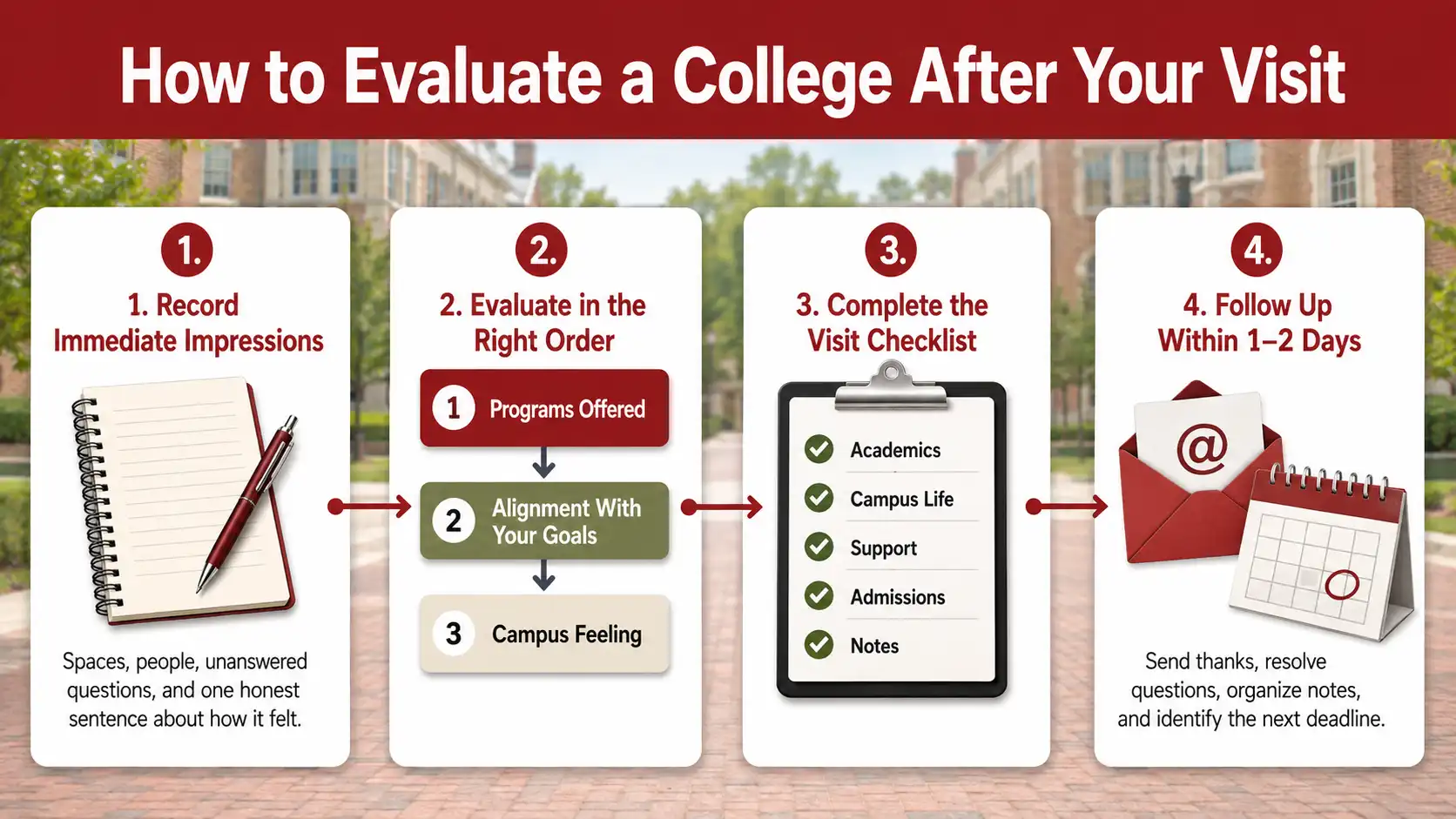
The most accurate impressions are those captured immediately after leaving campus, before the next visit, conversation, or day of school displaces them. Useful things to record straight away include:
- Specific spaces that stood out, positively or negatively, and why
- The names of any students, faculty, or staff members worth following up with
- Questions that arose during the visit that went unanswered
- A single honest sentence about how the campus felt to be on
The last point is not trivial. The felt sense of a place is a legitimate data point. It becomes less reliable when it is the only data point, which is why it belongs at the end of the recording process rather than the beginning.
2. How to Evaluate a College After a Campus Visit
McMillan Education’s college planning consultants recommend evaluating every campus visit through three questions, asked in this order:
- What does the college offer in the way of programs?
- How do those programs align with the student’s goals for their education?
- How did it feel to be on campus?
The order matters more than it might appear. Most families do this in reverse: they come away with a strong feeling about a place and work backward from there. Starting with what the institution actually offers, then asking whether that matches the student’s goals, keeps the evaluation grounded before the gut check gets a say.
3. College Visit Checklist
Before leaving a campus or closing out a visit, the following serves as a completion check across the article’s main observation and conversation categories.
Academic environment:
☐ Observed academic buildings, libraries, and study spaces beyond the tour route
☐ Noted laboratory access hours and availability of informal study spaces
☐ Asked questions about class size, academic advising, and faculty accessibility
Campus life:
☐ Observed student activity between classes
☐ Asked current students about daily life outside structured programming
☐ Noted the range of non-competitive social and recreational outlets
Support services:
☐ Visited or made contact with the student health or counseling office
☐ Asked about mental health resources, support groups, and academic accommodations
Admissions:
☐ Attended the information session and directed admissions questions to the officer present
☐ Asked about demonstrated interest policy and application timeline
Recording:
☐ Captured immediate impressions after leaving campus
☐ Completed the three-question evaluation framework
☐ Added notes to a consistent evaluation form for later comparison
For a more detailed checklist covering the social and belonging dimensions of a campus visit, our College Visit People & Places Checklist is worth reviewing alongside this one.
4. Follow-Up Actions After a College Visit
A campus visit generates several follow-up actions worth completing within a day or two of returning home.
- A brief thank-you note or email to any admissions officer, faculty member, or staff member who gave time during the visit reinforces a candidate’s demonstrated interest and leaves a direct point of contact on record, the note carries more weight when it references a specific person, building, or program that made an impression, rather than offering a generic expression of interest
- Any unanswered questions from the visit can be directed to the admissions office by email, which adds another documented point of contact
- Notes from the visit should be transferred to a consistent evaluation format while the details are still accurate
- If the visit confirmed serious interest in the institution, identifying the next relevant point of contact, whether an interview, an information session, or an Early Decision deadline, keeps the process on schedule
Do College Visits Affect Admissions?
Whether a campus visit affects admissions depends entirely on the institution. A NACAC survey found that 54% of colleges rate demonstrated interest as at least “considerably important” to an application, higher than the weight given to class rank or extracurriculars. That weight concentrates at smaller and mid-sized private colleges. At Ivy League institutions and highly selective non-Ivy schools like MIT and Stanford, as well as most large public flagships, it is not a factor. And the only reliable way to know where a given institution stands is to check its Common Data Set, Section C7.
Where demonstrated interest does matter, the registered campus visit is among the most concrete signals available. An unregistered walk of campus produces no record in the admissions system. Registration does. The same logic applies to virtual information sessions and direct contact with regional admissions representatives: what the office can document is what counts.
Demonstrated interest is not a universal admissions strategy. It is a variable worth understanding at specific institutions, and part of a broader set of recent college admissions trends that have shifted how those institutions evaluate candidate commitment.
Get Guidance From a College Admissions Consultant
A well-planned college visit is one part of a broader college admissions planning process that benefits considerably from institutional knowledge built over decades. McMillan Education’s college and university admissions consultants work with students and families to structure every stage of the process, from building a visit list to evaluating institutions, preparing applications, and identifying the right path forward. To speak with a consultant, schedule a free consultation.
Frequently Asked Questions
1. How long are college tours?
Most guided campus tours run approximately one hour. Many institutions pair the tour with a separate information session of similar length, making the full visit closer to two hours. Scheduling time for both is worth the additional commitment.
2. Are college tours free?
Yes. Campus tours and information sessions are free to attend at virtually all American colleges and universities. The only costs associated with a college visit are travel, accommodation, and meals.
3. Can anyone walk around a college campus?
Policies vary. Many campuses permit self-guided visits, but security measures have increased at a number of institutions, and some now require check-in at a visitor center or limit building access. A registered tour removes any ambiguity and produces a record of the visit in the admissions system, which a self-guided walk does not.
4. Can you visit a college without taking the official tour?
Yes. A self-guided visit is a legitimate option, particularly when official tours are unavailable or when a student wants an unfiltered view of campus life outside the structured route. It does not, however, register as demonstrated interest in the way a formal tour does.
5. How many colleges should I visit?
There is no fixed number, but visit lists are most productive when they mirror the application list: a distribution across reach, realistic, and likely institutions. Visiting schools already ruled out on cost, location, or academic scope produces little useful information.
6. Are college visits necessary?
No college requires a visit as part of the application process. That said, a campus visit provides direct exposure to an institution’s academic culture, student body, and physical environment that rankings and websites cannot replicate.
7. What to bring to a college visit?
A notebook or a structured evaluation form for recording impressions, a printed list of questions prepared in advance, a copy of the campus map, and comfortable walking shoes. The visit covers significant ground on foot and typically runs two hours or more when both the tour and information session are attended.
8. Should parents come on college visits?
Parents attending college visits is common and generally encouraged by institutions, which design information sessions with families in mind. The more productive visits tend to be those where the student leads the questions, and the parent observes, rather than the reverse.
9. What is demonstrated interest?
Demonstrated interest is the documented evidence that a prospective student has made meaningful contact with an institution: registering for and attending a campus tour, attending virtual information sessions, reaching out to regional admissions representatives, or applying Early Decision or Early Action. Some colleges formally track and weigh it as part of their admissions review; others do not. Checking a school’s Common Data Set, Section C7, indicates where a given institution stands.