

Families who have spent any time researching the different types of colleges will have encountered the terms R1 and R2, typically in rankings or college counselor shorthand, and rarely with much explanation of what those designations actually measure. That gap is what this article addresses: what a research university is, how R1 and R2 classifications work in practice, and how much weight either label deserves in a college search.
Key Takeaways
- Carnegie classifies research universities by research spending and doctoral output, not academic quality or undergraduate experience.
- R1 and R2 differ in research volume and institutional scale. Neither designation predicts what a specific undergraduate will experience inside a specific department.
- R3 is not a Carnegie classification. The informal term has no basis in the current framework.
- Cost is determined by public versus private institutional type, not Carnegie tier.
- For most undergraduates, department-level variables: faculty alignment, program access, advising quality, matter more than where an institution sits in the classification.
What Is a Research University?
A research university is an institution where teaching and organized, funded research operate alongside each other as parallel institutional missions. Faculty are expected to produce original research, secure external funding, and train graduate students alongside their undergraduate teaching responsibilities. The category spans public flagship universities and private institutions alike, encompassing hundreds of institutions that vary considerably in size, mission, and what they offer undergraduates.
The practical implication for families is that a research university is not simply a large university. It is an institution whose organizational priorities, resource allocation, and faculty incentives are shaped by the research enterprise as much as by undergraduate education.
How Research Universities Are Classified: R1, R2, and RCU
The standard framework for classifying research universities is the Carnegie Classification of Institutions of Higher Education, which categorizes research universities by two fixed measures: annual research expenditure and research doctoral degrees awarded. Carnegie revised its methodology in February 2025, the most substantial update in five decades, establishing explicit numerical thresholds for the first time and replacing a composite formula that had kept the R1 and R2 boundary opaque. Any institution now either meets the standard or it does not.
| Classification | Research Spending Threshold | Doctoral Degrees Required | Number of Institutions |
|---|---|---|---|
| R1 | $50M+ per year | 70+ per year | 187 |
| R2 | $5M+ per year | 20+ per year | 139 |
| RCU | $2.5M+ per year | Not required | 216 |
1. What Is an R1 University?
An R1 university is a research institution that Carnegie classifies at the highest level of research activity, defined by a minimum of $50 million in annual research expenditure and 70 research doctorates awarded per year. As of 2025, 187 institutions hold this designation, among them the University of Michigan, UCLA, MIT, and Duke, spanning public flagships and elite private universities alike. The label is widely cited in college search conversations. What it measures, and what it leaves unmeasured, are two different things.
2. What Is an R2 University?
An R2 university conducts significant research activity but at a smaller scale, meeting Carnegie thresholds of at least $5 million in annual research expenditure and 20 research doctorates awarded per year. 139 institutions currently carry this designation, among them Brigham Young University, Howard University, and Appalachian State. The difference in classification reflects research volume. It does not reflect academic quality or undergraduate opportunity, and families who treat the two designations as a hierarchy are working from an incomplete picture.
3. What Are Research Colleges and Universities (RCU)?
Research Colleges and Universities is a designation introduced in the 2025 Carnegie update for institutions that conduct meaningful research activity but do not award significant numbers of doctoral degrees. Any institution spending at least $2.5 million annually on research, and not already classified as R1 or R2, qualifies. 216 institutions currently carry this designation, including a range of undergraduate-focused colleges with active faculty research programs, among them Bowdoin College, Bryn Mawr College, Colorado College, and the Rhode Island School of Design.
RCU is not a position on the R1/R2 scale. It is a separate category measuring a different institutional profile entirely. The informal term “R3,” occasionally encountered in college search conversations, has no basis in the current Carnegie framework.
R1 vs. R2: What the Difference Means in Practice
The difference between R1 and R2 status is measurable at the institutional level. Whether and how that difference reaches undergraduates depends on the specific university, the program, and, in many cases, the individual department. The sections below address where the gap is most likely to be felt.
1. Class Size & Faculty Access
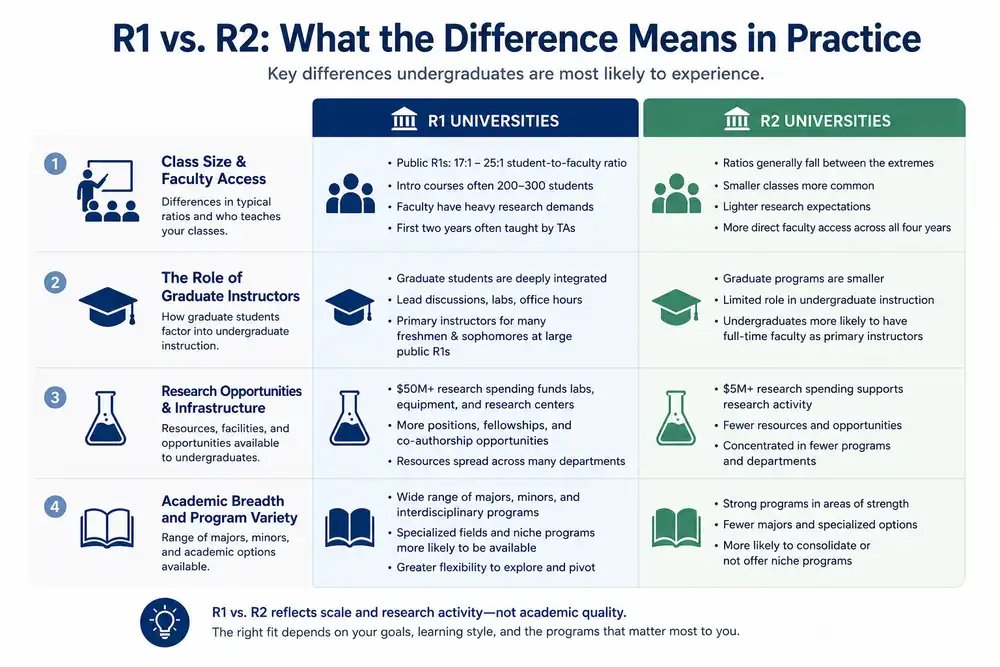
The scale difference between R1 and R2 universities is most immediately felt in the classroom. Major public R1s consistently report student-to-faculty ratios ranging from 17:1 to 25:1, with introductory courses frequently seating 200 to 300 students. Elite private R1s sit at the opposite end, typically reporting ratios between 6:1 and 10:1. R2 institutions generally fall between these extremes, with smaller departments and lighter research expectations producing more consistent direct faculty access across all four years.
The ratio, however, tells only part of the story. At large public R1s, faculty carry significant pressure to publish and secure grant funding, which frequently translates into lighter teaching loads. Undergraduates in their first two years will often be taught by graduate teaching assistants rather than tenure-track professors. At R2 universities, where research expectations are less intensive, undergraduate courses are more likely to be taught by full-time faculty throughout.
2. The Role of Graduate Instructors
At R1 universities, graduate students are deeply integrated into undergraduate instruction. They teach discussion sections, run laboratory sessions, and hold office hours, and in many large public R1s serve as the primary instructional contact for undergraduates in their first two years. This is a structural consequence of the same research enterprise that funds the lab positions and fellowships described above: doctoral programs at R1 scale produce large graduate populations, and those graduate students are integrated into the teaching infrastructure.
At R2 universities, graduate programs are smaller and their presence in undergraduate instruction correspondingly limited. Undergraduates are more likely to move through all four years with full-time faculty as their primary instructors.
3. Research Opportunities & Infrastructure
The $50 million annual research floor that defines R1 status does not stay at the faculty level. It funds the laboratories, equipment, and research centers that faculty need to conduct that work, and it generates positions, fellowships, and co-authorship opportunities for the undergraduates who work within them. The infrastructure is a downstream consequence of the spending, and it is distributed across departments at a scale that the R2 threshold, set at $5 million, cannot produce.
At R2 universities, the same logic applies within a narrower perimeter: research activity exists, undergraduate participation is possible, but both are concentrated in fewer programs and supported by correspondingly fewer resources.
4. Academic Breadth and Program Variety
Sustaining the doctoral output required for R1 classification demands a broad departmental infrastructure, and that infrastructure shapes what undergraduates have access to. R1 institutions typically offer a wider range of college majors, minors, and interdisciplinary programs than R2 institutions, including specialized fields that smaller institutions cannot sustain at the departmental level. A student who enters undecided, or whose interests shift during the first two years, has more room to pivot without transferring.
R2 universities offer strong programs within their areas of established strength. The trade-off is range. Where an R1 might sustain a dozen distinct engineering sub-disciplines or a full suite of less commonly taught languages, an R2 is more likely to consolidate or not offer them at all. For students exploring the best engineering major, this narrower range may limit opportunities to compare different disciplines before committing. For students with clearly defined academic interests that align with an R2’s strengths, this is rarely a practical limitation. For students still working out what they want to study, it is a variable worth weighing.
5. Campus Scale and Student Life
The enrollment gap between R1 and R2 universities is not purely an academic variable. Major public R1s routinely enroll 30,000 to 60,000 students, with the full infrastructure that scale demands: Collegiate athletic programs, hundreds of student organizations, multiple residential communities, and a campus that functions as a small city. For some students, that scale is the point. For others, it produces an environment where individual students can go unnoticed for years.
R2 universities are typically smaller, and that size shapes the student experience in tangible ways. Advising is more accessible, campus communities are more navigable, and the transition from a structured secondary school environment to university life is less abrupt. The trade-off is the breadth of social, athletic, and extracurricular options that only a very large institution can sustain simultaneously.
What Does a Research University Cost?
The cost of the research university depends on institutional type, not Carnegie classification. Public and private research universities exist at both R1 and R2 levels, and the financial implications of that distinction matter far more than where an institution sits in the Carnegie framework.
Public research universities are subsidized by state appropriations, which suppresses tuition for in-state students to a degree that no private institution can match. College Board data puts the average published in-state tuition at public four-year institutions at $11,950, with an average net price after aid of $2,300. Out-of-state students at the same institutions pay an average of $31,880 in published tuition before aid, closer to private university sticker prices than the in-state figure suggests. Neither figure includes room and board, which the College Board estimates at approximately $13,900 annually at public four-year institutions.
Private research universities carry higher published tuition figures. The College Board puts the average at $45,000. What that figure obscures is the degree to which endowment-funded need-based aid redistributes the actual cost of attendance. The average net price at private four-year institutions is $16,910, and elite private R1s, which hold the largest endowments in American higher education, frequently operate the most aggressive need-based aid programs in the country. The institutions with the highest sticker prices are often the same institutions best positioned to reduce them.
The only number that warrants serious attention is the net price after institutional and federal aid, and that number requires an individual calculation. Families who eliminate private R1s on the basis of published tuition alone are making a decision on incomplete information.
Research Universities and the College Search
Choosing the right type of university is the first decision in a college search, and research university status is one variable in that determination. For families who have worked through that question and identified a research university as the right institutional type, Carnegie classification then functions as a confirmation tool rather than a discovery tool, a way to verify that the infrastructure a student’s path requires exists at a given school.
1. When Research University Status is Relevant
Research university status is a meaningful filter for students with a defined trajectory toward doctoral programs, competitive fellowships, or fields where laboratory and research infrastructure are prerequisites rather than supplements. In the context of college admissions, the designation confirms whether the resources a student’s path requires are present and funded at the level those pursuits demand.
2. R1 vs. R2 as a List-Building Decision
For students who have determined that a research university belongs on their list, the R1/R2 designation is a starting point for research, not a decision criterion. The more productive approach is to identify the two or three institutions within either tier where the relevant department has the strongest faculty research alignment, the most accessible undergraduate research program, and the advising infrastructure to support a student who will need to be proactive about securing those opportunities.
That investigation is where experienced university planning consultants add the most value, not in filtering by Carnegie tier, but in evaluating the program-level variables that the classification does not surface.
Building the Right College List
Knowing which research universities belong on a list requires more than a tier designation. Program structure, faculty research activity, and undergraduate access to that research all exist, but the information is distributed across sources that take experience to read correctly.
McMillan Education’s educational consultants have spent decades building exactly that context. If the research university question is live for your family, the place to start is a conversation with a consultant who can work through the program-level variables that determine the list.
Frequently Asked Questions
1. What is the difference between a research university and a regular university?
At a research university, funded faculty research operates alongside undergraduate education as a core institutional function. At most teaching-focused universities, faculty carry heavier instructional loads with limited or no research expectations. For undergraduates, the difference shows up in program breadth, access to specialized facilities, and the presence of graduate students in the classroom.
2. Is an R1 university better than an R2 university?
Not as a general proposition. The designation measures research expenditure and doctoral output, neither of which determines undergraduate experience. A well-resourced R2 with deep investment in a student’s intended field can frequently outperform a sprawling public R1 where that department is mid-tier. Quality is program-specific, not tier-specific.
3. What is the difference between R1, R2, and R3 universities?
R1 and R2 are Carnegie designations with defined numerical thresholds. R1 requires $50 million in annual research spending and 70 doctoral degrees per year. R2 requires $5 million and 20 doctoral degrees. R3 has no basis in the current Carnegie framework. The term circulates informally but refers to nothing the classification system actually defines. The 2025 update introduced Research Colleges and Universities as a separate category for institutions with active research programs that do not award significant doctoral degrees.
4. Can undergraduate students do research at R1 universities?
Yes, though access is rarely automatic. The funding that defines R1 status supports the laboratories and faculty programs where undergraduate positions exist. At large public R1s, students who secure meaningful roles typically do so by identifying faculty whose work aligns with their interests and making direct contact. The opportunity is structural. Accessing it requires initiative.
5. What is the difference between a research university and a liberal arts college?
Research universities balance undergraduate instruction, graduate training, and faculty research simultaneously. Liberal arts colleges are undergraduate-only institutions where teaching is the faculty’s primary obligation. The differences are concrete: class sizes, who delivers introductory courses, whether graduate programs exist, and how broad the curriculum is. Which environment serves a student better depends on their academic goals and how they learn.
6. Do employers care whether a university is R1 or R2?
In most fields, the classification does not enter hiring decisions. Recruiting patterns follow institutional reputation, program strength, and alumni networks. The exception is a narrow set of research-intensive sectors, certain STEM fields, federal research roles, where doctoral program prestige and laboratory credentials carry direct weight. Outside those areas, the tier is largely invisible to employers.