


Getting financial aid for college is sometimes a matter of how informed students and families are about it. In the 2024-25 academic year alone, $4.4 billion in federal grant money went unawarded. And with 2027 federal student aid disbursements projected at $124.4 billion, there’s another year and another opportunity for students to access financial aid to assist in paying for college.
This article covers the full process of getting financial aid for college: the five funding sources, who qualifies for each, how to file the FAFSA and CSS Profile, and how to apply step by step.
What Is Financial Aid for College?
Financial aid for college is any funding that reduces the amount of money a student has to pay for their college education, and it comes from four main categories: federal aid, state aid, institutional aid, and private aid. College financial aid takes two basic forms: money that never has to be repaid, and money that does. Money that does not need to be repaid includes grants, scholarships, and earnings from work-study programs. Money that has to be repaid includes federal and private student loans.
Types of Financial Aid for College: The Five Funding Sources
The four types of financial aid are grants, scholarships, loans, and work-study. That framework is useful, but at McMillan Education, where college planning consultants average more than 20 years of student placement experience, we find that organizing by source is more useful for families making real college planning decisions, because what matters most is where the money comes from and what steps unlock it.

1. Federal Financial Aid
Federal aid is the most widely available source, and filing for federal aid unlocks other types of aid as well. Federal aid includes grants, student loans, and Federal Work-Study, and all three are accessed through the FAFSA (Free Application for Federal Student Aid). Filing the FAFSA is worth doing regardless of whether a family expects to qualify for a federal Pell Grant, because federal loans and most institutional aid require it too.
1.1 Grants
The Pell Grant is the primary federal grant for undergraduate students. It is need-based, does not have to be repaid, and has a maximum award of $7,395 for the 2026-2027 award year. Eligibility is determined by the FAFSA.
1.2 Federal Student Loans
Federal student loans generally offer better repayment protections and lower interest rates than private loans. The two main types for undergraduates are Direct Subsidized Loans and Direct Unsubsidized Loans.
- Subsidized loans are available to students with demonstrated financial need, and the federal government covers the interest while the student is enrolled at least half-time.
- Unsubsidized loans are not based on financial need, and interest begins accruing from the moment the loan is disbursed, though students don’t have to make payments while enrolled.
Annual borrowing limits for students start at $5,500 for dependent first-year students and rise to $7,500 by junior year. The lifetime aggregate cap for dependent undergraduates is $31,000. For independent undergraduates, annual limits start at $9,500 and the aggregate cap is $57,500.
Parents of dependent undergraduate students can also borrow through Parent PLUS Loans. The parent, not the student, is responsible for repaying Parent PLUS Loans. As of 2026, Parent PLUS Loans have an annual borrowing limit of $20,000 per student, with a four-year borrowing cap of $65,000 per student.
1.3 Federal Work-Study
Federal Work-Study is a financial aid program that gives eligible students who demonstrate financial need access to part-time jobs, usually on campus. Work-study is neither free money nor a loan. Students receive wages for the hours they work.
The work-study award sets the maximum amount a student can earn through the program. A student isn’t required to work simply because they qualify. If they don’t get a job or don’t work enough hours, they don’t receive the full amount of the award.
2. Institutional Financial Aid
Institutional aid comes directly from the college itself. At many private colleges, it’s the largest single component of a financial aid package, sometimes exceeding $50,000 per year at the most generous institutions. The advertised tuition price is rarely what a student actually pays.
Some colleges determine institutional aid using only the FAFSA. Others require the CSS Profile, which gives the college a more detailed financial picture. Not all colleges commit to meeting a student’s full demonstrated financial need, and how much a college covers varies significantly from school to school. Checking each college’s stated policy before finalizing a college list is worth doing. Colleges sometimes use the terms “grant” and “scholarship” interchangeably when describing their institutional awards. Whether the college calls it a grant or a scholarship, the key question is the same: does it have to be repaid?
3. State Financial Aid
Every state offers some form of financial aid for residents attending in-state colleges, though amounts, eligibility rules, and application processes differ widely. Some state aid is need-based, some is merit-based, and some is tied to specific college majors, professions, or public service commitments.
Some state programs use FAFSA data to determine eligibility. Others require separate state applications with their own deadlines. State funding is often limited, and some states award aid on a first-come, first-served basis until funds run out. This is a specific reason to file FAFSA within the first week it opens. within the first week it opens.
4. Merit-Based Financial Aid
Merit-based aid is awarded for academic achievement, athletic or artistic talent, leadership, or other accomplishments rather than financial need. Some merit awards are automatic and considered as part of the admissions decision. Others require separate applications, essays, interviews, or auditions.
Merit deadlines often fall earlier than Regular Decision deadlines, and missing them can forfeit consideration entirely. Merit aid can substantially reduce what a family pays. Colleges that offer it often produce lower net costs than highly selective schools that award aid primarily based on financial need.
A scholarship is not automatically guaranteed for all four years. Families should check whether it renews, what conditions apply, and whether the amount stays flat as tuition rises.
4.1 Athletic Scholarships
Athletic scholarships are awarded to student-athletes by colleges with athletic programs that provide athletic aid. The amount and conditions vary by sport, school, and NCAA division. Division I, II, and III schools have different rules on how athletic scholarships are awarded and how much they can cover. Less than 2% of college students receive athletic scholarships, and only about half of NCAA Division I or II athletes receive athletic scholarship money.
4.2 College-Specific Scholarships
These are scholarships a college awards to its own students directly. They can be merit-based, need-based, department-specific, or tied to a particular talent, activity, or background. Not all colleges commit to meeting a student’s full demonstrated financial need, and how much a college covers varies significantly from school to school.
4.3 Specialized Scholarships
Some scholarships have specific eligibility requirements tied to a field of study, career interest, extracurricular activity, geographic location, or family and community connection.
5. Private and Outside Scholarships
Private scholarships come from organizations with no college affiliation: employers, community foundations, civic groups, professional associations, religious institutions, and national scholarship programs. Most individual awards are modest, but they can add up.
One thing worth understanding before pursuing outside scholarships: some colleges reduce a family’s need-based institutional aid when the student brings in outside scholarship money. This is called scholarship displacement, and each college handles it differently. The policy is worth asking about directly.
Beyond these five sources, families also fund college through personal savings, 529 college savings plans, and family contributions. Those aren’t financial aid in the technical sense, but they factor into the same total cost picture.
Who Qualifies for Financial Aid for College?
Eligibility for financial aid depends on the source of aid, and qualifying for one type does not mean qualifying for all. Also, just qualifying does not determine how much a student actually receives. One important point that applies across all sources: income alone rarely disqualifies a family from all forms of aid. Here are the eligibility requirements by source.
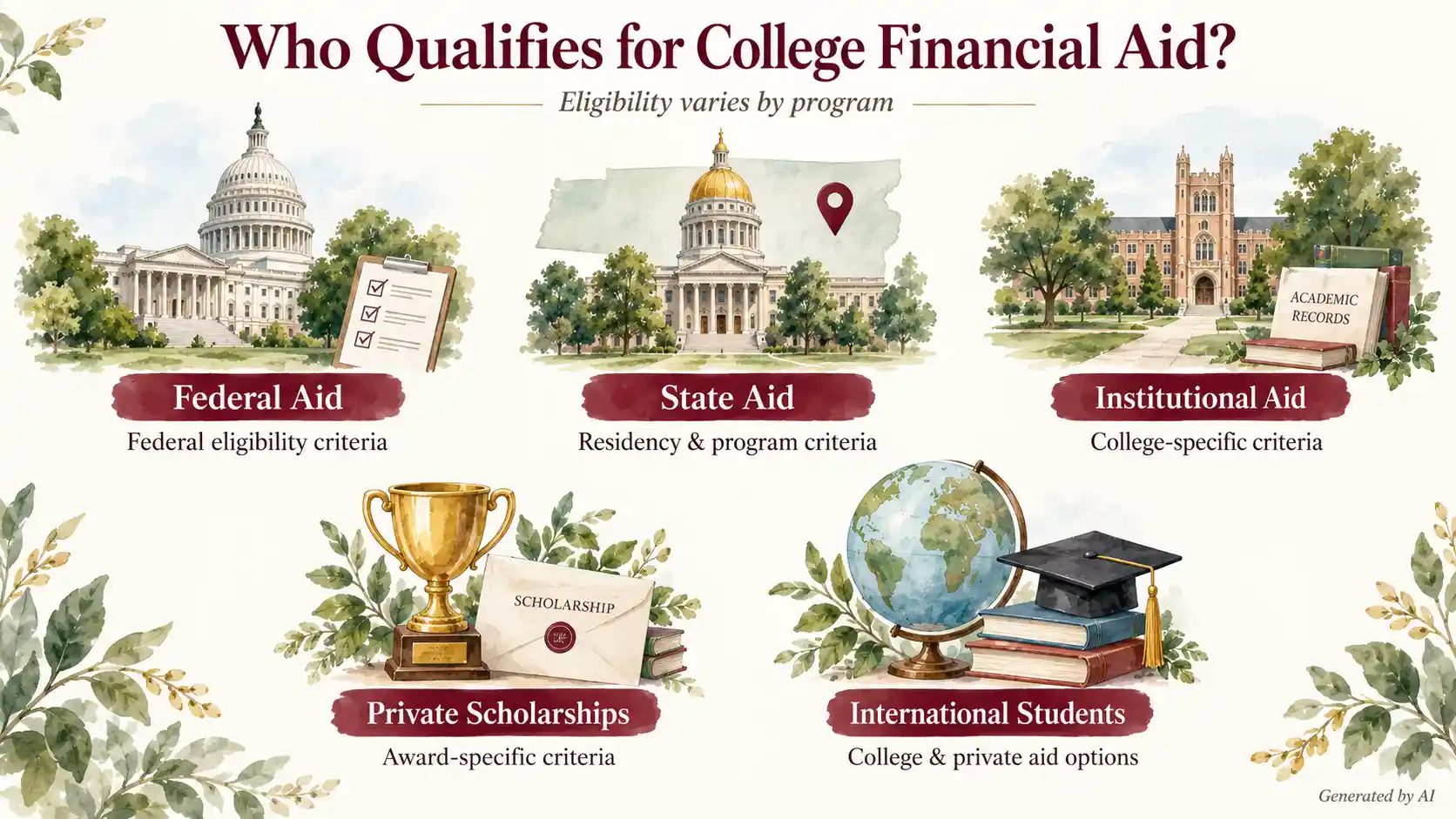
1. Federal Financial Aid Eligibility
Federal financial aid has a specific set of eligibility requirements that apply across all federal programs:
- U.S. citizenship or status as an eligible non-citizen
- A valid Social Security number
- Enrollment or acceptance into an eligible degree or certificate program
- At least half-time enrollment for most federal programs
- Maintaining satisfactory academic progress, defined by each college in terms of GPA and credit completion thresholds
- Not being in default on any existing federal student loans
Federal unsubsidized loans are available regardless of income. For the Pell Grant specifically, a new rule under the One Big Beautiful Bill Act sets a Student Aid Index cutoff of $14,790 for the 2026-2027 award year, above which students no longer qualify. That threshold doesn’t affect eligibility for federal loans or most institutional aid, so families above it still have plenty of reason to file the FAFSA..
2. State Financial Aid Eligibility
Most state grants and scholarships are restricted to state residents attending eligible in-state colleges, though exceptions exist. Requirements vary by state and by program, and states set their own academic, financial need, enrollment, and application criteria.
3. Institutional Financial Aid Eligibility
Colleges set their own eligibility criteria for institutional aid. Awards can be based on financial need, academic achievement, athletics, field of study, or other factors. A student generally must be admitted and enrolled to be considered. Institutional aid thresholds at many private colleges are far higher than families assume, with some colleges offering meaningful grants to families earning $200,000 or more.
4. Private Scholarship Eligibility
Eligibility is set by the awarding organization and varies widely. Requirements can include academic achievement, financial need, extracurricular involvement, intended field of study, geographic location, or other criteria specific to the scholarship.
5. International Student Eligibility
Most international students are not eligible for U.S. federal student aid. Some colleges and private organizations offer their own scholarships or need-based aid to international applicants, but availability varies significantly by institution.
For international students, the W.I.S.E. Admissions Playbook™ course International Students Applying to US Colleges covers this in detail.
The FAFSA: What It Is and When to File
FAFSA stands for Free Application for Federal Student Aid. Filing it is always free, and any website that charges a fee to submit it is a scam. FAFSA is submitted directly through StudentAid.gov, the U.S. Department of Education’s official website.
The FAFSA is the single most important form in the entire college financial aid system. Without it, a family is locked out of most of the money available to them, including federal aid, most state aid, and institutional aid at most colleges.
1. How to File the FAFSA
Filing the FAFSA is required to access federal aid, most state aid, and institutional aid at most colleges. Even at colleges that also require the CSS Profile, FAFSA is still needed. It’s the baseline form for the entire system.
Step 1: Create Your FSA ID
The FSA ID is separate from the FAFSA itself and needs to be created in advance. Both the student and one parent need their own FSA ID. The verification process takes one to three days, so creating the IDs before FAFSA opens avoids delays.
Step 2: Gather Your Documents
- Federal tax returns from the prior-prior year (2024 tax returns for the 2026-2027 FAFSA)
- Social Security numbers for the student and both parents (or one parent, in single-parent households)
- Records of untaxed income, including child support received and untaxed retirement account contributions
- Current bank statements and records of investments, real estate other than the primary residence, and business or farm assets
- The list of colleges to receive the FAFSA results
Step 3: File as Early as Possible
The FAFSA opens by October 1 each year. The federal deadline is June 30, but college and state priority deadlines fall much earlier, typically November through February. Some colleges set priority deadlines as early as November 15 for Early Action and Early Decision applicants. Filing in the first two weeks after opening puts a family ahead of most applicants and preserves eligibility for first-come, first-served funds. This matters especially at colleges with rolling admissions or early deadline structures.
Step 4: Check Whether CSS Profile Is Also Required
Filing FAFSA doesn’t mean the paperwork is done. Several hundred mostly private colleges also require the CSS Profile, with its own earlier deadline. Check every college on the list before assuming FAFSA alone is enough. Some colleges who do not require the CSS Profile have additional, college-specific financial aid forms they require as part of their process; check each school’s admissions and financial aid requirements carefully.
2. FAFSA Award Amounts
How much money a family can get from FAFSA depends on which programs they qualify for. The concrete numbers for the 2026-2027 award year:
- Pell Grant: Maximum $7,395, minimum $740, awarded based on Student Aid Index and enrollment status
- Direct Subsidized and Unsubsidized Loans: $5,500 first year, $6,500 second year, $7,500 third year and beyond for dependent undergraduates, with a $31,000 aggregate cap
- Direct Subsidized and Unsubsidized Loans for independent undergraduates: $9,500 first year, $10,500 second year, $12,500 third year and beyond, with a $57,500 aggregate cap
- Federal Work-Study: Varies by college and by student, averaging around $2,000 per academic year
- Parent PLUS Loans, capped at $20,000 per year, with a $65,000 aggregate cap per student
The federal aid FAFSA unlocks directly is meaningful. But at colleges that also use FAFSA to determine their own institutional aid, the total package can be many times larger than the federal portion alone.
The CSS Profile: The Second Financial Aid Application You May Need
The CSS Profile is a second financial aid application, separate from the FAFSA, required by several hundred colleges, mostly private, and some scholarship programs. A family that files only the FAFSA can miss the CSS Profile requirement at a college on their list and forfeit institutional aid at that school as a result.
The CSS Profile costs $25 for the first submission and $16 for each additional school. Fee waivers are available for domestic undergraduate applicants with a family adjusted gross income of $100,000 or less, orphans or wards of the court under age 24, and students who received an SAT fee waiver. According to the College Board, roughly 40% of applicants file the CSS Profile for free.
The CSS Profile asks for significantly more information than the FAFSA. Colleges use it to build a more detailed financial picture and distribute institutional aid more precisely.
How to File the CSS Profile
The CSS Profile is filed at cssprofile.collegeboard.org. Before filing, families should gather everything the FAFSA requires plus additional records: home equity estimates, non-custodial parent financial information where applicable, medical expense records, and small business or farm asset details.
The CSS Profile opens October 1 each year, the same date as the FAFSA, but individual college deadlines often fall earlier than their FAFSA deadlines. Families should check the CSS Profile requirements for every college on their list at the start of the application process, not after acceptance. The list of participating institutions is available there as well.
How to Apply for Financial Aid for College
Financial aid applications follow a specific sequence, and timing matters at every step. Here is the full process.

Step 1: Estimate Costs Before Applying
Every college in the United States is required by federal law to publish a Net Price Calculator on its website. Net Price Calculators produce a family-specific estimate of what a particular college will actually cost after financial aid, rather than the sticker price shown in tuition tables.
Running Net Price Calculators for every college under consideration during the research phase gives families the cost information they need to build a balanced list. Discovering a college’s true cost after applications are already submitted removes the option to add more affordable schools to the list. Cost estimation works most effectively when it happens alongside decisions about what type of college is the right fit and which categories of institutions belong on the list.
Step 2: Create an FSA ID and File the FAFSA
Both the student and one parent need their own FSA ID, created at StudentAid.gov before the FAFSA opens. The FAFSA opens October 1, and filing within the first two weeks puts a family ahead of most applicants. Full details are in the FAFSA section above.
Step 3: File the CSS Profile If Required
Check whether any college on the list requires the CSS Profile and file it if so. Full details are in the CSS Profile section above.
Step 4. Review Your Student Aid Report
After FAFSA is processed, the family receives a Student Aid Report confirming the information submitted and showing the calculated Student Aid Index. Review it carefully. Errors in income, household size, or dependency status can reduce aid or delay processing. Corrections can be submitted through StudentAid.gov, and since colleges receive the data automatically, corrections should be made as soon as possible.
Step 5: Evaluate and Respond to Your Award Letters
Award letters arrive from each admitting college in March or April. Families can accept individual components and decline others. Loans can be declined while grants are accepted, and there is no requirement to take the full package. Once a college is selected, the student notifies it by May 1.
If the offer does not reflect the family’s actual financial situation, it can be appealed directly with the college’s financial aid office. The circumstances that most often justify an appeal include a job loss, a significant change in income, divorce or separation, or major unreimbursed medical expenses. A factual request supported by documentation is more effective than a negotiation-style approach.
Get Help With College Financial Aid
Navigating the financial aid process is manageable, but the decisions made at each step, from building the college list to comparing award letters, have real financial consequences that compound over four years. McMillan Education’s college planning consultants have guided thousands of families through this process across more than 70 years of college placements. If you want a second set of eyes on any part of it, we’re here.
Speak with an Educational Consultant.
Frequently Asked Questions
1. How is college financial aid calculated?
Financial aid is calculated using the family’s Student Aid Index (SAI), which comes from information reported on the FAFSA. The college then subtracts the SAI from its Cost of Attendance to determine the family’s demonstrated financial need. At colleges that also require the CSS Profile, the college runs its own separate calculation that may reach a different number than the federal FAFSA calculation.
2. Do you have to pay back financial aid for college?
It depends on the type. Grants, scholarships, and work-study earnings do not have to be repaid. Federal and private student loans do have to be repaid, with interest, usually starting six months after the student graduates or leaves school.
3. Can you get financial aid for community college?
Yes. Community colleges participate in FAFSA and offer federal aid, state grants, and institutional aid. Because community college tuition is lower than at four-year institutions, the maximum Pell Grant of $7,395 often covers the full cost of tuition. Two-plus-two transfer paths, where students spend two years at community college before transferring to a four-year institution to finish the degree, can reduce total cost substantially while preserving financial aid eligibility.
4. What is the difference between financial aid and a student loan?
A student loan is one type of financial aid, specifically the type that has to be repaid. Financial aid is the broader category that also includes grants, scholarships, and work-study, none of which have to be repaid.
5. Does financial aid cover everything?
Usually not. Financial aid can cover tuition, fees, housing, food, books, transportation, and personal expenses at colleges that meet 100% of demonstrated need, but fewer than 100 colleges nationwide make that commitment. Most families cover some portion of college costs from savings, current income, or contributions from family.
6. How much money can you get from FAFSA?
For the 2026-2027 award year, the maximum Pell Grant is $7,395. Federal loan caps for dependent undergraduates start at $5,500 in the first year and total $31,000 across all four years. Federal Work-Study earnings average around $2,000 per year. Institutional aid unlocked by FAFSA can far exceed the federal portion at many colleges.
7. How can you maximize financial aid for college?
File the FAFSA in the first week it opens, build the college list around net cost rather than sticker price, file the CSS Profile at every college that requires it, compare award letters on net cost rather than headline totals, and appeal any offer that doesn’t reflect the family’s actual financial situation.
8. What is the highest income to qualify for financial aid?
There’s no single income cutoff for financial aid overall. For the Pell Grant specifically, students with a Student Aid Index at or above $14,790 for the 2026-2027 award year no longer qualify. For federal unsubsidized loans, there’s no income limit. For institutional aid, the answer varies enormously by college, with some colleges offering meaningful grants to families earning $200,000 or more.