


Engineering is one of the most declared undergraduate majors in the United States, and the best engineering major for any student depends on factors a salary chart alone cannot resolve. Demand for graduates across its disciplines has remained strong for decades, but the fields diverge significantly in technical demands, career trajectories, and graduate school pathways, in ways that make the choice of specific field one of the most significant decisions of the undergraduate years.
This article covers the most common engineering majors in American universities: what each degree involves, the careers and salary ranges it opens, the graduate school paths it feeds, and the technical demands it places on students. It also addresses how to choose between them.
What Are Engineering Majors and Why Do They Matter
An engineering major at the undergraduate level is a four-year Bachelor of Science program in a specific technical discipline. The types of engineering degrees available at American universities include mechanical, civil, electrical, chemical, computer, biomedical, aerospace, environmental, industrial, and petroleum engineering, among others. Each is accredited independently under ABET standards and built around a distinct technical curriculum.
What distinguishes engineering from most undergraduate fields is how early that commitment is required. Engineering programs are among the most structurally rigid in American higher education. Core sequences, laboratory requirements, and prerequisite chains are discipline-specific from the first semester, and switching between types of engineering mid-program may mean losing credits and extending time to graduation. A student who enters mechanical engineering and moves to electrical engineering in year two may face a reset, instead of a redirect. However, this is not a reason to avoid engineering. It is a reason to understand the field before declaring it.
Engineering Majors at a Glance
|
Major |
Median Salary |
Primary Industries |
Top Graduate Path |
|
Mechanical Engineering |
$102,320 |
Automotive, aerospace, manufacturing, energy |
MS, MBA |
|
Civil Engineering |
$99,590 |
Infrastructure, urban development, construction |
MS, MEng |
|
Electrical Engineering |
$118,780 |
Power systems, semiconductors, telecommunications |
MS, PhD |
|
Computer Engineering |
$155,020 |
Semiconductor design, AI hardware, technology |
MS, MBA |
|
Chemical Engineering |
$121,860 |
Pharmaceuticals, petrochemicals, biotechnology |
MS, PhD |
|
Biomedical Engineering |
$106,950 |
Medical devices, clinical engineering, biotech |
MS, MD |
|
Aerospace Engineering |
$134,830 |
Defense, commercial aviation, space |
MS, PhD |
|
Environmental Engineering |
$104,170 |
Water treatment, remediation, sustainability |
MS, MBA |
|
Industrial Engineering |
$101,140 |
Manufacturing, supply chain, consulting |
MS, MBA |
|
Petroleum Engineering |
$141,280 |
Oil and gas, geothermal energy |
MS, MBA |
Most Common Engineering Majors to Choose and What Each One Leads To
The following sections cover some of the most common engineering majors available at American universities. Each entry addresses what the field involves at the undergraduate level, where it leads professionally and academically, and what it demands from students in the classroom and laboratory. Salary figures throughout are drawn from the BLS Occupational Outlook Handbook.
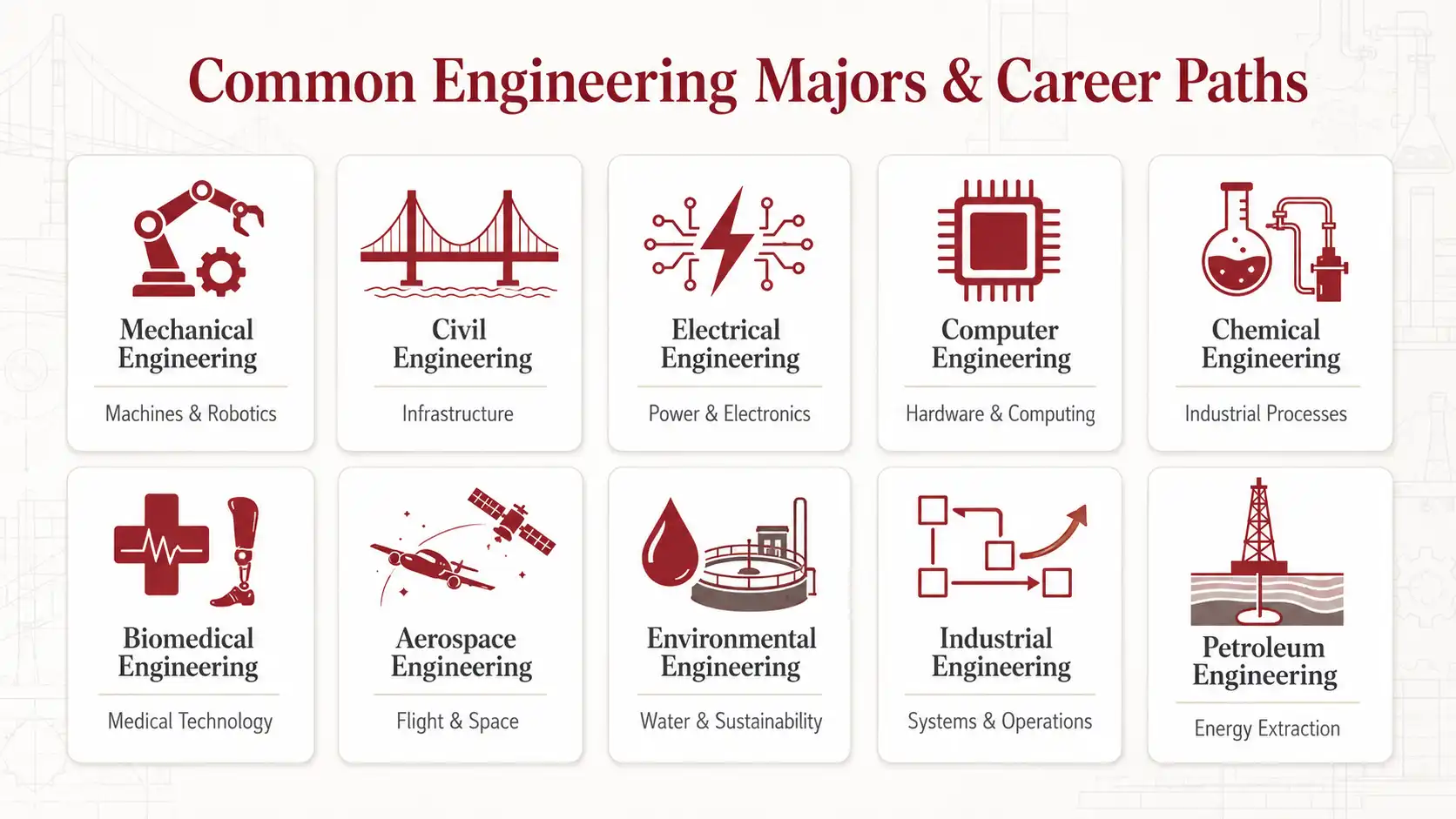
1. Mechanical Engineering
Mechanical engineering is the study of physical systems, how they move, generate force, and transfer energy. It is one of the oldest and most broadly applicable engineering disciplines, spanning industries from automotive and aerospace to energy and consumer products.
1.1 Career Paths and Salary Range
Mechanical engineering is widely regarded as the best major in engineering for students seeking broad industry applicability, offering career paths across automotive design, HVAC systems, robotics, and advanced manufacturing.
- Average salary: $105,220
- Entry-level: ~$75,000
- Mid-career (thermal systems, aerospace components, automated robotics): $130,000+
1.2 Graduate School Options
- MS in Mechanical Engineering: mechatronics, fluid dynamics, materials science
- MBA: product management, manufacturing director roles, operations leadership
- PhD: advanced academic research, principal investigator roles at national laboratories
1.3 Technical and Academic Profile
The curriculum is built on multivariable calculus, classical mechanics, and thermodynamics, with significant laboratory and design components. Students work with CAD software and finite element analysis tools across coursework that moves from theoretical modeling through physical prototyping. Students entering without a strong foundation in calculus and physics may face a difficult first-year sequence.
2. Civil Engineering
Civil engineering is the design, construction, and maintenance of built infrastructure, including roads, bridges, water systems, and public works. It is among the most directly visible of all engineering disciplines, with applications spanning municipal government, private development, and large-scale international infrastructure.
2.1 Career Paths and Salary Range
Civil engineering is among the best engineering majors for students targeting public infrastructure, with career paths across structural design, transportation planning, geotechnical analysis, and urban development.
- Average salary: $101,160
- Entry-level: $65,000–$75,000
- Mid-career (large-scale public works, complex private development): $120,000–$140,000
2.2 Graduate School Options
- MS in Civil Engineering: structural and geotechnical specializations
- MEng: professional practice track, alternative to research-oriented MS
- MBA: construction firm management, real estate development
- PhD: academia, highly specialized structural consulting
2.3 Technical and Academic Profile
The curriculum covers statics, structural analysis, fluid mechanics, and materials science, alongside coursework in environmental regulations and project management. Students work with structural analysis and CAD software and apply technical knowledge against real-world construction and safety constraints. Civil engineers entering professional practice typically pursue a Professional Engineer (PE) license, which requires two licensing examinations and a period of supervised field experience.
3. Electrical Engineering
Electrical engineering covers the design and development of electrical systems, from large-scale power infrastructure to microelectronics and signal processing. It underpins most modern technology, with applications across energy, communications, computing, and transportation.
3.1 Career Paths and Salary Range
An electrical engineering major leads to careers in power distribution, telecommunications, semiconductor design, and embedded systems development.
- Average salary: $117,680
- Entry-level: $75,000–$85,000
- Mid-career (RF systems, autonomous vehicles, digital logic design): $150,000+
3.2 Graduate School Options
- MS in Electrical Engineering: signal processing, photonics, embedded systems
- MBA: technology management, product marketing, venture-backed hardware companies
- PhD: quantum computing, advanced semiconductor physics, university faculty positions
3.3 Technical and Academic Profile
The curriculum is usually built on differential equations, linear algebra, and electromagnetism, with coursework in circuit theory, digital logic, and control systems. Students work with circuit simulation software and programming languages such as C or Python to design and test hardware systems. The field is among the more mathematically abstract in engineering, and students without strong preparation in calculus and physics may find the transition to upper-division coursework demanding. Graduate research in electrical engineering is concentrated at research universities with dedicated semiconductor and signal processing laboratories.
4. Computer Engineering
Of the engineering disciplines that feed directly into the technology industry, computer engineering sits closest to the hardware – the physical layer beneath every software system. The major covers microprocessor design, computing architectures, and embedded systems, drawing on both electrical engineering fundamentals and computer science.
4.1 Career Paths and Salary Range
Computer engineering is among the best engineering degrees for compensation at the undergraduate level, with graduates concentrated heavily in semiconductor companies, defense contractors, and major technology firms.
- Average salary: $147,770
- Entry-level: $90,000–$105,000
- Mid-career (AI hardware, chip architecture, major tech firms): $200,000+
4.2 Graduate School Options
- MS in Computer Engineering: VLSI design, machine learning hardware, cybersecurity
- MBA: product leadership, technology operations, CTO-track roles
- PhD: computing architecture research, advanced technology laboratories
4.3 Technical and Academic Profile
The curriculum spans discrete mathematics, digital logic, computer architecture, and electrical engineering fundamentals. Students work across hardware and software environments throughout the degree, which distinguishes it from a straight computer science program. Prior exposure to programming is a practical advantage entering the first year.
5. Chemical Engineering
Where most engineering disciplines work with physical systems or electronic signals, chemical engineering operates at the process level, scaling chemical reactions from laboratory quantities to continuous industrial production. It is among the more technically demanding undergraduate engineering majors, and one of the more versatile in terms of industry destination.
5.1 Career Paths and Salary Range
A chemical engineering major leads to careers in pharmaceuticals, petrochemicals, food processing, and alternative energy, with process engineering roles spanning both manufacturing and research functions.
- Average salary: $122,910
- Entry-level: $75,000–$85,000
- Mid-career (biomanufacturing, plant operations, advanced materials): $150,000+
5.2 Graduate School Options
- MS in Chemical Engineering: biotechnology, nanotechnology, materials science
- MBA: chemical plant management, corporate executive roles
- PhD: industrial R&D, drug development, novel materials research
5.3 Technical and Academic Profile
The curriculum is built on thermodynamics, fluid mechanics, and mass transfer, alongside advanced organic chemistry and multivariable calculus. It is one of the few engineering programs where chemistry coursework carries as much weight as mathematics. Students without a strong foundation in both may find the upper-division sequence particularly demanding.
6. Biomedical Engineering
Biomedical engineering applies engineering principles to medicine and healthcare, covering medical device design, prosthetics, tissue engineering, and clinical systems. It is one of the faster-growing engineering majors in American universities and one of the few undergraduate engineering degrees that serves as a viable pathway into medical school.
6.1 Career Paths and Salary Range
A biomedical engineering major leads to careers in medical device manufacturing, regulatory affairs, clinical engineering, and healthcare technology development.
- Average salary: $106,700
- Entry-level: $70,000
- Mid-career (medical device R&D, FDA regulatory, clinical systems): $130,000–$150,000
6.2 Graduate School Options
- MS in Biomedical Engineering: biomechanics, biomaterials, R&D roles
- MD: medical school, for students who complete pre-med prerequisites
- MBA: health technology startups, medical device company leadership
- PhD: independent research at academic medical centers, specialized biotech firms
6.3 Technical and Academic Profile
The curriculum spans engineering mathematics and mechanics alongside organic chemistry, anatomy, and human physiology, a combination that distinguishes it from most other engineering programs. Students must be prepared to work within strict regulatory environments and design for human biocompatibility. The degree demands breadth across disciplines that other engineering majors do not require.
7. Aerospace Engineering
The aerospace engineering degree is among the most specialized undergraduate engineering programs available, focused on the design and development of aircraft, spacecraft, satellites, and propulsion systems. The field divides broadly into aeronautics, which covers flight within Earth’s atmosphere, and astronautics, which covers space systems. Graduates enter a concentrated employer landscape relative to other engineering fields.
7.1 Career Paths and Salary Range
Aerospace engineering majors enter careers in aeronautics, astronautics, propulsion engineering, and systems integration. The primary employers are defense contractors, commercial aviation firms, NASA, and private spaceflight companies.
- Average salary: $134,330
- Entry-level: $80,000–$90,000
- Mid-career (propulsion, systems engineering, defense program management): $160,000+
7.2 Graduate School Options
- MS in Aerospace Engineering: aerodynamics, astrodynamics, advanced propulsion
- MBA: program management in large defense contracting firms
- PhD: research at NASA, military laboratories, private spaceflight organizations
7.3 Technical and Academic Profile
The aerospace engineering major spans fluid dynamics, orbital mechanics, structural analysis, and advanced materials science, and is broadly considered one of the more rigorous sequences in undergraduate engineering. Many roles in defense and government contracting require security clearances, which is a practical consideration students should factor into their planning. The employer concentration in aerospace is narrower than in other engineering degrees, and students should weigh that specificity against the flexibility other programs may offer.
8 Environmental Engineering
Environmental engineering addresses the technical side of environmental protection, covering water treatment, waste management, air quality systems, and ecological remediation. It draws from civil engineering, chemistry, and biology, making it one of the more interdisciplinary engineering degrees at the undergraduate level.
8.1 Career Paths and Salary Range
An environmental engineering major leads to careers in municipal water treatment, hazardous waste remediation, sustainability consulting, and regulatory compliance.
- Average salary: $105,840
- Entry-level: $65,000–$75,000
- Mid-career (ecological remediation, corporate sustainability initiatives): $120,000–$140,000
8.2 Graduate School Options
- MS in Environmental Engineering: advanced water treatment, hazardous waste remediation, climate impact modeling
- MBA: corporate sustainability leadership, environmental policy management
- PhD: environmental technology research, university faculty positions
8.3 Technical and Academic Profile
The environmental engineering degree spans fluid mechanics, environmental chemistry, hydrology, and biology, alongside coursework in environmental law and regulatory compliance. Students are expected to apply technical analysis within legal and policy frameworks, which distinguishes the program from most other engineering curricula. Those without a strong foundation in both chemistry and mathematics may find the interdisciplinary demands of the upper-division sequence challenging.
9. Industrial Engineering
A major in industrial engineering focuses on the optimization of complex systems, processes, and organizations. Where most engineering disciplines design physical objects or infrastructure, industrial engineering targets how work gets done, making it one of the more organizationally oriented engineering degrees available at the undergraduate level.
9.1 Career Paths and Salary Range
An industrial engineering major leads to careers in manufacturing operations, supply chain management, logistics, quality assurance, and process consulting across a wide range of industries.
- Average salary: $103,510
- Entry-level: $70,000–$80,000
- Mid-career (global supply chain, factory operations, process consulting): $125,000–$145,000
9.2 Graduate School Options
- MS in Industrial Engineering or Engineering Management: operations research, data analytics, systems optimization
- MBA: operations management, strategy consulting, C-suite roles
- PhD: academia, specialized corporate operations research
9.3 Technical and Academic Profile
The industrial engineering degree draws more heavily from probability, statistics, and human factors than from classical physics, which distinguishes it from most other engineering programs. The curriculum covers mathematical optimization, data analysis, and systems modeling, with applications across both manufacturing environments and service industries. Students with strong quantitative skills but less interest in mechanics or circuit design may find industrial engineering a better fit than other engineering degrees.
10. Petroleum Engineering
Petroleum engineering covers the design and development of methods for extracting oil and natural gas from subsurface deposits. It is among the most narrowly focused of all undergraduate engineering degrees, concentrated almost entirely within the energy sector, and consistently among the highest-compensating engineering programs at the undergraduate level.
10.1 Career Paths and Salary Range
Among engineering degrees by salary, petroleum engineering ranks highest, with careers spanning drilling engineering, reservoir modeling, production engineering, and geothermal energy applications.
- Average salary: $148,590
- Entry-level: $90,000–$100,000
- Mid-career (offshore drilling operations, reservoir simulation): $180,000+
10.2 Graduate School Options
- MS in Petroleum Engineering: hydraulic fracturing, deep-water drilling, geothermal energy applications
- MBA: executive energy management, transition out of field roles
- PhD: rare; pursued in advanced academic research or proprietary R&D within major energy corporations
10.3 Technical and Academic Profile
The petroleum engineering degree is built on geology, thermodynamics, and high-pressure fluid mechanics, with significant coursework in subsurface data modeling. Many roles require fieldwork in remote locations, which is a practical consideration distinct from most other engineering programs. The employer concentration is narrower than in most engineering fields, and students should weigh that specificity against the broader flexibility other engineering degrees may offer.
How to Choose the Right Engineering Major
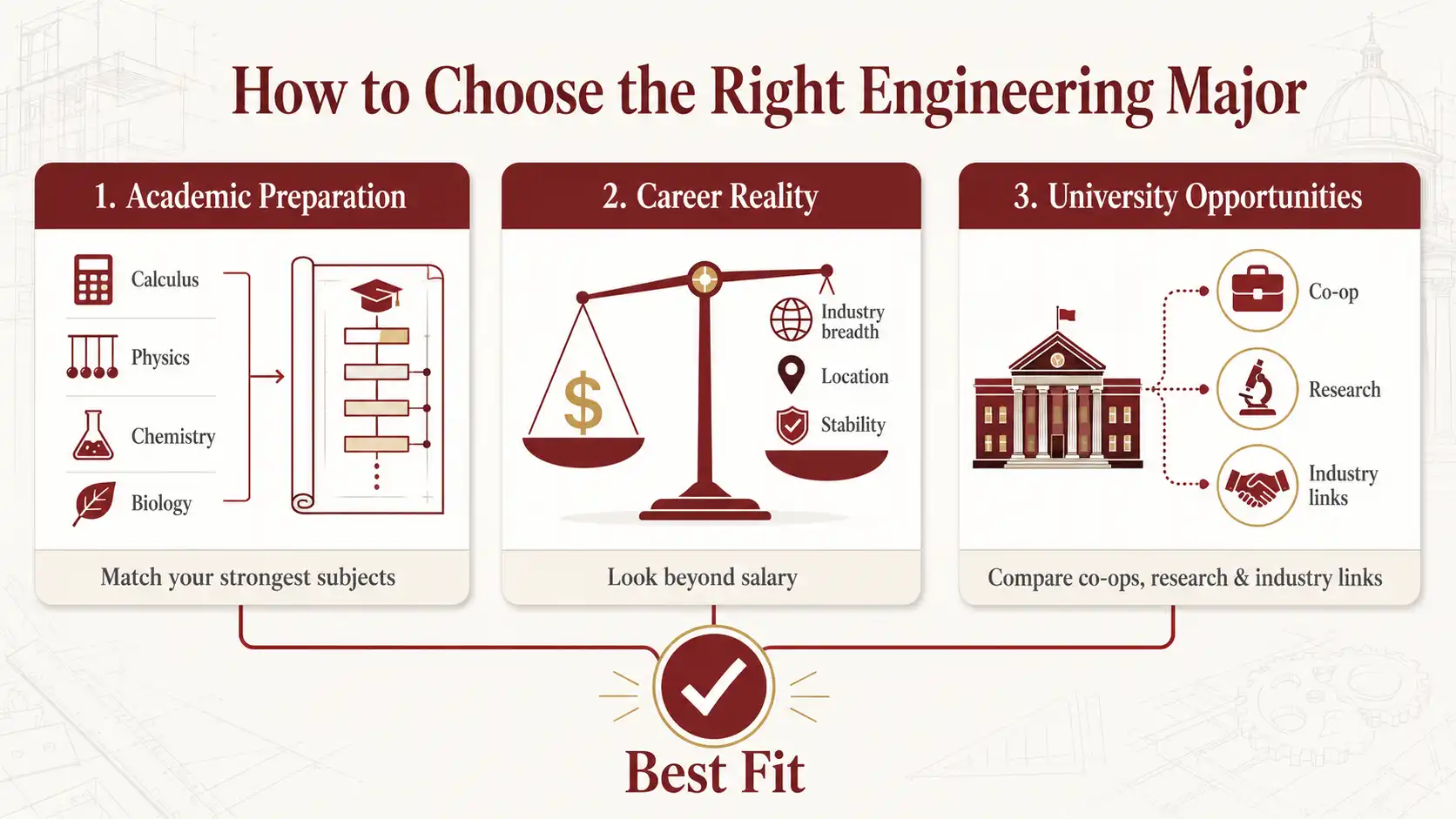
Families typically arrive at this decision by comparing engineering degrees by salary. But that is the wrong starting point. Choosing a major in engineering requires understanding what each field demands on the way to that salary, and how concentrated the employer landscape is once a graduate arrives. Petroleum engineering posts the highest median salary among undergraduate engineering degrees. It also places graduates in a single sector, in specific geographies, with well-documented exposure to commodity price cycles. The salary figure and the career reality are not the same number.
The more reliable starting point is the undergraduate curriculum itself. Engineering programs commit students to discipline-specific sequences from the first semester, and the academic preparation a student brings into college, in calculus, physics, chemistry, or biology, determines which of those sequences is realistic. A student whose preparation runs deepest in chemistry faces a different set of viable options than one whose foundation is in classical mechanics. That distinction belongs at the front of the conversation, not after a college list has already been built.
The final variable, and the one most often addressed last, is the institution. The same engineering major at two different universities produces different graduates depending on co-op structures, faculty research focus, and industry relationships that never appear in a program description.
For families considering institutions beyond the United States, some of the top engineering schools in Europe follow similar field structures with distinct curriculum and admissions differences worth understanding separately.
Start Planning the Engineering Path
McMillan Education’s college planning consultants have spent decades advising families on engineering placement at American universities, with direct institutional knowledge of program quality, industry pipelines, and graduate outcomes across all major disciplines. Schedule a free consultation to build your college plan.
Frequently Asked Questions
1. What is the best major in engineering?
There is no single answer. The best engineering major depends on a student’s academic preparation, intended industry, and graduate school plans. Computer engineering and mechanical engineering offer the broadest entry-level compensation and industry applicability. Fields like biomedical and chemical engineering may require graduate credentials for competitive positions. The right major is the one that aligns with where a student is starting and where they intend to go.
2. What are the top 5 engineering majors?
The most commonly declared engineering majors at American universities are mechanical, electrical, civil, computer, and chemical engineering. These fields account for the largest share of undergraduate enrollment and offer the broadest range of career destinations. Other disciplines, including biomedical, aerospace, environmental, industrial, and petroleum engineering, serve students with more specific industry or graduate school goals.
3. Which engineering major has the most job opportunities?
Mechanical and industrial engineering offer the broadest range of job opportunities across industries, given that both fields apply across manufacturing, healthcare, consumer products, energy, and logistics. Electrical engineering also carries strong demand, particularly in semiconductor design, power systems, and telecommunications.
4. What is the best engineering major for the future?
No single field holds that distinction, but several carry strong long-term demand signals. Environmental engineering is tied to water infrastructure, waste management, and ecological remediation, – areas with significant and growing regulatory investment. Biomedical engineering sits at the intersection of engineering and healthcare, a sector with consistent long-term growth. Computer engineering demand is driven by semiconductor manufacturing, AI hardware development, and defense technology. The answer depends as much on the institution and program as it does on the field.
5. What is the hardest engineering major?
Aerospace and chemical engineering are consistently identified as among the most technically demanding undergraduate programs, given the depth of mathematics, physics, and specialized coursework each requires from the first year. Electrical engineering is similarly demanding due to its mathematical abstraction.