


As families explore ways to pay for college, they encounter the terms need-based and merit-based financial aid almost right away, and two questions usually follow: could we qualify for one or both, and how much help might we receive?
This article answers those questions by explaining what each means, how they differ, and how colleges may combine them. It also shows families what to look for when estimating the cost of each college on their list.
Need-based and merit-based aid are two parts of a larger system, and our guide on how to get financial aid for college covers all of it, including how to apply.
What Is Need-Based Financial Aid?
Need-based financial aid is funding and work-study opportunities that federal, state, and college programs offer based on a student’s demonstrated financial need. Colleges calculate that need by subtracting the Student Aid Index from the cost of attendance, which includes tuition, housing, food, and other expenses. The FAFSA produces the index from financial information that the student and required contributors provide. Some colleges also request the CSS Profile to get broader financial information when they assess their own institutional aid.
Need-based aid can include:
- Grants and scholarships, which students generally do not repay
- Federal Work-Study, which pays wages for part-time jobs
- Direct Subsidized Loans, which students repay after they graduate but which do not accumulate interest while they are studying full-time
A need-based scholarship is an award that a college or outside organization offers to students who meet its financial need criteria. Some awards also consider academic achievement or other qualifications. Colleges sometimes use the terms grant and scholarship for their own need-based awards, so families should check each award’s terms.
A student can qualify for need-based aid and still face costs beyond the award. Each college decides how much of a student’s need it will meet, so two colleges with the same tuition can send the same family different offers. Families should compare each college’s full cost with its grants and scholarships, then account for potential work-study earnings and any loans before deciding what they can afford.
What Is a Merit-Based Scholarship?
A merit-based scholarship is an award that a college or outside organization offers based on a student’s achievements, talents, or other qualifications. Merit-based financial aid is the broader term for these awards, and an award letter may list them as scholarships or grants. Merit-based scholarships can reward:
- Academic achievement, such as grades and test scores
- Athletic ability, which can lead to scholarships at some Division I and Division II colleges Artistic talent, such as music, art, or theater
- Leadership or community service
Some colleges consider students for merit awards automatically during admission review. Others require a separate application, essay, interview, or audition. Outside organizations set their own criteria and deadlines.
Families who expect little or no need-based aid can still qualify for merit-based scholarships that reward what a student has accomplished. The amount on an award letter does not always lower the bill by the same amount, because colleges combine merit awards with need-based aid in different ways.
The Difference Between Need-Based Aid and Merit-Based Aid
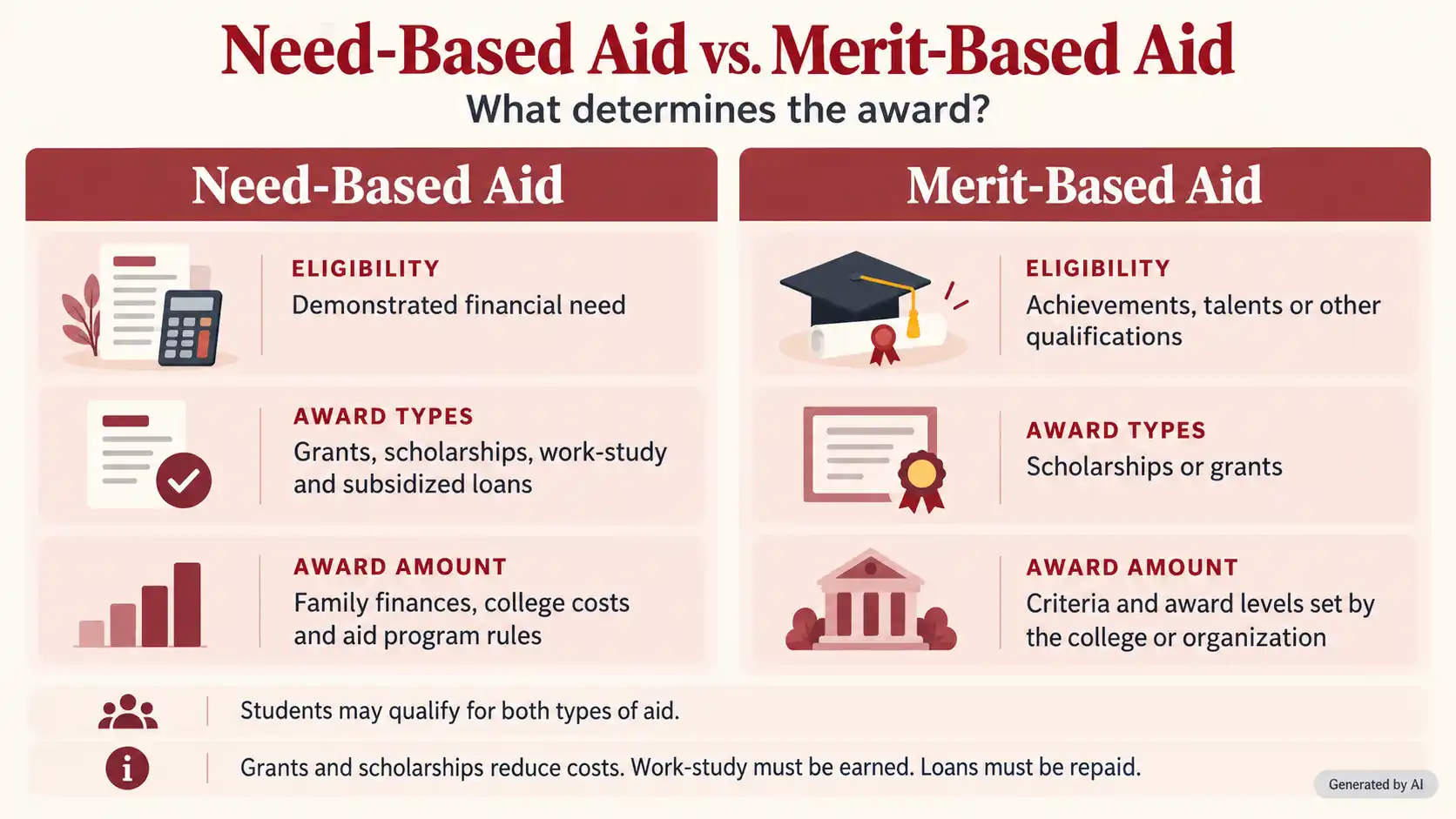
The main difference between need-based and merit-based aid is what decides the award. Need-based aid reflects financial need, while merit-based scholarships recognize achievements, talents, or other qualifications.
|
Key Question |
Need-Based Aid |
Merit-Based Aid |
|
What determines eligibility? |
Demonstrated financial need |
Achievements, talents, or other qualifications |
|
What can the award include? |
Grants, scholarships, work-study, subsidized loans, and Parent subsidized or unsubsidized loans |
Scholarships or grants |
|
What determines the amount? |
The student’s financial circumstances, the college’s cost, and the aid program’s rules |
The criteria and award levels the college or organization sets |
1. Who Qualifies for Need-Based Financial Aid or Merit Scholarships?
Each type has its own eligibility rules and looks at different evidence. Need-based aid depends on the finances a family reports, while merit-based scholarships depend on a student’s record, such as grades, test scores, a portfolio, or an audition. Qualifying for one type does not settle eligibility for the other, so a family may qualify for both in some cases.
2. What Can the Award Include?
Need-based aid can include grants, scholarships, work-study, and subsidized loans, while merit-based aid usually comes as a scholarship or grant. Grants and scholarships reduce costs without repayment. Work-study pays wages after a student finds a job and works the hours, while a subsidized loan provides money the student must repay. The total aid figure on an offer mixes all of these, so it does not show how much a student will need to earn or borrow.
3. What Determines the Amount?
Need-based amounts start with the finances a family reports, and each college sets how much of the resulting need it meets. Amounts can change from year to year, because each new FAFSA reflects the family’s finances at that point.
Merit-based amounts follow the criteria and renewal conditions that the awarding college or organization sets, such as a minimum GPA or full-time enrollment. Many families receive both, and the college’s combining policy then decides the net cost.
How Need-Based and Merit-Based Aid Combine in a Single Package
When a student qualifies for both types of aid, a college may add a merit scholarship to its need-based offer or adjust another award. Each college sets its own rules for combining merit-based financial aid with need-based aid, so two colleges can offer the same scholarship amount and leave a family with different costs. The effect on a family’s cost depends on which award the college adjusts.
1. When Merit Aid Adds to Need-Based Aid
If a college does not cover all of a student’s demonstrated need, the gap between what the college costs and what the family can afford, it may add a merit scholarship while keeping the existing need-based awards. Grant and scholarship aid rises, and the family’s net price falls. Net price is the college’s cost of attendance minus grants and scholarships. A loan can cover part of that remaining cost, but the student or parents must repay it.
2. When Merit Aid Reduces Need-Based Aid
A college may lower another award when it includes the merit scholarship. If the college reduces a need-based grant by the scholarship’s full amount, the family receives the same total in grants and scholarships. If it reduces a loan, the student can borrow less. If it reduces work-study, the student needs to earn less.
Suppose a college has a $50,000 cost of attendance and calculates $30,000 in financial need. Its initial offer includes a $20,000 need-based grant and a $5,000 subsidized loan. The college then offers a $5,000 merit scholarship. Before the scholarship, the net price is $30,000, with $5,000 available through borrowing.
- If the college adds the scholarship: Net price falls to $25,000, and the $5,000 loan remains.
- If it replaces $5,000 of the grant: Net price stays at $30,000, and the loan remains.
- If it replaces the loan: Net price falls to $25,000, and offered borrowing falls to zero.
Students who receive outside merit scholarships are generally required to report them to the financial aid office, which is one reason colleges may adjust the need-based package. Reviewing an offer means looking at the grants, work-study, and loans alongside the merit scholarship. If the offer does not show which amounts changed after the merit scholarship, families can ask the financial aid office, and educational consultants who review award letters can help compare offers from different colleges on a net-price basis.
How to Get Need-Based Financial Aid and Merit-Based Scholarships
Forms and deadlines differ from college to college, so getting either type of aid starts with checking every college on the list. The full application process, from creating a StudentAid.gov account to reviewing the FAFSA Submission Summary, is in our guide on how to get financial aid for college. This section covers what to check at each college.
1. How to Get Need-Based Financial Aid
Families often ask who qualifies for need-based financial aid. No single income figure decides it, because need depends on a college’s cost as well as the family’s finances. Students file the FAFSA for federal aid, and most institutional aid depends on it too.
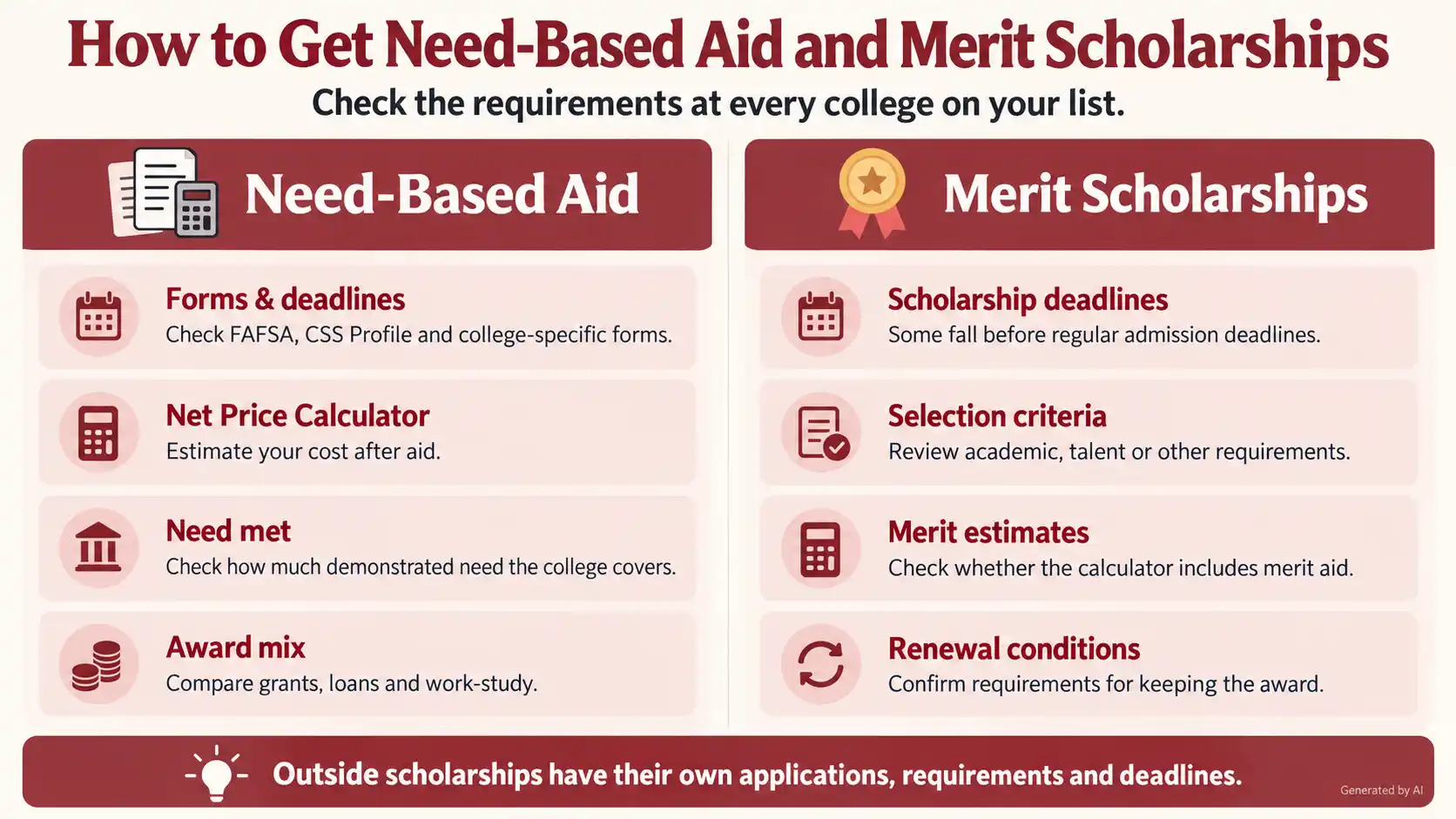
At each college, check:
- Whether it uses only the FAFSA or also the CSS Profile or its own aid form, and the priority deadline for each
- Its Net Price Calculator, which estimates the cost after aid for the family’s own finances
- Its policy on how much demonstrated need it meets
- Whether its need-based packages lean on grants or on loans and work-study, since some colleges replace loans with grants
Running the Net Price Calculator at every college under consideration shows which ones are realistic before applications go in. It works best alongside decisions about what type of college belongs on the list, and college planning consultants can build cost estimates into that list from the start.
2. How to Get Merit-Based Scholarships
How to get merit-based scholarships depends on where the scholarship comes from. College awards and outside scholarships follow different routes.
At each college, check:
- The merit scholarship deadline, which can fall earlier than the regular admission deadline
- Any published criteria, such as GPA or test score ranges
- Whether its Net Price Calculator includes merit aid in the estimate
- The conditions for keeping the award in later years
Outside scholarships come from employers, community foundations, and other organizations, and each sets its own requirements, process, and deadline. Each college’s outside scholarship policy determines whether the full amount lowers the bill, so families should confirm it before counting on the award.
How College Aid Policies Shape Need-Based and Merit-Based Awards
A college’s aid policy shapes which awards a student can receive and what the family might pay. As families build a list across different types of colleges, they should check each school’s approach to need-based aid and merit scholarships. Admission policies also shift from year to year, so recent college admission trends belong in that research too.
1. Colleges That Award Aid Based Only on Need
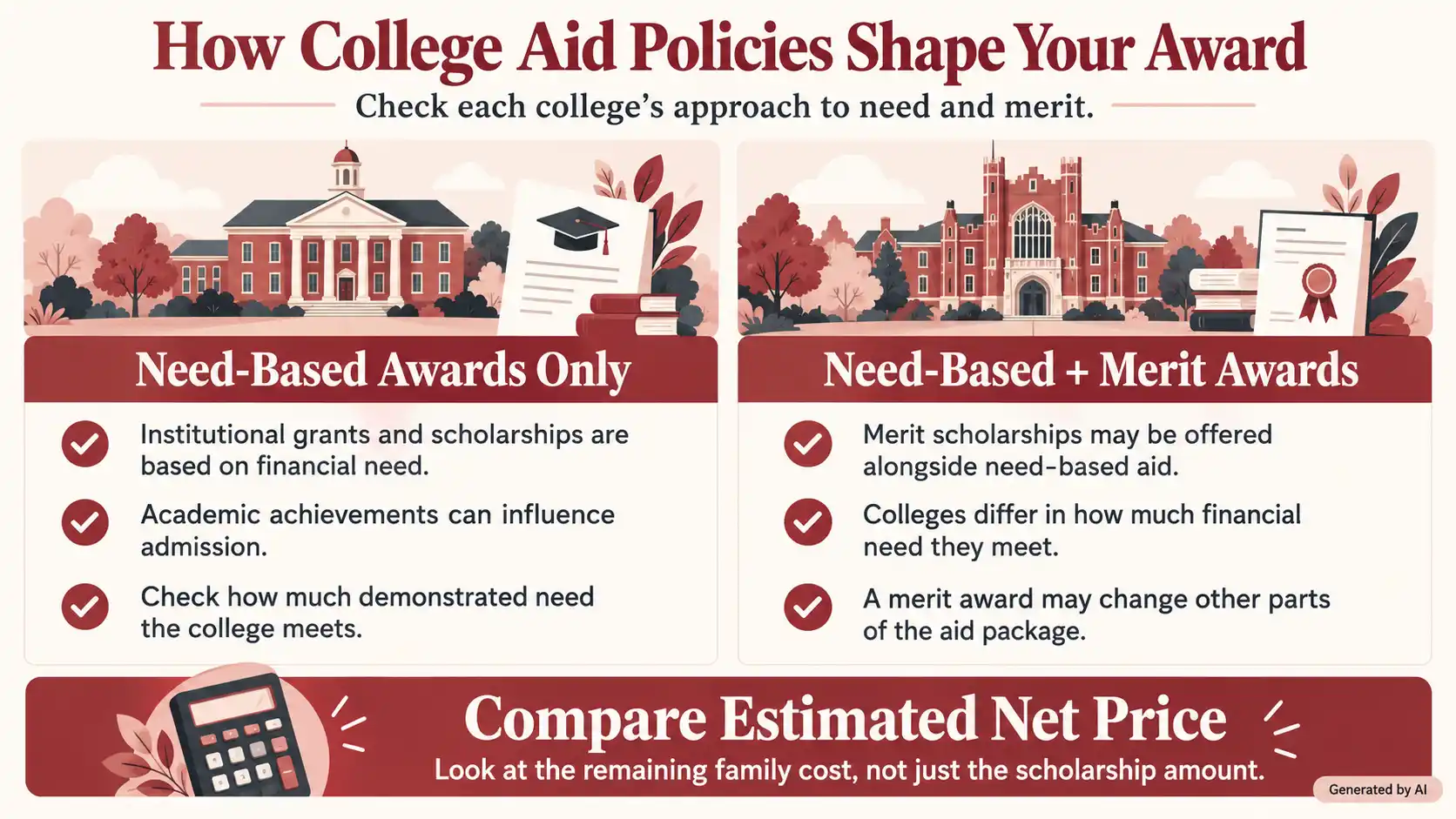
The eight Ivy League schools and MIT are examples of colleges that base their own grants and scholarships solely on financial need. Strong grades and talents can influence admission, while the financial aid office calculates the college’s award solely from the family’s finances.
2. Colleges That Offer Both Need-Based Aid and Merit Scholarships
Some highly selective non-Ivy League schools meet full demonstrated need and also offer merit scholarships. Other colleges offer merit awards while meeting only part of a student’s financial need. Two policies matter here: whether the student has a realistic merit opportunity and how much of the remaining cost the college leaves to the family.
A merit scholarship can change another part of the aid offer. The estimated net price gives families a better basis for comparing colleges than the scholarship amount alone.
Need-Based and Merit-Based Aid for International Students
Federal aid, the most widely available source of aid for US students, is closed to most international students. Colleges and outside organizations supply what aid exists, and the rules change from one college to the next.
1. How Need-Based Aid Works for International Applicants
For international students without federal aid eligibility, colleges may use the CSS Profile or a college-specific form to assess their own need-based aid. Before applying, check:
- Whether the college offers need-based aid to international applicants at all
- Whether it is need-blind or need-aware for international applicants, meaning whether a family’s ability to pay can affect the admission decision
- What share of demonstrated need it meets for international students, which can be lower than the share it meets for US students
- Which form and deadline it uses
2. Merit-Based Scholarships for International Students
Some colleges consider international applicants for merit scholarships, either automatically during admission review or through a separate application. Merit awards depend on a student’s record, so they can carry more weight where need-based aid for international students is limited. Scholarships from home-country governments and organizations add another route.
The W.I.S.E. Admissions Playbook™ course, International Students Applying to US Colleges, covers each step in detail.
Get Guidance on College Aid
Whether you are building a college list, preparing aid applications, or comparing offers, McMillan Education’s college planning consultants can guide you through the choices that shape college cost.
Speak with an educational consultant for individual guidance, or use the WISE Admissions Playbook™ to work through college selection, financial aid, and scholarships at your own pace.
Frequently Asked Questions
1. Can a student receive both need-based and merit-based aid?
Yes. A student can receive merit and need-based scholarships from the same college, and some scholarships weigh both criteria. How the college combines the two decides what the merit award does to the family’s cost.
2. Is FAFSA the same as need-based financial aid?
No. The FAFSA is the application, and it produces the Student Aid Index that colleges and government programs use to award need-based aid. It also opens access to aid that does not depend on need, such as Direct Unsubsidized Loans. Some colleges ask for it before awarding their own merit scholarships.
3. Do families need to apply separately for merit-based scholarships?
It depends on the source. Some colleges consider every admitted student for merit awards automatically, and others require a separate application, essay, interview, or audition. Outside scholarships require their own applications.
4. Does receiving a merit scholarship reduce need-based aid?
It can. Some colleges add the merit scholarship on top of the need-based package. Others lower a grant, loan, or work-study award by some or all of its amount. A reduction in a loan still lowers what the student borrows, while a reduction in a grant leaves the net price unchanged. Outside scholarships may follow a separate policy, which our financial aid guide explains.
5. Is need-based aid guaranteed if a family qualifies?
Only in part. Every eligible student can receive a federal Pell Grant. State and college need-based funds depend on each program’s budget and policy, and some state programs award aid until funds run out. Each college also decides how much of a student’s demonstrated need it meets.
6. What is the difference between a scholarship and a grant?
Neither one requires repayment. Grants more often depend on financial need, and scholarships more often depend on merit or other specific criteria. Colleges use both terms for their own awards, so the award’s terms matter more than its label.