

The steps to apply to graduate school are broadly similar across programs, but there is no universal application platform; admissions decisions may involve faculty or specialized committees, and deadlines vary by degree and institution. This article sets out each step of the graduate school application process and explains how it differs across the main degree paths, from master’s and doctoral programs to business, law, and medical school.
Graduate School Application Steps at a Glance
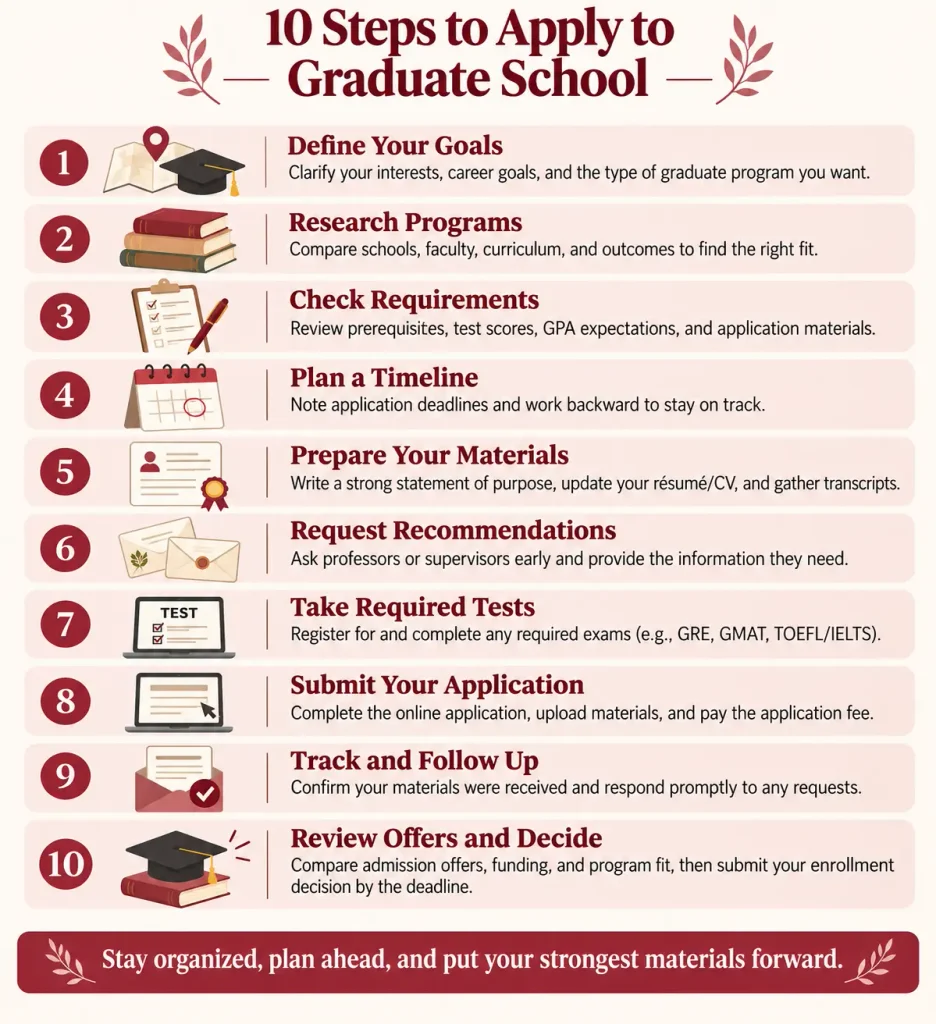
Applying to graduate school typically involves these ten steps:
- Define the degree and the career outcome
- Research programs and build a list
- Review graduate school requirements and prerequisites
- Plan for entrance exams, if required
- Write the statement of purpose or personal statement
- Prepare the resume or CV and supplementary materials
- Secure strong recommendations
- Submit the application
- Prepare for interviews, if invited
- Evaluate offers and funding
In practice, several of these steps happen at the same time, and medical and PhD applicants work through them in a different order. The degree section below explains how.
Step-by-Step: How to Apply to Graduate School
The steps below follow the graduate school application process in the order most applicants work through it, from choosing a degree to weighing offers in the spring, and each one explains what admissions committees look for.
Step 1: Define the Degree and the Career Outcome
The degree an applicant chooses shapes nearly every decision that follows, from which entrance exam to take and which platform to apply through to how early applications are due, so it’s worth settling before any program research begins. The types of graduate programs fall into two broad groups:
- Academic programs, such as research-based master’s degrees (MA, MS) and PhDs, train students in a discipline and, at the doctoral level, prepare them for careers in research and teaching.
- Professional programs, such as the MBA, MSW, MEd, JD, and MD, prepare graduates for a specific profession and tend to weigh practical experience more heavily.
Some fields offer both paths, and the difference matters more than the degree titles suggest. In engineering, for example, a Master of Science typically centers on research and a thesis, while a Master of Engineering is coursework-based and built around industry practice, so the right choice depends on the career an applicant is aiming for as much as on their undergraduate engineering major.
Deciding how to go to grad school also means deciding when, and many applicants make that choice by default by applying in their senior year of college. Programs differ widely in what they expect:
- Many academic master’s, PhD, and law programs admit students straight from college.
- MBA programs at the most competitive end expect several years of work experience first, while part-time and early-career programs admit applicants with less.
- Medical programs admit applicants both directly after college and after one or more gap years. Applicants should choose a timeline that allows them to complete prerequisites, prepare for the MCAT, and build meaningful clinical and service experience.
Even applicants who meet a program’s requirements as seniors benefit from asking whether a year or two of relevant work would make their application stronger, a question McMillan Education’s graduate admissions consultants take up in why graduate school candidates should think ahead and avoid applying too early.
Step 2: Research Programs and Build a List
The most useful program research looks past names and rankings to what a program actually delivers, since two programs with similar reputations can lead to very different careers. For each program under consideration, it’s worth looking closely at four areas:
- Outcomes: where graduates work after finishing, licensure pass rates for professional programs, and where PhD graduates go on to teach or research
- Faculty: for research degrees, whether faculty are working in the applicant’s area of interest and taking on new students
- Structure: thesis or non-thesis options, internships, clinical or field placements, and how long the program usually takes
- Cost and funding: whether the program funds its students through assistantships and fellowships or expects them to borrow
Once each program has been researched against these four areas, the list can take shape. A balanced list mixes programs at different levels of selectivity, each one weighed against the applicant’s academic record and experience, and before it’s final, a simple check is whether the applicant would be glad to attend every program on it.
Step 3: Review Graduate School Requirements and Prerequisites
Requirements for graduate school vary from program to program, but most applications draw on the same core materials, and knowing what each one is for makes it easier to see where an application is strong and where it needs work:
- Bachelor’s degree: confirms eligibility for graduate study
- Undergraduate GPA: shows readiness for graduate-level coursework
- Prerequisite coursework: confirms preparation in required subjects
- Entrance exam scores: gives a standardized measure, where a program requires one
- Recommendation letters: offers an outside view of the applicant’s ability
- Statement of purpose or personal statement: shows direction, motivation, and why this particular program
- Resume or CV: records experience, research, and achievements
- Work or clinical experience: required or expected by MBA, medical, and some health programs
GPA requirements for graduate schools are often set at the university level, with individual programs adding their own expectations on top. The University of Washington, for example, sets a 3.0 minimum for its graduate school while allowing programs to petition to admit students below it. Committees also read the direction of an applicant’s grades, so strong results in upper-level courses can carry more weight than a weaker first year.
Prerequisites are worth checking early, since some programs require specific courses regardless of the applicant’s major, and a missing one can delay an application by a full cycle. The type of undergraduate degree plays a part here, because a BA or BS can leave different gaps in math and science coursework. Applicants missing required courses can complete them through a post-baccalaureate (postbacc) program, which offers non-degree coursework after the bachelor’s degree and is a common route for career changers heading to medical school.
Step 4: Plan for Entrance Exams, If Required
Many graduate programs still ask for an entrance exam, and where one is required, planning for it early gives the applicant time to prepare properly and sit the test again if the first score falls short. Each degree path has its own exam:
- GRE: academic master’s and PhD programs that require testing
- GMAT or GRE: business school, where many programs accept either
- LSAT: law school, with some law schools also accepting the GRE
- MCAT: medical school, for both MD and DO programs
- DAT: dental school
GRE requirements for graduate schools are often set program by program, so one department may require the GRE while another at the same university treats it as optional. Checking each program’s admissions page before the list is final shows exactly which tests are needed, and it leaves enough time to schedule a first attempt, review the score, and plan a retake well ahead of the earliest deadline.
Step 5: Write the Statement of Purpose or Personal Statement
The statement is one of the main opportunities for applicants to explain, in their own words, why they want the degree, why they are applying now, and why the program fits their goals, and admissions committees read it closely because grades and test scores can’t answer those questions. Graduate programs ask for it in one of two forms:
- Statement of purpose: sets out academic and research goals and the preparation behind them, the form master’s and PhD programs typically ask for
- Personal statement: explains what drew the applicant to the field and what experience confirms that choice, more common in law, medical, and other professional programs
At many universities, the department’s own faculty decide who is admitted. At Howard University, for example, the graduate admissions office checks an application against general requirements, then a committee of the department’s graduate faculty evaluates it and recommends a decision. Faculty readers are looking for evidence that the applicant understands what graduate study in their field involves, so the strongest statements of purpose:
- name a specific question or problem the applicant wants to work on, and show what earlier coursework, research, or work has already been done on it
- connect that interest to particular faculty, labs, or courses in the program, which shows the research behind the application
- explain why the applicant is ready now, especially when the statement follows a gap or a change of field
Professional programs read personal statements for something slightly different: whether the applicant’s interest in the profession is grounded in real experience. A medical applicant’s clinical hours, a law applicant’s work in a legal setting, or an MBA applicant’s leadership on the job carries more weight than a description of long-held ambition.
The statements that fall flat tend to share the same problems: they retell the applicant’s life from childhood, restate the resume, or praise the program in terms that could apply to any school. A practical test for each draft is whether the program’s name could be swapped for another without changing anything else. If it could, the statement needs more work before it goes out.
Step 6: Prepare the Resume or CV and Supplementary Materials
In a graduate program application, the resume or CV gives the admissions committee a quick, factual record of what the applicant has done, and the format a program expects depends on the type of degree:
- Resume: one to two pages focused on work experience, responsibilities, and results, the format most MBA and professional programs expect
- CV (curriculum vitae): a longer academic record covering research, publications, conference presentations, teaching, and technical or lab skills, the format research master’s and PhD programs typically expect
Alongside the resume or CV, some programs ask for materials that show the applicant’s work directly:
- Writing sample: common in the humanities and social sciences, and best chosen from the applicant’s strongest research-based paper in the field, trimmed to the program’s page limit
- Portfolio: standard in art, design, architecture, and other creative programs, where the selection and sequence of work matter as much as the individual pieces
Where the application allows it, an applicant with a weak semester, a low GPA, or a significant gap in study can submit a brief explanation of the circumstances, sometimes called an addendum or additional information statement. The most effective addenda run to a paragraph or two, state what happened without excuses, and point to what has changed since, such as stronger grades in later semesters or relevant work experience, so the committee can read the earlier record in context.
Step 7: Secure Strong Recommendations
Most graduate programs ask for two or three letters of recommendation, and committees read them for what the rest of the application can’t show: how the applicant works, thinks, and compares with others the recommender has taught or supervised. Who writes the letter depends on the program:
- Academic programs: faculty who know the applicant’s coursework or research closely, ideally from upper-level courses, a thesis, or work in a lab
- MBA programs: professional supervisors who can describe performance, leadership, and contributions at work.
- Medical programs: often a combination of science faculty, clinical supervisors, and, at some colleges, a committee letter from the pre-health advising office
- Law schools: professors or other recommenders who can evaluate academic ability, analytical skills, and writing; professional supervisors may also be appropriate, depending on the applicant’s circumstances and the school’s instructions.
The strongest letters come from people who have seen the applicant’s work over time and can describe it in detail, which matters more than the recommender’s title. A useful check is whether each recommender could name a specific project or result of the applicant’s without looking it up.
Step 8: Submit the Application
Graduate school has no single application platform, so how an application for grad school is submitted depends on the program. Most programs take applications through the university’s own online portal, where the graduate program application follows a similar sequence:
- Create an account and select the program and start term.
- Add each recommender’s name and email so the portal can send them a request.
- Upload the statement, resume or CV, transcripts, and any supplementary materials.
- Pay the fee or request a waiver, then submit and track the application until it’s marked complete.
Many professional programs use a centralized application service instead, where the applicant completes one application that is sent to every participating program on the list:
- Law school: LSAC Credential Assembly Service
- Medical school (MD): AMCAS
- Osteopathic medical school (DO): AACOMAS
- Dental school: ADEA AADSAS
- Physician assistant programs: CASPA
- Pharmacy school: PharmCAS
- Physical therapy: PTCAS
- Occupational therapy: OTCAS
- Public health: SOPHAS
- Veterinary school: VMCAS
- Nursing: NursingCAS
Many professional programs use centralized application systems or credential services. These can reduce duplication, but applicants may still need school-specific applications, essays, supplemental forms, and fees.
Step 9: Prepare for Interviews, If Invited
An interview invitation usually means the applicant has made a program’s shortlist, though how much weight programs place on interviews varies by degree. MBA programs and medical schools treat them as a standard part of admissions, with many medical schools using the multiple mini interview (MMI), a series of short, timed stations, each built around a different scenario or question. PhD programs often invite shortlisted applicants to campus visit days or individual conversations with faculty, while most law schools and many master’s programs decide on the written application alone.
Interviewers often work directly from the application, so the most useful preparation is rereading it the way an admissions committee would and identifying what it leaves unanswered: a change of direction, a gap, or a goal that needs more explanation than the statement allowed. Applicants who prepare well treat the interview as a chance to add what the written file couldn’t show, such as how they think through a problem, how they work with others, and how clearly they can talk about their own experience under questioning.
Step 10: Evaluate Offers and Funding
The clearest way to evaluate offers is to compare them on the same points: the net cost of each program once funding is subtracted from tuition and living costs, whether an assistantship or fellowship covers the full program or only the first year, how much would still need to be borrowed, and how well each program’s graduate outcomes line up with the applicant’s career goal. Borrowing deserves particular attention, since federal graduate loan options have narrowed in recent years, so it’s worth confirming the full cost of each program before accepting an offer.
How the Application Process Varies by Degree
The steps above apply to applying to graduate schools of every kind, but the timing and what committees weigh most change from one degree path to the next. Other professional fields, such as pharmacy, physical therapy, and veterinary medicine, follow models similar to medical school.
Master’s Programs
Master’s programs cover the widest range of fields, from data science and engineering to education, social work, and the arts, and their admissions vary more than any other category. Deadlines range from fixed dates to priority deadlines and rolling review, often set program by program within the same university, so the calendar for each program on the list needs checking individually. Professional master’s programs look for a clear career goal, while research-based programs look more closely at coursework and research preparation.
MBA Programs
Business schools admit applicants in rounds, typically a first round in early fall, a second in winter, and a smaller final round in spring, each with its own decision date. Many applicants aim for the first two rounds, since the final round tends to be smaller. Committees look for evidence of leadership and a clear reason for pursuing the degree at this point in the applicant’s career.
Law School
Law school applications open in the fall, and many schools review them on a rolling basis, so applying early in the cycle matters more than the final deadline suggests. Committees weigh the LSAT or GRE score and undergraduate GPA heavily, and they admit students from every major, though some undergraduate majors build the skills law school demands more directly than others.
Medical and Health Programs
US medical school admissions typically follow a lengthy cycle. Primary application services generally open in May, with submissions beginning in May or June, followed by school-specific secondary applications and interviews that may continue into the following spring. Strong MCAT scores and grades are expected, along with the pre-med coursework and experience committees look for, including clinical experience, service, and evidence that the applicant understands the profession, all part of the path set out in how to become a doctor in the USA.
PhD Programs
Many US PhD programs have December or January application deadlines for fall entry, with admissions decisions commonly arriving in late winter or spring. Research preparation and alignment with a department’s faculty are especially important, although selection processes vary by discipline. Many research PhD programs offer funding through fellowships, assistantships, or tuition support, but funding availability, duration, and conditions should be checked for each offer.
How Graduate Applications Vary by Country
For applicants who apply for graduate school abroad alongside US options, the differences go beyond the application form, since degree length, testing, and entry routes can change the whole plan.
United Kingdom
A UK master’s is a shorter, more focused commitment: most taught programs take one year, the GRE and GMAT are generally not required, and applications go directly to each university. That makes a UK degree a practical option for applicants who want an advanced qualification without a two-year program, though it also means less time for internships and recruiting.
Law follows a separate professional qualification route. In England and Wales, graduates without a law degree typically need to complete foundational legal training before progressing toward qualification as a barrister. Aspiring solicitors can qualify through the Solicitors Qualifying Examination (SQE) route without a mandatory law conversion course, although some employers prefer applicants to complete additional legal training. Training also differs between law schools in the UK and Scottish law schools, since Scotland has its own legal system.
Canada
Applying in Canada will feel familiar to anyone who has researched US programs, but research-based degrees may require more attention to potential supervisors. Some thesis-based master’s and doctoral programs require applicants to secure a supervisor before admission, while others assign supervisors after enrollment. Applicants should check each department’s policy and contact potential supervisors early where encouraged or required. Canadian law schools offer the JD as a graduate degree, as in the US, though each sets its own admission standards and timelines.
Europe
Most European countries offer two-year master’s programs, but requirements, language of instruction, and calendars vary from one country to the next, so each program needs to be researched on its own terms. Medicine is where the gap with the US is widest, since entry routes into medical schools in Europe follow a different structure from the American two-stage cycle.
Australia
Australia’s graduate-entry medical programs are broadly comparable to the American MD route and generally take four years to complete, combining academic study with clinical placements. Admission commonly considers undergraduate academic performance, an entrance examination, and an interview, although requirements vary by institution. Domestic applicants generally take the GAMSAT, while international applicants may be able to use the MCAT, depending on the medical school. How heavily each component counts varies among Australian medical schools, which affects where a given applicant is most competitive.
An applicant who completes a degree abroad and later applies to US programs should also expect American programs to assess that credential, since foreign degree equivalency can affect eligibility and prerequisites.
Graduate School Application Timeline
Starting the grad school application process 12 to 18 months before enrollment is a useful planning guideline, though the time an applicant actually needs depends on the degree, its application calendar, and how much preparation is still ahead, such as an entrance exam or missing prerequisites. Working backward from the intended enrollment date shows when each step needs to happen:
- 18 to 12 months before enrollment: research programs, decide which entrance exams are needed, and begin conversations with potential recommenders
- 12 to 9 months before: take entrance exams, draft statements, and narrow the program list
- 9 to 6 months before: request letters and submit applications, following the calendar for each degree path set out above
- 6 to 3 months before: interviews and admission decisions
- Final months: compare offers, confirm funding, and commit to a program
The summer before applications open tends to be the most productive window. Without coursework competing for attention, there is time to complete entrance exams, draft statements, and settle the final list.
Much of what makes an application strong, from research experience to the faculty relationships behind the best letters, is built during college, which is why graduate school planning that starts early tends to pay off at application time.
How to Choose the Right Graduate School
Choosing the right graduate school comes down to a question the research in Steps 1 and 2 can’t fully answer on its own: where will this applicant’s record carry the most weight? Two programs with similar requirements can read the same application very differently. One may place research experience above GPA, another may value professional background over test scores, and a third may be looking to build strength in a specific area the applicant already works in. The programs where an applicant’s strengths line up with what the committee is looking for are usually the ones where that applicant stands out, and they’re not always the programs with the most familiar names.
Making that judgment well is where most applicants find the process hardest, since the information that matters most rarely appears on a program’s website. The common result is a list built on reputation, too heavily weighted toward programs where admission is unlikely, and missing strong programs where the applicant would have been a leading candidate. Applicants also misread how much a program values their particular background, or spend effort on programs that were never a strong prospect for their record.
Our graduate admissions consultants draw on McMillan Education’s more than 70 years of experience in educational advising to help identify programs that fit each applicant’s academic record, experience, and goals.
McMillan Education’s graduate school planning is built around that judgment. Our graduate admissions consultants draw on more than 70 years of placements to identify the programs where each applicant’s record is most competitive, then carry that strategy through every part of the application, from the program list and the statement of purpose or personal statement to recommendation strategy, a testing plan, funding, and interview preparation, so that the finished candidacy stands out to the committees reading it.
Graduate School Planning With McMillan Education
Whether an applicant is still deciding if and when to apply, building a program list, or partway through the graduate school application process, a conversation with an experienced consultant can clarify where their record gives them an edge and what the strongest next step would be.
Schedule a free consultation with one of our graduate admissions consultants to review the applicant’s goals, current record, and the programs under consideration, and to build an application strategy designed to stand out in the applicant pools they’re targeting.
Frequently Asked Questions
1. How long does the graduate school application process take?
Most applicants need 12 to 18 months from first research to enrollment, though the timeline depends on the degree. Medical school runs the longest cycle, with applications opening in May and decisions continuing into the following spring, while many master’s programs with rolling review move faster.
2. How many graduate schools should you apply to?
There’s no fixed number, since the right count depends on the field, how selective the programs are, and how much work each application takes. Programs that require a tailored statement and research into faculty limit how many strong applications one person can realistically prepare, while medical applicants typically apply more widely because of how competitive the field is.
3. Do all graduate programs require the GRE?
No. Testing policies are set program by program, so one department may require the GRE while another at the same university treats it as optional or doesn’t accept it at all. Each program’s admissions page lists its current requirement.
4. What is a good GPA for grad school?
Many graduate schools set a minimum GPA of 3.0, and more competitive programs expect considerably higher. Committees also look at the trend in an applicant’s grades, so strong results in upper-level courses might offset a weaker start.
5. Can you get into graduate school with a low GPA?
Yes, in many cases. Some graduate schools allow programs to admit applicants below the standard minimum, and some offer conditional admission. A strong record since the weaker semesters, relevant experience, good test scores where they apply, and a short addendum explaining the circumstances can all strengthen the application.
6. Can you apply to graduate school without work experience?
Yes. Many academic master’s and PhD programs admit students straight from college, and law schools do as well. Work experience carries the most weight in MBA admissions, and medical schools look for clinical experience, which many applicants gain after college.
7. Can you apply to graduate school before finishing your bachelor’s degree?
Yes. Applicants who plan to start graduate school right after college apply during their final year, and admission is confirmed once the bachelor’s degree is completed.
8. Can you apply to graduate school while working full-time?
Yes, and many applicants do, especially for MBA and professional master’s programs. Planning matters more in this case, since entrance exam preparation, statements, and recommendations all have to fit around a work schedule, which makes starting 12 to 18 months ahead particularly useful.