

Pre-med qualifications are well-documented, and most of them are visible years before a student reaches the application stage. The required courses and the GPA and MCAT benchmarks are publicly available. What this article covers is what those requirements actually are, what classes are generally required for pre-med, how early planning begins to take shape, and what high school students can do to plan to meet their requirements now.
Key Takeaways
- Pre-med is not a major. It is a course track open to any undergraduate.
- Core pre-med courses cover Biology, Chemistry, Organic Chemistry, Biochemistry, Physics, Statistics, and English.
- Going beyond the prerequisites, with courses like Psychology, Sociology, and upper-level Biology, strengthens both MCAT preparation and transcript depth
- AMCAS science GPA is calculated from college coursework only. AP credits and high school GPA do not count.
- Medical schools evaluate GPA, MCAT, clinical experience, research, and extracurriculars together.
What Pre-Med Is
Pre-med, short for pre-medicine, refers to the undergraduate preparation required before applying to medical school. It is not a major or a degree program; students can pursue any college major while completing pre-med requirements. It is a track: a defined set of coursework, academic benchmarks, and experiences that medical schools expect applicants to have completed before matriculation.
The track typically spans four undergraduate years, though the median age of a medical school matriculant is 24, and more than 70% take at least one gap year before applying. For most students, college is where the pre-med record is built, not where the process ends.
Any student actively working toward medical school admission requirements is considered pre-med. There is no formal declaration process. The requirements are set by medical schools, documented publicly, and consistent enough across institutions that the AAMC standard serves as the reliable baseline for planning.
What Classes Are Required for Pre-Med?
Medical schools publish their course prerequisites, and while individual institutions set their own policies, the AAMC standard reflects what the field expects consistently enough to serve as the planning baseline for any pre-med student.
1. Required Courses: The AAMC Standard
The core classes required for pre-med fall into six subject areas. Most medical schools expect applicants to have completed coursework in each before matriculation.
Biology
One to two years of college-level Biology, typically including laboratory work. Biology forms the scientific foundation of the MCAT and appears across multiple sections of the exam.
General Chemistry
One year, with laboratory. Prerequisite for Organic Chemistry and Biochemistry, both of which appear on the MCAT and in the medical school curriculum.
Organic Chemistry
One year, with laboratory. Among the most demanding courses in the pre-med sequence, and a subject that medical schools evaluate closely on transcripts.
Biochemistry
One semester at minimum, though many competitive applicants complete a full year. Biochemistry was added to the MCAT content in 2015 and is now a tested subject across multiple sections.
Physics
One year, with laboratory. Covers the physical sciences content tested on the MCAT.
Mathematics and Statistics
College-level Statistics is the most broadly required math course across medical school prerequisites. Calculus is required by a smaller subset of institutions. Families should verify the math requirements of specific target schools, as policies vary more in this subject area than in any other core prerequisite.
English and Writing
One year of college-level writing or literature. Medical schools assess written communication as a core competency, not an ancillary requirement.
2. Recommended Courses Beyond the Prerequisites
The AAMC standard establishes what is required to apply. What positions a student competitively is a longer list, and the logic behind it is consistent: courses beyond the published prerequisites serve two functions simultaneously. They strengthen MCAT preparation by building content knowledge across tested subject areas, and they signal academic depth to admissions committees evaluating transcripts.
The most strategically valuable recommended courses include:
- Psychology and Sociology: Both are heavily tested on the MCAT. Taking them formally significantly reduces your independent study burden.
- Upper-Level Biology (Genetics, Cell Biology, Physiology): These subjects form the MS1 curriculum. Completing them provides concrete evidence of academic depth beyond the bare minimum.
- Bioethics or Philosophy: They train you to navigate moral gray areas, directly preparing you for situational judgment tests (CASPer, AAMC PREview) and Multiple Mini Interviews (MMIs).
- Public Health and Epidemiology: Demonstrates a mature understanding of systemic healthcare, population-level health, and social determinants of health.
- Computer or Data Science: Coding and data analysis are highly demanded in clinical research. These skills make it much easier to secure competitive, publication-producing lab placements.
3. How Course Requirements Vary by Medical School
Individual medical schools set their own prerequisite policies, and the variance between institutions is significant enough to affect how a student plans their undergraduate course sequence.
The clearest illustration is AP credit. Policies differ substantially across institutions:
- Harvard Medical School does not accept AP credit for Biology. For Chemistry and Physics, AP credit is accepted only if the student places into a higher-level course and completes one semester of that advanced coursework in college.
- Johns Hopkins requires students who use AP or IB credit for Biology or Chemistry to complete one additional semester of an advanced course in that discipline.
- UCSF accepts AP credit for prerequisites provided the undergraduate institution granted credit that appears on the official transcript.
- Mayo Clinic Alix School of Medicine lists no specific prerequisite courses and evaluates competency through MCAT sub-scores and undergraduate coursework rigor instead.
As you can see, these four institutions have four materially different policies on the same question. A student who enters college having used AP credits to place out of introductory science courses may satisfy the general field expectation while falling short of the requirements at specific target schools. The decisions that create that gap are made in high school, often before a student has identified target schools or understood the implications. This is an area where strong pre-med advising can be helpful to undergraduates considering the track.
Pre-Med Requirements Beyond Coursework
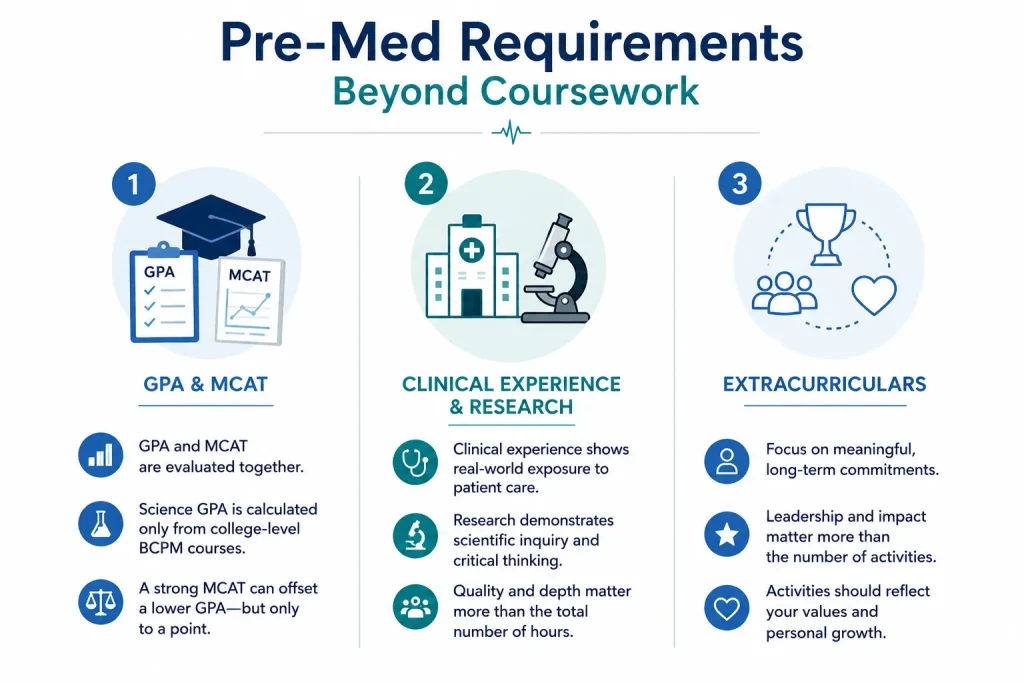
Coursework establishes the academic foundation of a pre-med application, but pre-med qualifications extend beyond what appears on a course list. Medical schools evaluate a profile that includes GPA, MCAT performance, clinical exposure, research experience, and extracurricular engagement. Each element carries weight independently, and the relationship between them matters as much as any single component.
1. GPA and MCAT
Medical school admissions evaluate GPA and MCAT together. A stronger MCAT can offset a lower GPA, but only to a point. GPA remains a filter that test performance alone cannot overcome.
The science GPA warrants separate attention. AMCAS calculates it exclusively from college-level Biology, Chemistry, Physics, and Math courses. AP credits do not count, and neither does high school GPA, whether weighted or unweighted. A student who uses AP credits to skip introductory college science courses starts that calculation with nothing recorded. Their first grades in it are often among the most demanding courses in the pre-med sequence. Most families make that placement decision in tenth or eleventh grade, before the downstream consequences for the science GPA are part of the conversation.
2. Clinical Experience and Research
Medical schools expect applicants to have engaged with clinical environments before they apply. The reasoning is institutional: a student who has spent years preparing academically for medicine but has no direct exposure to its practice has not yet demonstrated that the commitment is grounded in reality. Clinical experience is how that demonstration is made.
What counts as clinical experience varies by institution, but the category broadly includes direct patient contact: volunteering in hospitals or clinics, scribing for physicians, working as an emergency medical technician, or participating in community health programs.
Research experience, while distinct, follows the same evaluative logic. Medical schools weigh it as evidence that a student can engage with scientific inquiry at a level beyond coursework, and for students targeting research-intensive programs, it carries considerable weight in the application review.
Neither clinical experience nor research has a published minimum requirement, the way prerequisite courses do. What medical schools evaluate is depth and authenticity. A student with two years of consistent clinical volunteering and a meaningful research contribution reads differently than a student who accumulated hours across multiple disconnected activities in the months before applying. The distinction is visible on an application, and admissions committees are practiced at identifying it.
3. Extracurriculars
Medical school applications include a section for extracurricular activities, and the instinct many students bring to it is additive – the more activities listed, the stronger the application. That instinct is worth examining. Admissions committees are not counting entries. They are reading for evidence of sustained engagement, genuine leadership, and the kind of character that holds up under sustained pressure.
A student who has spent three years in a single meaningful commitment, a research lab, a community organization, a leadership role, presents a more legible record than a student who accumulated a broad list of short-term activities with no evident thread. The extracurricular section is where an applicant’s priorities become visible, and what those priorities communicate about the person matters as much as the activities themselves.
How to Prepare for Pre-Med in High School
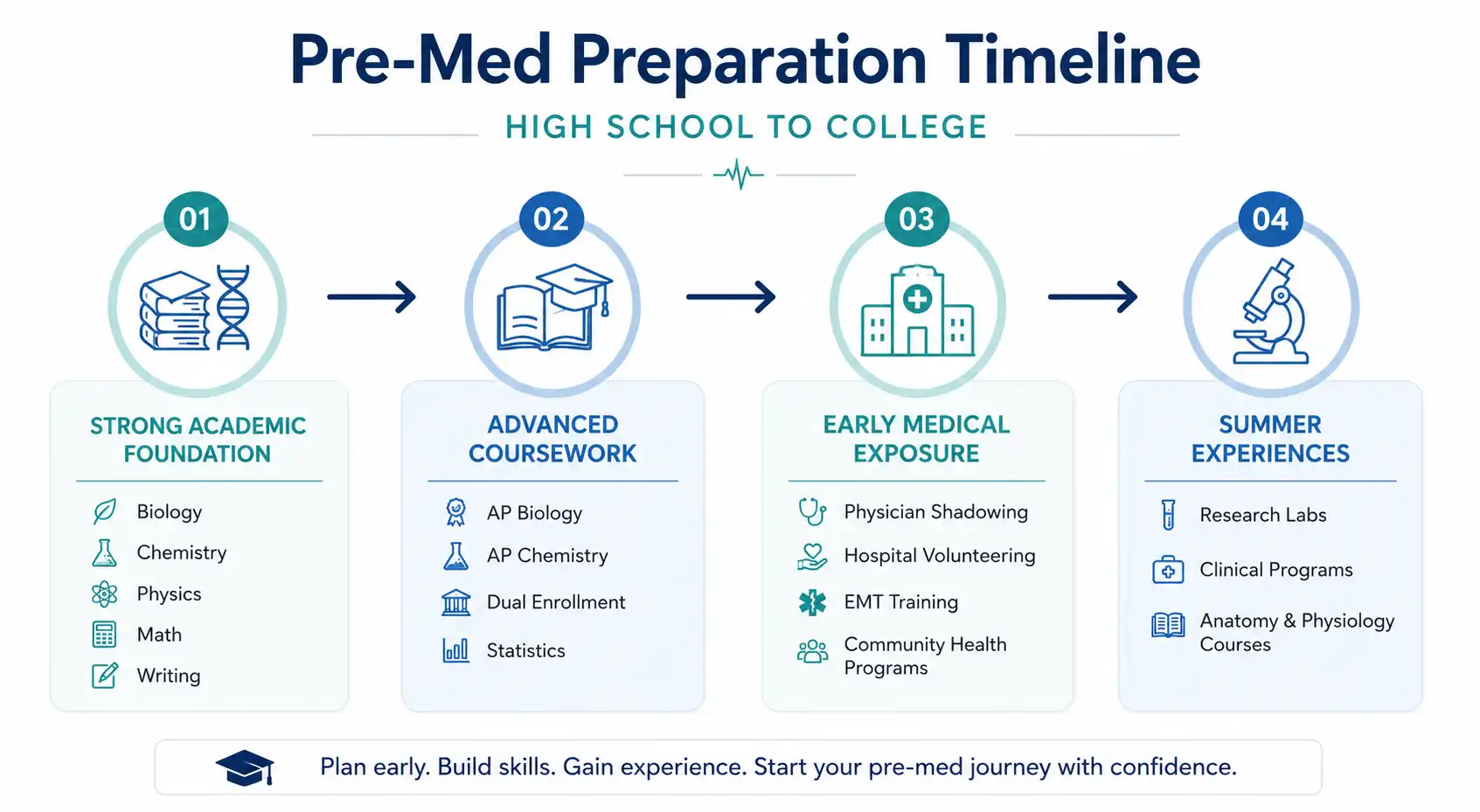
The pre-med track is built in college, but some of the decisions that determine how it starts are made in high school. Course selection, AP placement, and early clinical exposure all shape what is available to a student in their first undergraduate year. Building toward pre-med qualifications starts well before college orientation. The early planning that happens in ninth and tenth grade can help determine how much of the track a student can complete and how competitively.
1. High School Courses to Take Before Pre-Med
The pre-med sequence in college is built on a chain of prerequisites. General Chemistry gates Organic Chemistry. Organic Chemistry gates Biochemistry. A high school student who has completed Biology, Chemistry, and Math through Algebra II arrives at college able to enter that chain without delay.
The courses worth completing before college:
- Biology: Full year, with lab if available. Directly prerequisite to college-level Biology and foundational to MCAT content.
- Chemistry: Full year, with lab. General Chemistry is the first college science course most pre-med students take, and it is the gateway to the rest of the sequence. Arriving without high school Chemistry as preparation makes it significantly harder.
- Physics: A full year is ideal, though not always available before senior year. Its college-level prerequisites are math-based, but high school Physics builds the conceptual foundation that college Physics assumes.
- Algebra through Algebra II: Required before college-level Calculus. Statistics requires only an Algebra II foundation and can be taken in high school without Pre-Calculus.
- English and Writing: College-level writing is a formal medical school requirement. A strong writing foundation in high school makes that requirement easier to meet competitively.
- Statistics: Worth taking in high school, where available. It maps directly to a college prerequisite that a growing number of medical schools require.
- Psychology and Sociology: Not standard offerings at every high school, but worth taking if available. Both are tested on the MCAT, and familiarity with either subject before college reduces the preparation load later.
The sequence matters as much as the subjects. Each course opens the next one.
2. AP and Dual Enrollment: How They Affect Your College Sequence
AP courses and dual enrollment are both ways to complete advanced coursework in high school, but they affect the pre-med sequence differently, and the distinction matters for planning purposes.
AP courses earn college credit at the discretion of the receiving institution and, as covered earlier, are excluded from the AMCAS BCPM GPA calculation regardless of the score. Dual enrollment courses are taken at a college while the student is still in high school. The grades earned appear on a college transcript and are included in the AMCAS GPA calculation.
A student who takes dual enrollment General Chemistry in eleventh grade and earns an A has started their science GPA before they arrive at college. A student who takes AP Chemistry and scores a 5 has not.
The strategic question for AP is not whether to take it, but which courses to use for placement and which to retake at the college level. AP Biology, Chemistry, and Physics can demonstrate academic rigor on a high school transcript without being used to skip the college-level equivalent. A student can take AP Chemistry, perform well, and still take General Chemistry in college, building the BCPM GPA from a course they are well-prepared for rather than entering the sequence one level higher with no recorded grades beneath them.
Dual enrollment, where available and where the course quality is equivalent, offers a more straightforward advantage for pre-med students. The grades count, the coursework is genuine college-level preparation, and the science GPA begins accumulating before the undergraduate years formally start.
3. Clinical Exposure and Volunteering Before College
One of the most time-sensitive aspects of pre-med preparation is clinical exposure. The options available before college are more limited than most guides suggest, and direct patient contact in hospital settings typically requires students to be 18 or older. Several options are nonetheless accessible before college, and starting with them in eleventh or twelfth grade means arriving at college with a record already in progress.
The options realistically available before college:
- Physician shadowing: Arranged independently through family connections or direct outreach to local practices. No minimum age requirement in most cases. Even limited shadowing hours in high school establish early informed exposure to the field and demonstrate that the commitment to medicine is grounded in direct observation.
- EMT certification: Available to students 16 or older in some states. One of the most substantive forms of clinical exposure accessible before college combines formal training with direct patient contact in emergency settings.
- Non-patient-facing hospital volunteering: Many hospitals accept volunteers at 16 for administrative or support roles. Direct patient contact is restricted, but consistent participation builds institutional familiarity and a documentable volunteer record.
- Community health programs: Free clinics, Federally Qualified Health Centers, and community organizations often have fewer age restrictions than hospital settings. Relevant for students interested in primary care or underserved populations, and accessible earlier than most hospital programs.
The goal at this stage is not to replicate the clinical record a college student builds. It is to begin one early enough that it reflects sustained engagement by the time a medical school application is submitted, one of the pre-med qualifications that takes the longest to establish.
4. Pre-Med Summer Programs for High School Students
Pursuing a substantive summer program before college is one of the most effective ways to build toward pre-med qualifications while still in high school. The main options are:
- University research placements: Competitive programs placing students in working research labs alongside faculty and graduate students. Often unpaid or stipended. Among the most substantive pre-med experiences available before college.
- Clinical immersion programs: Structured clinical exposure, typically hospital or simulation-based. Programs affiliated with academic medical centers offer more substantive experience than general enrichment programs marketed to pre-med students.
- Academic enrichment courses: Summer courses covering subjects like Anatomy or Physiology on college campuses. Build familiarity with pre-med content, but do not produce transcript grades that count toward AMCAS GPA.
Not all three carry equal weight toward pre-med qualifications. The closer a program is to real research or clinical work, and the more competitive its selection process, the more it adds to the record.
Plan Your Pre-Med Path
McMillan Education has guided families through college and pre-professional planning for over 70 years. As America’s oldest educational consultancy, our team has placed generations of students across the country’s institutions, including many students who entered high school with a pre-med goal and built toward it with a plan.
If you are looking for structured guidance at any point in the pre-med planning process, our college planning consultants can guide you through it.
Frequently Asked Questions
1. What math classes are required for pre-med?
College-level Statistics is the most broadly required math course across medical school prerequisites. Calculus is required by a smaller subset of institutions. Families should verify the math requirements of specific target schools, as policies vary more in this subject area than in any other core prerequisite.
2. What’s a good GPA for pre-med?
There is no universal cutoff, and GPA is evaluated alongside MCAT performance, the strength of the science course sequence, and the selectivity of the institutions where those grades were earned. That said, recent admissions trends show the mean GPA among enrolled medical school matriculants is 3.81. Students with GPAs below that range are accepted every cycle, particularly when MCAT performance, clinical experience, and research contributions present a strong overall profile. The science GPA, calculated separately by AMCAS from Biology, Chemistry, Physics, and Math courses, carries particular weight and is worth tracking independently throughout the undergraduate years.
3. What is the hardest class in pre-med?
Organic Chemistry is consistently identified as the most demanding course in the pre-med sequence. It is a gating prerequisite for Biochemistry, appears on the MCAT, and is evaluated closely on transcripts by medical school admissions committees. Biochemistry and Physics are also frequently cited as among the most challenging courses in the sequence.
4. Can you go pre-med with any major?
Yes. Pre-med is a track, not a major. Students can pursue any undergraduate major while completing pre-med requirements. What matters to medical schools is that the required science and math prerequisites are completed, regardless of the student’s declared major.
5. Do you have to take the MCAT for pre-med?
The MCAT is not required during the pre-med track itself. It is required as part of the medical school application. Most students take it in the spring of their junior year or during a gap year, after completing the prerequisite coursework that the exam covers.
6. Are European medical schools an option for pre-med students?
European medical schools operate on a different admissions pathway. Most do not require the MCAT, follow distinct prerequisite structures, and admit students directly from secondary school in many countries rather than after an undergraduate degree. For students open to studying abroad, European programs represent a distinct route to a medical degree, one that McMillan Education’s international consultants are equipped to guide families through.