


In a college admissions landscape increasingly shaped by anxiety over starting salaries, return on investment, and career readiness, a liberal arts education – broad-based, spanning the humanities, sciences, and social sciences can look, at first glance, like the less practical choice. It is not.
This article examines that claim directly, tracing the benefits of a liberal arts education across the areas families weigh most carefully: career outcomes, earning potential, graduate school placement, and preparation for a workforce being fundamentally reshaped by AI.
What Is a Liberal Arts Education?
A liberal arts education, more precisely a liberal arts and sciences education, is a broad-based academic model spanning three domains: the humanities, the natural sciences, and the social sciences. The term is frequently misread, often treated as synonymous with the humanities alone. In practice, most liberal arts students today major in the sciences and social sciences, and the curriculum has always been designed to span all three domains in equal measure.
The academic structure reflects that breadth. Distribution requirements most often mandate coursework across all three domains before a major is declared. Students are not expected to arrive with a field of study chosen. Major declaration typically happens at the end of the first or second year, after sufficient exposure across departments. Double majors across unrelated disciplines are a structural norm, built into the model rather than grafted onto it.
1. How Liberal Arts Colleges Are Structured
Liberal arts colleges are small institutions, typically enrolling 3,000 students or fewer, with classes that are seminar-based and commonly have fewer than 30 students. Many institutions require a senior capstone or independent research project as a condition of graduation, culminating a four-year experience organized around breadth in the first two years and focused disciplinary depth in the last two.
What this produces is a graduate who has worked across multiple domains of knowledge, sustained an extended independent argument, and developed the capacity to move between fields of inquiry. That profile sits at the center of what the liberal arts model is designed to deliver.
The debate around this model tends to organize itself around a familiar tension: specialists versus generalists. A pre-professional track produces graduates with specific, marketable credentials, and the question that follows naturally is whether a liberal arts education can compete on those same terms. In a job market that appears to reward technical specificity, breadth can look like a liability. Whether that holds up against the evidence is a question this article seeks to address directly.
The Advantages of a Liberal Arts Education
The benefits of a liberal arts education are more numerous and more concrete than the debate around the model typically acknowledges, and they extend across dimensions that families tend to weigh separately, but that reinforce each other over time.
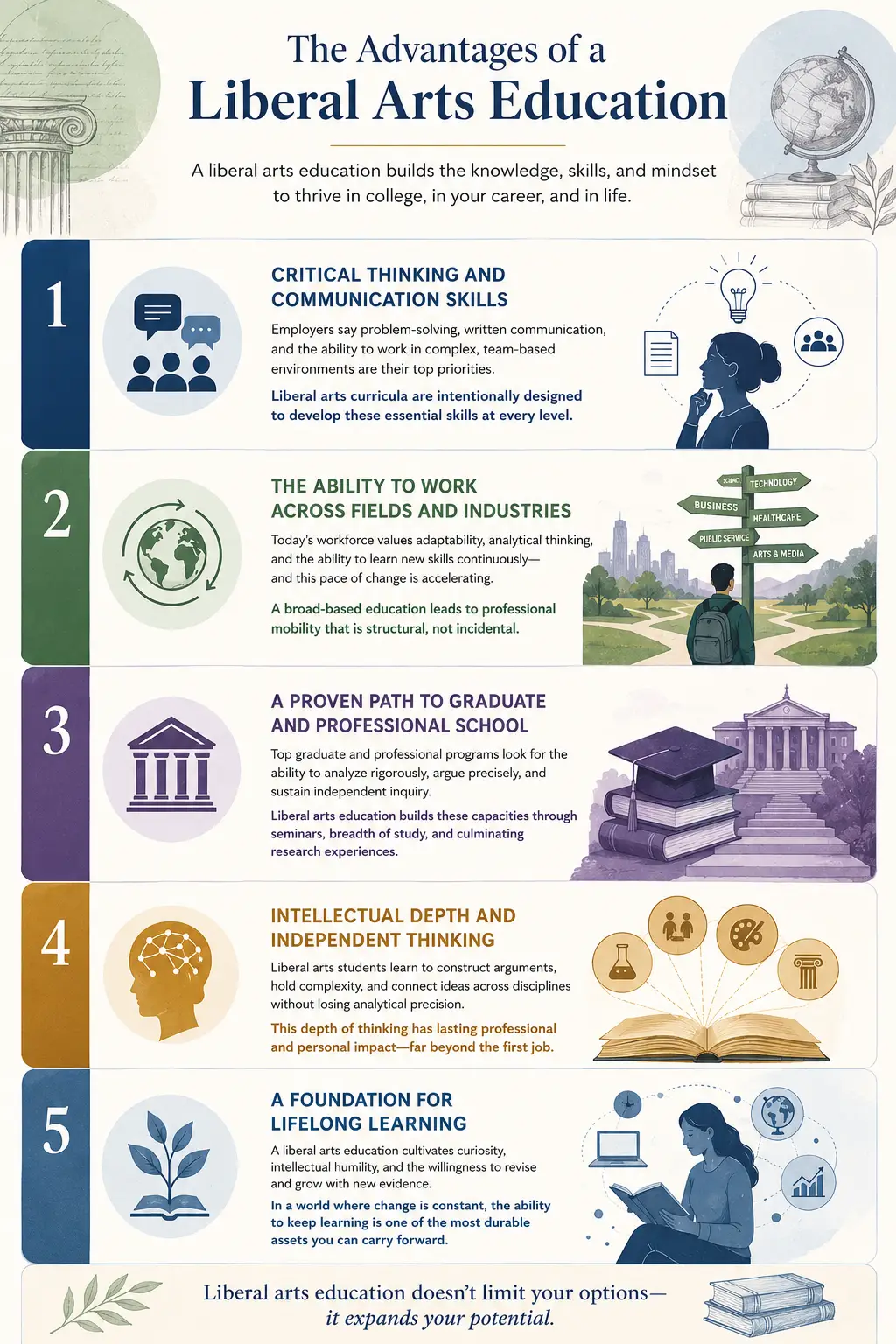
1. Critical Thinking and Communication Skills
According to NACE’s Job Outlook 2025 survey, the three skills employers most consistently prioritize in new hires are problem-solving, written communication, and the capacity to work across complex, team-based environments. The AAC&U’s 2025 Employer Survey adds a more specific finding: employers are not framing these capacities as supplementary to technical preparation. They are treating them as the primary indicators of a candidate’s long-term professional value. And a benefit of liberal arts education is that it is structured, at every level of the curriculum, to develop exactly these capacities.
2. The Ability to Work Across Fields and Industries
The assumption that a career unfolds along a single disciplinary track has become increasingly difficult to sustain. The World Economic Forum’s Future of Jobs 2025 report identifies adaptability, analytical thinking, and the capacity to acquire new skills continuously as the defining requirements of the contemporary workforce, and notes that this pace of change is accelerating, not stabilizing. A broad-based education that does not organize itself around a single vocational destination produces graduates whose professional mobility is structural, not incidental.
3. A Proven Path to Graduate and Professional School
Graduate and professional schools are not selecting for pre-professional training at the undergraduate level. Medical schools, law schools, doctoral programs, and MBA programs are selecting for the capacity to analyze rigorously, argue precisely, and sustain independent inquiry over an extended period. These are capacities that a liberal arts education deliberately develops through the seminar format, the distribution requirements that build breadth before depth, and often a culminating research project that demands both.
4. Intellectual Depth and Independent Thinking
There is a meaningful difference between acquiring knowledge within a field and developing the capacity to think within and across fields simultaneously. A liberal arts education is designed to produce the latter. Seminar-based instruction, cross-disciplinary requirements, and extended independent research each push toward the same outcome: a graduate who can construct an argument, hold complexity without flattening it, and move between fields of inquiry without losing analytical precision. That capacity has both professional and personal consequences that extend well beyond the first job.
5. A Foundation for Lifelong Learning
Among the most enduring liberal arts education benefits is the one least visible at graduation, the disposition to keep learning, and to do so with genuine intellectual appetite. A curriculum organized around inquiry, rather than instruction, develops the capacity to take up unfamiliar problems with genuine curiosity and revise prior understanding in the face of new evidence. In a professional environment that now requires continuous learning as a permanent condition, that disposition is among the most durable assets a graduate carries forward.
The Age of AI and the Benefits of a Liberal Arts Education
Among the more telling college admission trends of recent years is that liberal arts colleges continue to attract serious applicants despite a public conversation that treats this kind of degree as a professional liability in an AI economy. The advantage of a liberal arts education in an AI economy is, as the evidence now suggests, precisely the opposite of what that developing “conventional wisdom” assumes.
1. The Skills AI Cannot Replace
A liberal arts education develops the skills that automation is least positioned to displace. McKinsey Global Institute’s research “Agents, Robots, and Us: Skill Partnerships in the Age of AI,” maps approximately 6,800 skills against projected automation exposure through 2030 and finds that people-centric, communicative, and analytical skills sit consistently at the low end of that exposure scale, with leadership, negotiation, communication, and writing among them. Families weighing undergraduate options are choosing between credential profiles whose long-term durability, as that data makes clear, differs considerably.
2. The Eight Skills the AI Economy Needs Most
The same research identifies communication, management, problem-solving, leadership, writing, detail orientation, customer relations, and operations as the transferable skills that remain essential as automation advances. The value of liberal arts education in an AI economy becomes clearest when examined through what those eight skills actually have in common. What connects them is that none can be performed well without contextual judgment, the capacity to read a situation, weigh competing considerations, and act without a fixed procedure to follow. A liberal arts education trains students to do exactly that, not in one domain but across several simultaneously, which is precisely the condition under which these skills are most demanded.
3. Liberal Arts Graduates as AI Collaborators
As AI takes over the execution of routine tasks, the human role shifts toward what the workforce literature now describes as orchestration and validation: framing problems, questioning outputs, challenging assumptions, and applying judgment where AI cannot. Critical thinking is the foundation of that capacity, and it is also the organizing principle of a liberal arts education. A graduate trained to construct, test, and revise arguments across disciplines is well-positioned to direct AI systems rather than be displaced by them.
4. From Routine Writing to Strategic Storytelling
Artificial intelligence performs routine writing competently, and the demand for workers whose primary function is producing that kind of output is declining as a result. The work that commands a premium now is what AI does not do well: shaping an argument for a specific audience, interpreting evidence within a broader context, and making judgments that require cultural and situational understanding. A liberal arts education develops those capacities as a matter of course, producing graduates whose contribution to writing and communication tasks sits at precisely the level the current labor market rewards most.
5. Adaptability as a Durable Asset
The speed of technological change raises the value of skills that transfer across professional contexts rather than those calibrated to a specific domain. A liberal arts education is built around that principle. Where specialized training produces depth within a defined field, liberal arts produces adaptability – the capacity to move across fields as conditions shift. In a labor market being continuously reorganized by automation, that capacity is among the most durable assets a graduate carries forward.
Do Liberal Arts Degrees Pay Off?
What the long-term data on AI and labor markets will ultimately show is still being written. What exists now, across decades of graduate earnings research, is a financial case for liberal arts education that holds up to scrutiny when examined across the right time horizon.
The entry-level salary gap is real and worth naming directly. Georgetown Center on Education and the Workforce data shows liberal arts graduates starting at a median of $29,000, against $43,000 for STEM graduates. That figure, taken in isolation, is misleading. Across a 40-year horizon, the picture is different:
Median return on investment at liberal arts colleges reaches $918,000 at the 40-year mark, approximately 25% above the national median across all college types
Approximately 40% of liberal arts graduates go on to earn an advanced degree, including law, medicine, and MBA programs, and are twice as likely to enter PhD programs.
It is also worth noting that the comparison most families are making is not liberal arts versus STEM. It is humanities versus STEM. The two are not the same. Liberal arts colleges produce engineers, mathematicians, and biologists alongside historians and philosophers, and the earnings data that follows graduates of those institutions reflects that full range.
What this data shows is that a liberal arts education is not a compromise on earning potential. It is a different kind of bet structured around a longer arc, a higher rate of advanced degree attainment, and a return on investment that compounds precisely because the model was never designed to optimize for a single destination.
The Liberal Arts Advantage in Today’s Hiring Market
The latest labor market data from Forbes and LinkedIn adds a near-term dimension to the financial benefits of a liberal arts education.
LinkedIn data from April 2026 found that graduates in the social sciences and humanities are proving resilient in today’s job market because they gained skills that can be used across multiple industries. Engineering graduates, by contrast, face a dual disadvantage: a weak hiring market in their traditional fields and a narrower range of industries available to them when those fields contract.
In a slow hiring environment, LinkedIn concluded, versatility may be the single most significant competitive advantage a new graduate can carry, and it is precisely what a liberal arts degree provides.
How Hiring Has Shifted: Entry-Level Jobs by Major, 2019–2026
|
Major |
% Decline |
% of Grads on LinkedIn |
|
Engineering |
-25% |
7.70% |
|
Computer & Information Sciences |
-24% |
3.70% |
|
Interdisciplinary Studies |
-24% |
6.40% |
|
Business & Marketing |
-23% |
24.30% |
|
Communication & Journalism |
-23% |
4.00% |
|
Physical Sciences |
-23% |
1.50% |
|
Visual & Performing Arts |
-23% |
5.20% |
|
Social Sciences |
-22% |
6.40% |
|
Homeland Security & Law Enforcement |
-22% |
2.20% |
|
English |
-21% |
1.40% |
|
Biological Sciences |
-19% |
5.80% |
|
Parks, Recreation & Fitness |
-19% |
2.40% |
|
Psychology |
-18% |
6.10% |
|
Health Professions |
-16% |
9.00% |
|
Education |
-16% |
2.10% |
Source: Forbes & Linkedin; ” The College Majors Most Likely To Get You Hired In Your Field And Outside Of It”
Liberal Arts Colleges and the College Planning Process
Choosing between a liberal arts college and a pre-professional or research university track shapes every subsequent planning decision, from list-building to application strategy to financial aid analysis. Families who approach that choice by asking which institution type produces better outcomes are asking a question with no clean answer. The question that produces useful planning guidance is more specific: which college type suits this student’s academic profile, intellectual range, and professional timeline.
The planning implications follow from that. A student with a fixed vocational direction and clear credentialing requirements (like engineering, nursing, or architecture) builds a list differently than a student whose intellectual interests run across disciplines and whose professional direction will develop through the curriculum rather than before it. Liberal arts colleges are structured for the second profile, and the strongest applications to those institutions reflect genuine excitement about the opportunities that structure affords.
The range within the liberal arts college category, across selectivity, academic culture, financial aid structures, and graduate school placement rates, is considerable. Families who build lists without that institutional granularity tend to end up with options that are too similar to each other or poorly matched to the student’s actual strengths. Experienced college planning guidance through that landscape can be helpful in producing a list that is both ambitious and well-calibrated.
Start Your Liberal Arts College Planning
For more than 70 years, McMillan Education has guided families through precisely the kind of decision this article examines, not by pointing toward a single institution type, but by building the institutional knowledge required to match a student’s academic profile to the right college environment. Thousands of families have placed students at liberal arts colleges across the country through that process, with broadly successful outcomes.
The benefits of a liberal arts education are real and well-documented. Realizing them begins with a planning process that understands what these institutions are looking for, how they differ from each other, and where a specific student’s strengths position them most competitively. Our college admissions consultants bring decades of placement experience and direct institutional relationships to that analysis. Schedule a free consultation to begin.
Frequently Asked Questions
1. What jobs can you get with a liberal arts degree?
Liberal arts graduates are distributed across virtually every professional sector, including finance, law, medicine, technology, government, consulting, and media. The degree does not map to a single career track by design, and that is structural rather than incidental. Career mobility tends to increase over time precisely because the preparation transfers across industries rather than being calibrated to one.
2. Do liberal arts graduates get into medical school?
Liberal arts colleges have long been among the strongest feeders into medical school. The seminar-based instruction, writing preparation, and independent research experience the model requires align directly with what medical school admissions committees evaluate. Several of the most selective liberal arts colleges post medical school acceptance rates that exceed national averages by a considerable margin.
3. What is the difference between a liberal arts college and a university?
A liberal arts college is a small, undergraduate-focused institution, often enrolling fewer than 3,000 students, organized around seminar-based instruction, cross-disciplinary requirements, and close faculty access. A research university is a larger institution whose faculty divide time between teaching and sponsored research, with graduate programs that often shape departmental priorities. That structural difference often produces a meaningfully different undergraduate academic experience.
4. Are liberal arts degrees becoming more or less relevant with AI?
More relevant. McKinsey Global Institute research mapping approximately 6,800 skills against automation exposure through 2030 finds that communication, analytical thinking, leadership, and writing sit consistently at the low end of automation risk. As AI absorbs routine execution tasks, the professional premium shifts toward exactly the capacities a liberal arts curriculum is structured to build.
5. What is the purpose of a liberal arts education?
A liberal arts education is designed to develop the capacity to think rigorously across multiple domains, sustain independent inquiry, and apply analytical precision to unfamiliar problems. The curriculum is organized around breadth before depth, producing graduates equipped for a range of professional directions rather than a single predetermined one. That preparation becomes more valuable, not less, as career paths lengthen and professional conditions change.