


Few stretches of parenting test the heart quite like the college process. The child who once needed a hand crossing the street is suddenly weighing majors, essays and campuses, and every loving instinct says to organize, protect and fix. Parents do play a real role in college planning, but that role changes at every stage, and knowing when to lead, when to step back, what to do and what to leave alone is what makes the difference for the student. This college planning guide for parents walks through each of those stages, shaped by more than 70 years of experience at America’s oldest educational consultancy.
Key Takeaways
- College planning is a multi-year process. From ninth grade to the final decision, it unfolds one stage at a time, covering academic choices, testing, extracurricular choices, applications and financial aid.
- Parents lead some parts and let go of others. Parents take care of logistics, partner in the big decisions, and trust the student with the essays and applications.
- The role shifts as the student grows. Parents stay close in the early years and, by senior year, become trusted advisers their students turn to at key moments.
- Honest money conversations are a kindness. Talking about cost early spares a student heartbreak later, and good research and careful budgeting help families build a list they can afford.
- Calm is contagious. Students take their cues from their parents, and a steady, loving, supportive approach is best during both the highs and the lows of the process.
- Wise guidance matters. An independent educational consultant offers a level of time and personal attention that busy school counselors often can’t, and personalized insight that AI can’t muster.
What Is College Planning?
College planning is the multi-year process of preparing a student for college admission and choosing where to enroll. It covers academic preparation, standardized testing, extracurricular activities, building a college list, campus visits, applications, financial aid and the final enrollment decision, and it unfolds across all four years of high school.
Behind the deadlines and forms, college planning comes down to two things. The first is understanding the student: their strengths, interests and values, and the kind of environment where they will grow. The second is strategy. Course choices, testing plans, selecting activities and summer planning, application strategies and a balanced college list all shape how a student stands out in the applicant pool, and this is where technical admissions knowledge matters most.
The two work best together, with the student at the center. A plan built around who the student is produces applications that authentically sound like them, and planning that begins early gives the student time to grow into the process and gives parents time to find their place in it.
The Parent’s Role in College Planning
Parents are part of college planning from the first conversation to the last, but the shape of that role keeps changing. In ninth grade, a parent may play a significant role with school advisers in course selections, extracurricular choices and summer plans. By senior year, the same parent reads essay drafts only when invited and keeps a steady hand on the finances while the student runs the show. The table below shows where that balance sits across each part of the process.
What Parents Lead and What Students Own
Area | Parents Do | Do Together | Parents Don’t |
|---|---|---|---|
Finances | Set the budget and share what the family can contribute and borrow | Discuss cost early so the college list reflects it | Hold back financial limits until acceptances arrive |
College list | Raise options and ask about size, setting and academic resources | Research and visit colleges | Steer toward prestige or a parent’s alma mater |
Testing | Handle registration logistics and prep resources | Agree on a test plan and timeline | Treat scores as a measure of the child’s worth |
Applications and essays | Read and give honest reactions when asked | Review the timeline and the overall application story | Rewrite essays or impose a parent’s voice |
Deadlines | Keep a shared family calendar | Check progress at agreed times | Take over the student’s tasks |
Campus visits | Plan logistics and save questions for aid and practical matters | Talk through each visit afterward | Lead conversations on tours and in info sessions |
Setbacks and results | Stay steady and keep reactions private | Talk through next steps | Rescue the student or show panic and disappointment |
Final decision | Compare aid offers side by side | Agree on who makes the final call | Make the decision for the student |
One principle runs through every row: students should take on as much responsibility for the process as they can handle, with guidance from their parents. The “Parents Don’t” column can be the hardest to honor, because it asks parents to stand back at the very moments they instinctively want to step in. It is also where students build the independence that college will ask of them from their first week on campus.
The balance moves with time. Parents carry more of the logistics in the early high school years, and by senior year the student owns most of the work, with finances still in the parents’ column and the final decision remaining shared. Getting that balance right matters, and open communication helps parents and students work together.
Why Doing Too Much Backfires
One of our educational consultants remembers driving her daughter back to school before the first bell to hunt for a missing graphing calculator, hours before an algebra test. Her daughter could break down the hardest physics problem, yet she kept losing track of the small things: a pencil, a calculator, half of an English paper left in the printer at home. Looking back, our colleague saw that the routines that had worked when her daughter was small, the clothes laid out and the backpack packed, had stayed in place long after her daughter was ready to take them on herself. The skills came eventually, but later, and with more stress for both of them.
That morning came from love. Children, though, learn from natural consequences in ways they cannot learn from being rescued, and a weaker grade on one test is a small price compared with discovering in college that no one else is going to keep track for them.
Research points the same way. A 2025 meta-analysis in the Journal of Adult Development found helicopter parenting associated with higher anxiety and depressive symptoms in emerging adults. A parent’s protection, however loving, can quietly tell a child that the world is more than they can manage, and anxiety in the admissions process is something families can plan for together.
For a teenager, applying to college is a rite of passage. When a parent takes over the essays, the deadlines or the decisions, the student hears, however unintended, that they could not have done it alone. Psychologists call the space where real growth happens the zone of proximal development: the distance between what a learner can do alone and what they can do with guidance. Parents can stand at its edge with a question or a gentle nudge, but have to regularly remind themselves not to cross it for the student.
Every Family Plays This Role Differently
Years ago, one of our consultants, then a director of college counseling, hosted an evening for juniors and their parents where admissions officers encouraged families to let students make their own college decisions. Afterward, he noticed one mother had quietly walked out. When they spoke a few days later, she explained that in the Netherlands, where she grew up, choosing a college was a family decision, talked through at the dinner table with parents at its heart. Being told to step aside had felt dismissive of everything she valued.
Both perspectives held something true. The admissions officers were right that students need room to make their own decisions, and the mother was right that a decision this large belongs to the whole family. The advice to step back still stands, but it has to leave parents feeling included, and every family will find its own balance. What matters is a healthy transition, with the student gaining independence and the parent keeping a meaningful place in the conversation.
For parents new to the American college process, whether they are the first in their family to go through it or were raised in a different education system, the learning curve is steep, and that is nothing to apologize for. The experienced educational consultants at McMillan Education can offer the college guidance parents need and fill in what feels unfamiliar, starting with the whole family and leaving parents free to focus on the part no one else can play: knowing their child.
A Grade-by-Grade College Planning Timeline for Parents
For parents planning for college, each year of high school asks something different of the student and of the family around them. Here is what each year involves and where parents come in.
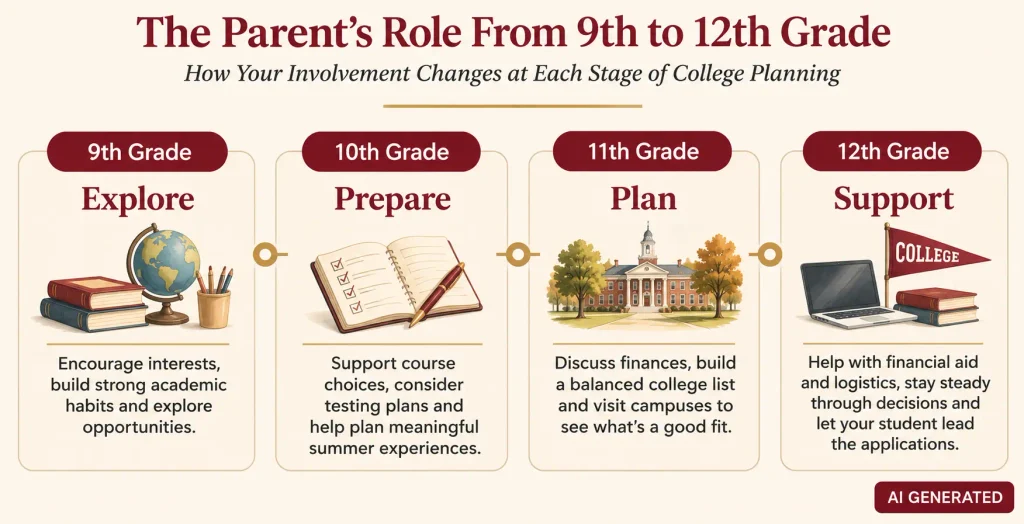
9th Grade: Laying the Foundation
Ninth grade is a year of fresh starts and new habits, with few big decisions required. Grades from this year appear on the transcript colleges review, so a solid start in core courses matters, as does choosing a few activities the student truly enjoys and can engage with. Two or three commitments pursued with depth, whether in a sport, the arts, club engagement, or community service, tell a far richer story by senior year than a long list of brief ones.
The parent’s role: notice what lights the student up, keep the focus on academic and extracurricular engagement authentic to the student, and resist the urge to map out all four years at once.
10th Grade: Building Momentum
Sophomore year is when course rigor starts to count. Students who are ready can take on honors or AP classes, and the PSAT 10 or PSAT (or diagnostic testing later in the year) can offer a low-stakes first look at standardized testing. Summers become more valuable too, whether spent working, studying or exploring an interest more deeply.
The parent’s role: talk through next year’s course schedule with the student and the school counselor, weighing challenge against balance so the student stretches without burning out.
11th Grade: The Plan Takes Shape
Junior year is the last full year of grades colleges see before applications are due, and the fall PSAT/NMSQT sets the table for standardized testing and can qualify students for National Merit recognition. Students also build a testing plan for the SAT or ACT. Several selective colleges, from Ivy League schools such as Harvard, Yale and Dartmouth to non-Ivy schools such as MIT, Stanford and Johns Hopkins, have reinstated testing requirements, while many others remain test-optional, so each college’s current policy is worth checking as students develop their list. By spring, a first college list begins to form, along with the first campus visits and the spring priorities of junior year.
The parent’s role: this is the year for the money conversation, before the list grows and before the student’s heart is set on any one school. It’s important to know that a school’s “list price,” more often than not, is not representative of what most families will actually pay. Some of the colleges with the highest tuition and other costs also have the most robust financial aid support, so it’s important to use college-specific net price calculation tools before writing schools off as too expensive.
12th Grade: The Student Takes the Lead
Senior year moves quickly, and the summer before is the best time to get ahead on essays. The Common Application opens on August 1, early deadlines commonly fall in November, and regular deadlines generally follow in January. The FAFSA for the following year opens in the fall; the 2027–28 form opened on September 23, 2026, the FAFSA’s earliest launch yet. Some colleges also require the CSS Profile, which opens in the fall, for their own institutional aid. Decisions arrive from December through spring, ahead of a commitment deadline that is commonly May 1.
The parent’s role: gather the financial documents the aid forms require and keep the family calendar current, leaving the applications themselves, and the voice in them, to the student. For many parents, this is the year of watching from a little further back, and it is often the year they are proudest of.
The Parent’s Role in Building a College List
Helping a child choose a college starts with the college list, where a parent’s opinions can run strongest, and with good reason: parents know their children deeply, and they care about where those children will spend four formative years. The parent’s part is to widen the student’s view, ask good questions and bring that knowledge to the table, while the student picks the college. The criteria themselves are laid out in detail in a guide to finding the right type of college. What follows is how parents can contribute to the list without taking it over.
Know the Whole Child
No counselor or admissions office knows a student the way a parent does, which makes this the natural place to begin. Educators at America’s oldest and foremost educational consultancy look at the whole child, as a learner, a citizen and an athlete, and parents can do the same at home. How does the student learn best? How much structure do they need? Where have they come alive: in a classroom, on a team, in a studio, or in a quiet corner with a book? Those observations, offered as questions and shared over time, give the student a clearer picture of themselves and give the college list something real to build on.
Widen the Search Beyond Grades and One Target School
It is natural to begin with metrics: are the grades strong enough, and could the student keep pace? Those questions matter, but a search that stops there misses much of what will shape the student’s experience. Early on, the search can range widely across different types of colleges, large and small, urban and rural, close to home and far away, before it narrows. As it does, a balanced list of likely, target and reach colleges keeps every outcome open. Admissions decisions depend on each college’s institutional priorities in a given year, from the programs it is building to the number of beds on campus, so no single school should hold the whole plan.
Weigh the Environment Alongside Academics
An academic match is only one piece of the picture. Size, setting, academic resources, activities, location and campus culture all shape how a student lives and learns. A student who would flourish at a small liberal arts college might feel lost at a large research university, and a student who might flourish in a bigger environment might feel somewhat suffocated on a smaller campus. In our consultants’ experience, when a student struggles at a school that looked promising on paper, the cause lies beyond ability more often than not; issues often are rooted in the culture, the pace, or the level of personal attention. Asking where the student will feel known, challenged and at home matters as much or more than asking whether they will be admitted.
Look Past Prestige and Familiar Names
The most prestigious college, the one closest to home, or a parent’s own alma mater can each feel like the obvious choice, and none of them is automatically the right one. A parent’s fond memories of a campus, or a name that impresses among friends, can quietly steer a student toward a place chosen for someone else’s reasons. Rankings measure what is easy to count and say little about whether a particular student will grow somewhere, and some of the colleges that shape students most deeply sit well outside the headlines, as the colleges that change lives show. Growth and fulfillment last far longer than the name on a diploma, and that is the measure worth holding onto as the list comes together.
Questions Parents Should Ask Colleges
Campus visits, information sessions and college fairs give families a chance to see past the brochures, and some of the most useful college information for parents sits well outside them. On a visit, the day belongs to the student: they take the lead in conversations on the tour, sit in on a class if the college offers it and form their own first impressions, and the conversation afterward, over a simple “What did you notice?”, can be the most valuable part of the day.
The questions parents should ask colleges have their own time and place, and knowing where each one belongs makes every conversation more productive. Planning the visits themselves is covered in a complete guide to college visits.
Look Up Before Visiting
- What share of first-year students return for sophomore year?
- What share of students graduate in four years, and in six?
- What does the college’s Net Price Calculator estimate for the family?
Retention and graduation rates are published on the federal College Navigator tool, and every college is required to post a Net Price Calculator on its website.
Ask the Financial Aid Office
- How closely do actual aid offers follow the Net Price Calculator estimate?
- Is admission need-blind or need-aware?
- Does the college meet full demonstrated need, and how much of that aid comes as loans?
- How do outside scholarships affect the aid package?
- Is merit aid available, and is it renewable for all four years?
- What costs fall outside tuition, room and board, such as fees, books and travel?
Raise at Information Sessions or Admitted Student Days
- How does academic advising work, and how often do students meet with their adviser?
- Is housing guaranteed, and for how many years?
- Where can families find the college’s annual campus security report?
- How does the college provide accommodations for learning differences?
- What health and counseling services can students access?
Leave to the Student
- How large are first-year classes, and who teaches introductory courses?
- How easy is it to change majors or add a second one?
- What do students do on weekends, and what makes this campus community distinctive?
- What do graduates go on to do, and how does the career services office connect students with internships?
These are the student’s questions to ask on the tour, in a class visit or of current students. Parents can talk them through beforehand, so the student arrives ready to ask.
College Applications and the Parent’s Part
The parent’s role in college admissions grows quieter once applications begin, but it remains real. Parents read essays when invited, write about their child when the parent statement calls for it, and keep the many moving parts of application season organized.

Essays
The college essay is the one place where admissions readers hear the student directly, and a parent can be one of its most useful readers. A parent can help by asking questions like “What happened next?” or “Why did that moment matter?” or “What did you learn about yourself?” Questions like these draw out the story only the student can tell, and an honest reaction (“this part made me feel I was there,” “here I lost the thread”) gives the student something real to work with. The words stay the student’s, in the essay and in the supplemental essays each college adds.
Deadlines and Organization
An application season brings test dates, early and regular deadlines, financial aid forms and scholarship applications, and a shared family calendar keeps all of them in view. The student owns the tasks. The parent keeps the calendar and agrees with the student on when to check in, perhaps once a week, so reminders feel like part of a plan and stop feeling like pressure. When the details start to pile up, a few practical strategies for managing deadlines and the anxiety around them can ease the load for the whole family.
The Parent’s Role in Recruiting, Learning Differences and the Arts
Every family’s college plan has its own shape, and for some, there is an added layer: a sport the student has trained for since childhood, a learning difference that shapes how they learn best, or an art form they have poured themselves into. Each one adds its own timeline and questions, and each changes the parent’s role in college planning in a particular way.
Athletic Recruiting
For a student athlete, recruiting can feel like a second application process running alongside the first, and the parent’s role is to keep the whole student in view. Coaches are an essential part of the process, but their first responsibility is to their team, so a recruiting process run by coaches alone may not put the student’s academic and personal goals first. Parents can make sure academics, campus life, and cost stay part of every conversation, while the student does the talking with coaches and learns to speak for themselves. The common mistakes parents make in athletic recruiting are worth knowing early, and McMillan Education’s athletic recruiting consultants plan recruiting alongside the broader college search.
Learning Differences
When a learning difference is part of the picture, the college process marks a meaningful shift in the parent’s role. In high school, parents can advocate directly for accommodations; in college, students request accommodations themselves through the disability services office, with the documentation the college specifies. Part of preparing a child for college life, then, is handing that advocacy over gradually, so the student arrives on campus able to explain what they need and comfortable asking for it. Parents can also keep evaluations current, decide with the student whether and how to address a learning difference in the application, and research each college’s resources for learning differences as the list takes shape. McMillan Education’s learning differences consultants bring that experience to each family’s plan.
The Arts
For a student whose heart is in music, theater, dance, film or the visual arts, the application becomes a chance to show that work, and the parent’s role is largely practical. Portfolios, auditions and prescreening recordings can carry earlier deadlines than the main application, and audition travel belongs in the family budget. The artistic choices, from repertoire to portfolio pieces, belong to the student and their teachers, and a parent’s place is in the audience, cheering them on. McMillan Education’s visual and performing arts consultants coordinate these pieces with the rest of the college plan.
Decision Season and the Final College Choice
Decision season brings the moments families have been working toward for years, and it brings them quickly. The parent’s role in this stretch is part emotional and part practical: staying steady as results arrive, then weighing the options with the student and reaching a final choice together.
Managing the Parent’s Own Reaction
Every result carries feeling, for students and parents alike, and students look to their parents to learn how much a disappointment should weigh. A parent’s calm tells a student they are loved whatever the outcome, while visible worry can make them feel they have let the family down. Parents deserve space for their own emotions, shared privately with a partner, a friend or the student’s counselor. In front of the student, steadiness is the gift that matters most.
When the Results Arrive
An acceptance deserves wholehearted celebration, and when several arrive, campus revisits let the student look again with a decision in mind. A deferral or a place on the waitlist means the story is still unfolding, and the student should still commit elsewhere by the deposit deadline. A denial hurts, but it reflects a college’s priorities in a given year far more than the student’s worth, and the balanced list built earlier exists for exactly this moment. Next steps after a deferral or denial deserve their own careful plan.
Comparing Offers and Making the Final Decision
Comparing aid offers side by side reveals the true cost of each college, and when an offer falls short, parents can ask the financial aid office to reconsider. From there, the family decides together, guided by where the student will grow and thrive, and a few thoughtful questions can bring that into focus. Once the choice is made, the student submits a single deposit by the commitment deadline, commonly May 1, and finishes senior year with the same care that brought them this far.
School Counselor or Independent Educational Consultant?
School counselors know a student within the context of the life of their school, and they play a part no one else can: they write the counselor recommendation, send the transcript and school profile, and speak for the student to colleges that know their school. Talking with the counselor early and staying in touch throughout the process grounds that recommendation in real knowledge of the student and gives families access to the counselor’s advice.
An independent educational consultant brings another wise set of eyes and a level of attention, intention, and support to the whole process that meaningfully augments and supports the student’s work with their school counselor. Knowing the student through regular time spent together that can’t be duplicated in school, and knowing colleges from the inside, a consultant shapes each decision, from course choices to the college list to the application itself, so the student stands out in the applicant pool and lands at a college that sets them up for the life and career they want. A consultant also changes the conversations at home: a deadline reminder from a consultant is simply a reminder, and with the consultant handling the details and the honest talks about the list, the parent gets to stay in a supporting role rather than fighting with their student for the wheel.
Begin With a Conversation
That steady guidance and strategy are what McMillan Education, America’s oldest and foremost educational consultancy, has offered families for more than 70 years.
Schedule a free consultation to speak with an educational consultant about a student’s path to college.
Frequently Asked Questions
How involved should parents be in college applications?
Parents should stay involved as advisers while the student leads. Parents typically handle finances, logistics and the family calendar, share the college search and the final decision, and leave the essays and applications to the student. Involvement should gradually lessen from ninth grade to senior year as the student takes on more of the work.
How do I know if I’m too involved in my child’s college applications?
Writing or rewriting essays, contacting colleges or coaches on the student’s behalf, choosing the college list, or making the final decision are signs of over-involvement. Research links helicopter parenting to higher anxiety in young adults, and students who own their applications arrive at college better prepared for independence.
How can parents manage college admissions stress?
Parents can manage stress by keeping a shared calendar, agreeing on regular check-in times and processing their own worries privately with a partner, friend or counselor. Students take their cues from their parents, so a calm, steady response, especially while waiting for decisions, keeps stress from spreading through the household.
How can parents help their child choose a college?
Parents help their child choose a college by widening the search, asking good questions and sharing what they know about how their child learns and grows. A balanced list of likely, target and reach colleges, chosen for environment and outcomes over prestige, keeps every option open while the student makes the final choice.
What should parents do if they disagree with their child about college?
Parents should start by listening to the student’s reasons, then share their own concerns openly, especially about cost and distance. Agreeing early on which decisions belong to the student and which are made together prevents conflict later. A school counselor or independent educational consultant can offer a neutral perspective when a family reaches an impasse.
What is the parent’s role in paying for college?
Parents lead financial planning for college. That means an honest conversation about cost by junior year, running each college’s Net Price Calculator, filing the FAFSA and, where required, the CSS Profile, and comparing need-based and merit-based aid offers side by side. Early Decision also requires a parent’s signature and rules out comparing offers.
Can you get financial aid if your parents make $200,000?
Yes. Need-based aid depends on a college’s cost, family size, assets and the number of children in college, as well as income, and merit aid is awarded regardless of income. Several highly selective colleges, including Harvard and MIT, cover full tuition for families earning $200,000 or less. Each college’s Net Price Calculator gives a personalized estimate.
How much can parents borrow for college with Parent PLUS loans?
For students starting college on or after July 1, 2026, Parent PLUS loans are capped at $20,000 per year and $65,000 in total per dependent student. Families already borrowing for a student who started before that date keep the previous terms during a transition period.
What is the best advice for a son or daughter going to college?
The best preparation for college life is independence built during high school. Before move-in day, students should manage their own schedules, money and deadlines, and feel comfortable asking for what they need, from a professor’s office hours to campus resources. Parents who hand over these responsibilities gradually give their child a confident start.