

Students with dyslexia arrive at college with a diagnosis, often a history of intervention, and in many cases an established set of accommodations. From decades of working with these students, McMillan Education’s learning specialists know that the diagnosis itself is not what determines how well they perform in college; rather, how clearly students understand their own academic profile, what the environment requires, and how effectively they build the systems to meet those demands will underwrite their success or their struggles. This article addresses those realities in practice by highlighting what managing dyslexia in college actually requires.
The planning process that precedes enrollment is covered separately in McMillan’s guide to dyslexia and college admissions.
Key Takeaways
- Dyslexia in college is a self-managed process. Unlike K-12, no one initiates or monitors accommodations on the student’s behalf.
- Register with disability services before the semester begins. Accommodations are not applied retroactively.
- Documentation is submitted after acceptance, not before. Requirements vary by institution.
- Accommodation approvals do not renew automatically. Students must undergo the renewal process each semester.
- Text-to-speech and speech-to-text are the two most practical tools for managing reading load and written output in college.
- AI tools can reduce processing barriers, but academic integrity policies vary by institution and course.
- Major selection is a planning decision. Remediation level determines how much the reading and writing demands of a field of study matter in practice.
- The first semester is the steepest adjustment. Having accommodations in place before day one sets the foundation for future accommodations’ ease.
How to Self-Advocate in College with Dyslexia
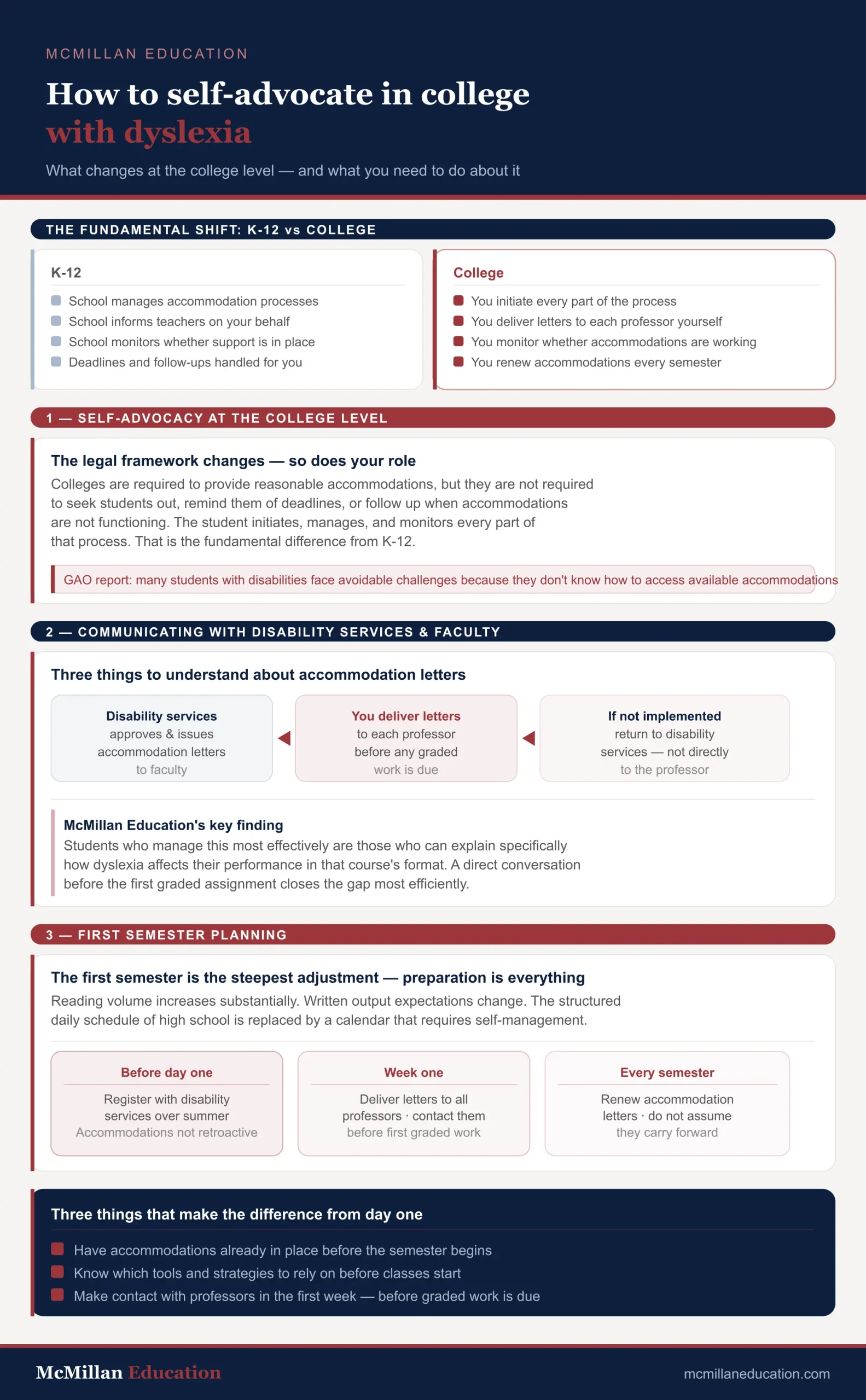
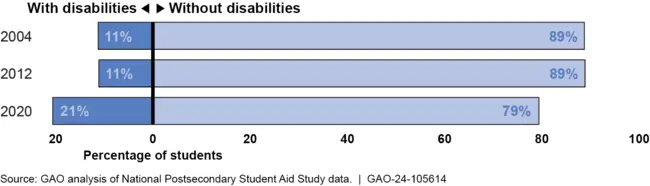
In K-12, the school manages accommodation processes, informs teachers, and monitors whether support is in place. In college, that responsibility transfers entirely to the student. A GAO report found that many college students with disabilities face avoidable challenges simply because they do not know how to access the accommodations available to them. What follows is written to close that gap.
Dyslexia and ADHD frequently co-occur, and the self-advocacy demands of managing both conditions in college are compounded. McMillan’s guide to ADHD and college addresses those additional planning considerations separately.
1. Self-Advocacy at the College Level
The legal framework guiding learning accommodations changes at the college level. Colleges are required to provide reasonable accommodations, but they are not required to seek students out, remind them of deadlines, or follow up when accommodations are not functioning. The student initiates, manages, and monitors every part of that process for the vast majority of traditional 4-year colleges. That is the fundamental difference from K-12, and it has practical consequences from the first week of the semester.
2. Communicating with Disability Services and Faculty
Disability services offices approve accommodations and issue formal letters to faculty. What they typically do not do is ensure those letters are acted upon. At most colleges, the student is responsible for delivering accommodation letters to each professor, ideally at the start of the semester and before any graded work is due.
Faculty responses vary, and when an approved accommodation is not being implemented, the appropriate first step is to return to disability services rather than attempt to resolve it directly with the professor.
In McMillan Education’s experience, the students who manage this most effectively are those who can explain specifically how dyslexia affects their performance in that course’s format. Because the gap between verbal aptitude and expressive output and performance is not always apparent to faculty, so a direct conversation before the first graded assignment most efficiently closes that potential misunderstanding.
3. First Semester Planning for Dyslexic Students
The first semester often presents the steepest academic adjustment. Reading volume increases substantially, written output expectations change, and the structured daily schedule of high school is replaced by a calendar that requires self-management. For dyslexic students whose preparation for this new challenge is last minute, these demands may arrive while the accommodation registration process is taking effect, which may not produce results that the student can recognize immediately, potentially triggering a less-than-ideal start.
Having accommodations already in place from day one, knowing which tools and strategies to rely on, and making contact with professors in the first week are what make the difference.
How to Register with College Disability Services for Dyslexia
Securing academic support for dyslexia in college starts with registering with the disability services office. The registration process typically follows these steps:
- Locate the disability services office through the college website and review their specific registration requirements
- Submit a registration request through their online portal or by direct contact
- Upload the required documentation, including the psychoeducational evaluation and supporting materials
- Confirm receipt with the office and ask for an estimated review timeline
- Schedule the intake appointment, where at some institutions specific accommodations are discussed and formally approved
- Once approved, collect accommodation letters and deliver them to each professor before graded work begins
The standard best practice is to register well before the semester begins. For incoming students, the summer before the first semester is the appropriate window. Approval takes time, and accommodations for dyslexia are not applied retroactively. Students who wait risk completing early graded work without any support in place.
1. Documentation Requirements for Dyslexia Accommodations
Documentation requirements for dyslexia accommodations vary by institution, so students should contact each college’s disability services office directly to confirm what is needed.
Most colleges require:
- A current psychoeducational evaluation
- A formal dyslexia diagnosis statement
- A history of accommodations previously received
- Documentation of how dyslexia affects academic functioning in practice
Currency requirements vary. Most institutions require evaluations completed within three years, while others apply different standards. Students who arrive with outdated documentation may face delays or be asked to update their psychoeducational evaluation before accommodations can be issued.
The evaluation must document the functional impact of dyslexia on academic performance, not the diagnosis alone. A diagnosis without documented functional impact may not meet a college’s eligibility threshold.
2. How to Follow Up After Submitting
Submitting documentation does not result in accommodations automatically. The review process takes time, and students are responsible for following up to confirm the status of their submission and ensure that accommodation letters are issued in advance of the first week of classes.
If documentation is deemed insufficient, the disability services office will typically specify what is missing. Students should treat that response as actionable rather than final. Once accommodation letters are issued, the next step is delivering them to faculty, which is where the accommodation process moves from administrative to practical.
Available Accommodations for Dyslexia in College
Colleges are required to provide reasonable accommodations for dyslexia, but what that means in practice varies considerably by institution. The range of what is available, and how each accommodation is administered, is not uniform. The standard range of accommodations colleges offer for dyslexia typically includes:
- Extended time on college exams, typically 50 percent additional time. Students whose psychoeducational evaluation documents more significant processing impact may qualify for 100 percent
- A separate testing room
- Reader access, either human or text-to-speech, for exam questions and course materials
- Speech-to-text software for written assignments and exams
- Note-taking assistance, through peer notes or recorded lectures
- Priority registration, which gives dyslexic students early access to course selection before general registration opens
Students should expect that not every institution provides all of these accommodations. The disability services office is the authoritative source for what is available at a specific college. Students need to be prepared to use their own acquired skills to compensate through alternative strategies where formal accommodations may be denied.
At most institutions, accommodation approvals do not carry forward automatically from one semester to the next. Students are responsible for requesting renewal and ensuring updated accommodation letters are issued and delivered to faculty at the start of each semester.
Academic Strategies and Tools for Dyslexic College Students
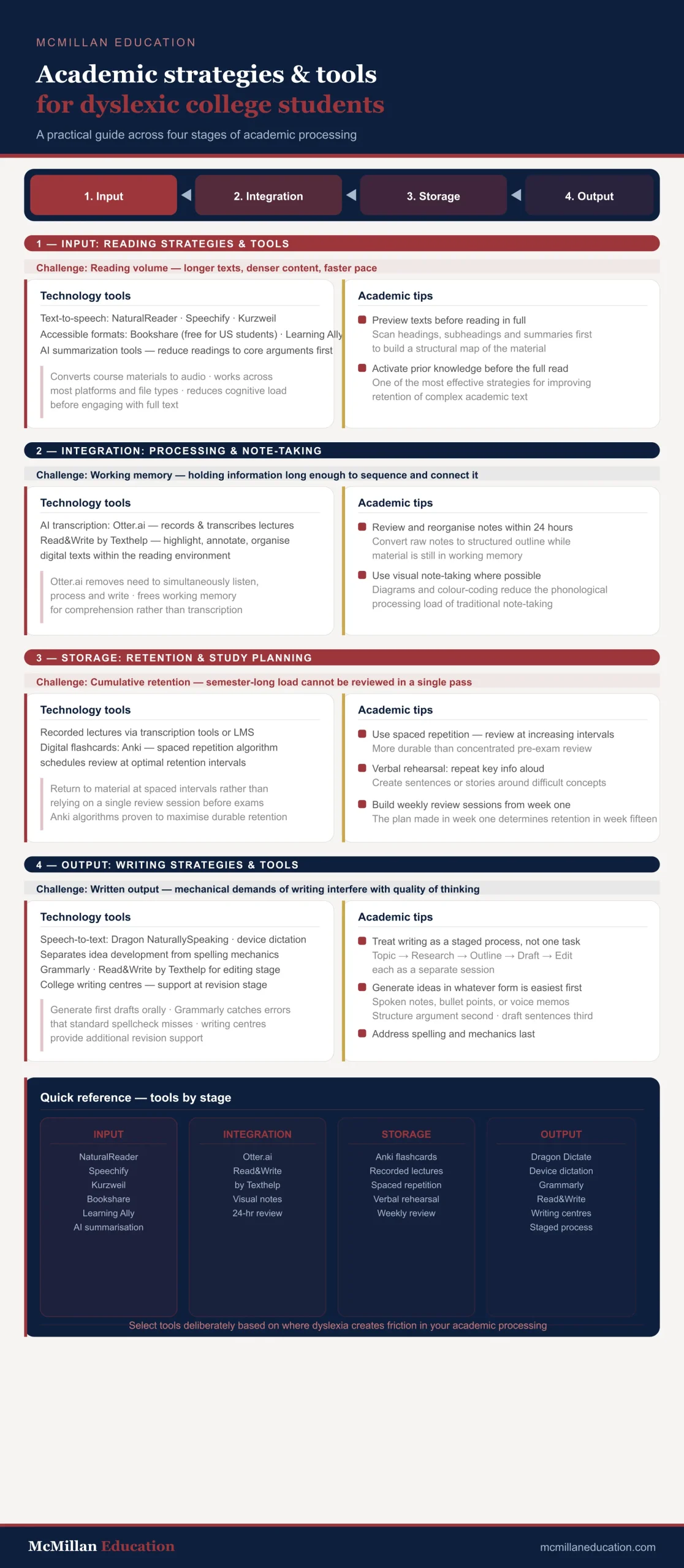
Dyslexia affects academic performance at four distinct points:
- how information is taken in (input)
- how it is processed and sequenced (integration)
- how it is retained (storage)
- how it is reproduced under output conditions (output)
The tools and strategies that work in college address one or more of those stages specifically. A student who has a clear picture of where dyslexia creates friction in their academic processing is in a position to select tools deliberately rather than accumulate them by default. The sections below offer practical strategies and tools for each stage.
1. Input: Reading Strategies and Tools
The primary input challenge for dyslexic students in college is reading volume. Assignments are longer, texts are denser, and the pace of a semester does not allow for the slow, deliberate decoding that may have been manageable before. Research on university students with dyslexia shows that the most successful readers build compensatory systems using their intact language abilities rather than attempting to read the way other students do.
1.1 Technology Tools
- Text-to-speech software converts course materials to audio, allowing students to process content through listening rather than decoding. Tools such as NaturalReader, Speechify, Kurzweil, and built-in device accessibility features serve this function across most platforms and file types.
- For courses that rely on physical texts, Bookshare, which is free for qualifying US students, and Learning Ally provide course materials in accessible audio and digital formats.
- AI summarization tools can reduce long readings to core arguments before a student engages with the full text, reducing the cognitive load of the initial encounter with dense material.
1.2 Academic Tips
- Preview texts before reading in full. Scanning headings, subheadings, and summaries first builds a structural map of the material.
- This activates prior knowledge before the full read, which research on reading comprehension identifies as one of the most effective strategies for improving retention of complex text.
2. Integration: Processing and Note-Taking
Integration is where reading and listening become organized thought. For dyslexic students, the challenge at this stage is working memory, holding information long enough to sequence, connect, and make sense of it. Note-taking is one of the two most consistently difficult academic tasks for dyslexic university students, precisely because it requires simultaneous listening, processing, and writing.
2.1 Technology Tools
- AI transcription tools such as Otter.ai record and transcribe lectures in real time, removing the need to simultaneously listen, process, and write. This frees working memory for comprehension rather than transcription.
- Read&Write by Texthelp supports integration by allowing students to highlight, annotate, and organize digital texts directly within the reading environment.
2.2 Academic Tips
- Review and reorganize notes within 24 hours of a class while the material is still in working memory. Converting raw notes into a structured outline immediately after a lecture consolidates integration before the storage stage requires it.
- Where possible, use visual note-taking. Drawing out concepts, using diagrams and color-coding rather than prose reduces the phonological processing load that makes traditional note-taking difficult for dyslexic students.
3. Storage: Retention and Study Planning
Retention is where the cumulative demands of a college semester become visible. Dyslexic students who manage input and integration effectively can still lose material if study planning does not account for how memory consolidates over time. A semester-long reading load cannot be reviewed in a single pass before exams.
3.1 Technology Tools
- Recorded lectures, accessible through transcription tools or institutional learning management systems, allow students to return to material at spaced intervals rather than relying on a single review session.
- Digital flashcard tools such as Anki use spaced repetition algorithms to schedule review at the intervals most likely to produce durable retention.
3.2 Academic Tips
- Spaced repetition is one of the most well-supported study approach for long-term retention. Reviewing material at increasing intervals rather than concentrating review immediately before an exam produces significantly more durable retention.
- Verbal rehearsal is particularly effective for dyslexic students: repeating key information aloud, creating sentences or stories around difficult concepts, and representing material through visual imagery all help maintain more in working memory for longer.
- Build weekly review sessions into the semester calendar from the first week, not the week before exams. The plan made in week one determines what is retained in week fifteen.
4. Output: Writing Strategies and Tools
Written output is where dyslexia creates the most visible and sustained academic pressure. Research on dyslexic university students identifies writing as one of the two most consistently difficult academic tasks, alongside note-taking. Papers, essays, and timed exams require accurate spelling, organized argument, and sustained production under deadline conditions. For dyslexic students, the mechanical demands of writing frequently interfere with the quality of thinking behind it.
4.1 Technology Tools
- Speech-to-text software separates idea development from the mechanics of spelling and transcription. Dragon NaturallySpeaking and built-in dictation features on most devices allow students to generate first drafts orally.
- Grammarly and Read&Write by Texthelp support the editing stage by catching errors that standard spellcheck misses and suggesting structural improvements.
- Writing centers at most colleges provide additional support at the revision stage.
4.2 Academic Tips
- Treat writing as a staged process rather than a single task. Break the work into specific micro-tasks: choosing a topic, researching, outlining, drafting, and editing, each as a separate session.
- Generate ideas first in whatever form is easiest: spoken notes, bullet points, a voice memo. Structure the argument in a second pass. Draft full sentences in a third. Address spelling, grammar, and mechanics last.
Choosing a Major and Planning a Career with Dyslexia
Dyslexia does not by itself determine which college major a student should pursue, nor does it limit which colleges for dyslexic students are worth considering. It does, however, make the academic demand profile of a major a more consequential planning decision than it is for most students.
College majors vary significantly in how much sustained reading and analytical writing they require. Humanities fields like history, philosophy, political science, and English place the highest demands on both, with assessment structured largely around long-form written argument.
Business, psychology, and communications sit in the middle range: writing is present but more structured, shorter in form, and balanced against quantitative or applied work.
STEM fields, architecture, computer science, and art and design tend to assess through quantitative problem-solving, lab work, project outputs, and visual production.
McMillan Education’s learning differences educational consultants have worked with dyslexic students through this evaluation for decades, placing them across a wide range of colleges and watching them build successful careers.
The relevant question is not which majors are best for dyslexic students in general. It is how a specific student’s remediation level and academic profile map onto the demands of the major they are considering. A student who has built effective reading and writing systems can succeed across a wide range of fields. A student still developing those systems should weigh those demands carefully before declaring.
Get a Clear Plan for Managing Dyslexia
Dyslexic students can succeed in college across every major and every institution type. What determines how well they perform is not the diagnosis itself but how clearly they understand what the environment requires and how effectively they build the systems to meet those demands. That clarity is achievable with the right planning.
McMillan Education’s learning differences educational consultants have worked with dyslexic students through every stage of that planning process for decades. The team includes developmental psychologists and learning specialists with direct experience as special educators, working across the full range of learning profiles and remediation levels.
Every student’s profile is different, and every plan starts with understanding that profile clearly. Schedule a free consultation to discuss where your student stands and what the path forward looks like.
Frequently Asked Questions
1. What accommodations are available for dyslexic college students?
The most common accommodations include extended time on exams, a separate testing room, reader access, speech-to-text software, note-taking assistance, and priority registration. Availability varies by institution.
2. What are the best majors for students with dyslexia?
Dyslexia does not determine which major a student should pursue. The relevant question is how a specific student’s remediation level and academic profile maps onto the reading and writing demands of the major they are considering. STEM fields, architecture, computer science, and art and design tend to place lower demands on sustained analytical writing than humanities fields. But a student with effective reading and writing systems can succeed across a wide range of fields.
3. What are the biggest academic challenges for dyslexic students in college?
Research consistently identifies note-taking and written output as the two most difficult academic tasks for dyslexic university students. Beyond those, reading volume, time management across a full course load, and the shift to self-managed accommodation processes present the steepest adjustments in the first semester.
4. What should dyslexic students do if their accommodations are not being followed?
The first step is to return to the disability services office, not to attempt to resolve it directly with the professor. Disability services offices are the appropriate point of escalation. Students should document the specific accommodation that is not being implemented and request that the office follow up with the faculty member directly. If the issue persists, most institutions have a formal grievance process through the disability services office or the dean of students.
5. Can dyslexic students succeed in competitive college programs?
Yes. Remediation level, not diagnosis, is the determining variable. Students whose dyslexia has been substantially addressed through structured intervention apply to and succeed in competitive programs on largely the same terms as any other student. McMillan Education’s educational consultants have placed dyslexic students across the full range of institutional selectivity, including highly competitive colleges and universities.
6. What is the best way to study with dyslexia?
The most effective approach addresses each stage of academic processing separately. For reading, text-to-speech and previewing strategies reduce cognitive load. For note-taking, transcription tools and visual methods reduce working memory demands. For retention, spaced repetition and verbal rehearsal produce more durable results than concentrated pre-exam review.
7. Can you get extra time for exams in college with dyslexia?
Yes. Extended time is the most commonly approved accommodation for dyslexic college students, typically 50% additional time. Students whose psychoeducational evaluation documents a more significant processing impact may qualify for 100%. Extended time is arranged through the disability services office and administered through the campus testing center at most institutions.