

For students with Attention Deficit Hyperactivity Disorder (ADHD), the transition to college is not simply a new chapter. It is a fundamentally different environment. High school quietly provides the structure that many students with ADHD rely on: fixed schedules, parental oversight, teachers who follow up. College removes all of it. The student is left to manage independently, often for the first time, in an environment that does not compensate for executive functioning deficits the way high school did.
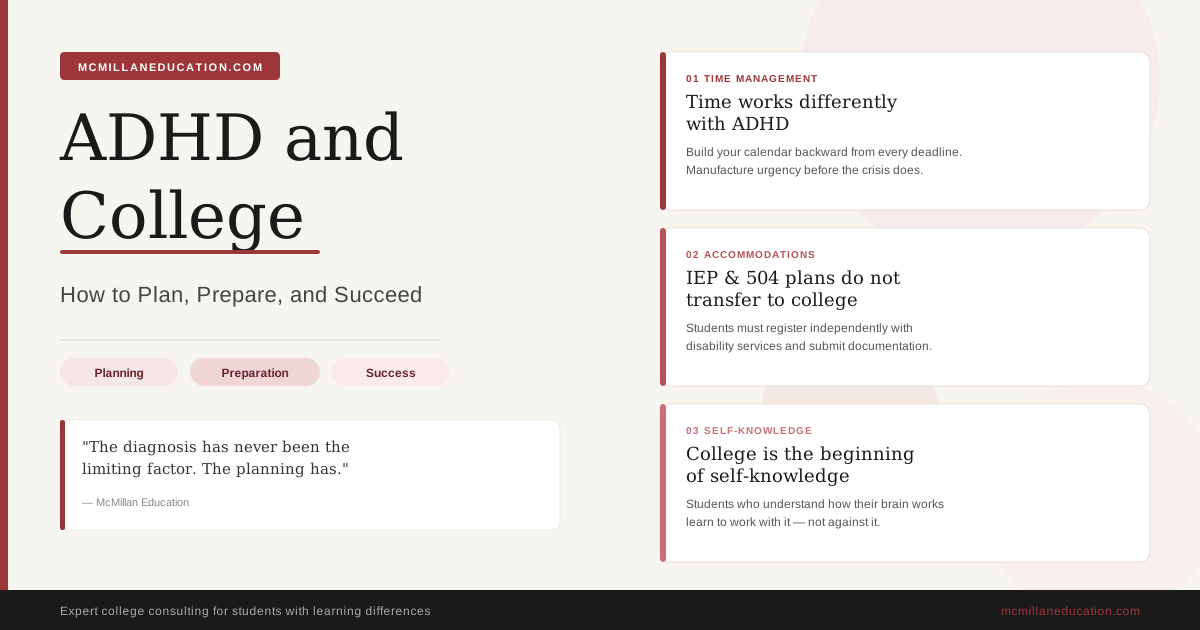
This is not a reason to avoid college. With the right preparation, the right college environment, and experienced guidance, students with ADHD succeed academically and go on to build careers they are proud of. The diagnosis has never been the limiting factor. The planning has.
This article addresses ADHD and college across the full arc of that preparation: how the condition affects students academically and in daily life, what families need to put in place before arrival, how the college accommodation system works in practice, and what strategies help students manage and succeed once enrolled.
Key Takeaways
- ADHD does not prevent college success. Preparation does.
- The scaffolding that high school provides compensates for the daily living and learning deficits of ADHD in ways most families do not notice until it disappears.
- Inattention is the primary driver of academic difficulty for college students with ADHD.
- Co-occurring anxiety, depression, and learning disabilities are common alongside ADHD and require their own planning consideration.
- IEP and 504 plans do not transfer to college.
- The students who succeed in college with ADHD are those who develop self-advocacy skills and consolidate daily living habits before they arrive.
- Many students with ADHD go on to excel academically and build strong, meaningful careers.
How ADHD Affects College Students
Attention Deficit Hyperactivity Disorder is a neurodevelopmental disorder that affects executive functioning – the brain’s capacity to plan, initiate, sustain attention, regulate impulses, and manage time. It is not a measure of intelligence. Students with ADHD are as capable as any other student of understanding course material and succeeding academically. What the condition affects is consistency, initiation, and self-regulation.
In college, where those capacities are tested daily and without external support, the difference becomes consequential. None of this is insurmountable. Students with ADHD succeed at every level of higher education, and the path to doing so is well understood.
Why the Transition from High School to College Is Uniquely Difficult
High school compensates for ADHD in children in ways that are easy to underestimate. Fixed schedules tell students where to be and when. Teachers follow up on missing work. Parents monitor homework, track deadlines, and intervene when things start to slip. Smaller class sizes mean students are seen. Frequent, low-stakes assessments provide regular feedback and natural checkpoints throughout the semester. None of this feels like compensation at the time. It simply feels like school.
College withdraws all of it at once. There is no one telling students to go to class. Assignments are due weeks from now. Lectures are large and impersonal. Professors do not follow up. Parents are not there. The student is responsible, for the first time, for initiating and managing the full architecture of their academic and daily life without any external prompting.
For students with ADHD, this is not an adjustment. It is an exposure. The executive functioning deficits that high school quietly managed around are now fully visible.
A four-year longitudinal study found that college students with ADHD received grades approximately half a grade level below their peers consistently across all four years, and faced higher dropout rates than students without the condition. The condition did not get worse. The environment stopped compensating for it.
How ADHD Affects Academic Performance, Organization, and Daily Life
ADHD is not a single, uniform condition. It presents differently from student to student, which is why the college experience varies so widely among those who have it. There are 3 recognized ADHD presentations:
- The inattentive type is marked by difficulty focusing, organizing, and completing tasks, often described as daydreaming or losing track.
- The hyperactive-impulsive type presents as restlessness, impulsivity, and difficulty staying still or waiting.
- The combined type, the most common, involves symptoms of both.
Among the three, inattention is the primary driver of academic difficulty in college. A large-scale study of 3,688 post-secondary students found that inattention symptoms were the strongest predictor of lower grades and higher dropout rates among college students with ADHD.
In practice, this looks like difficulty sustaining effort on long-term assignments, missed deadlines, poor retention from lectures, and a tendency to avoid coursework that demands extended, focused reading or writing. A student may understand the material clearly and still fail to produce the work consistently.
The effects extend beyond academics. ADHD disrupts the organizational demands of daily life: appointments, sleep schedules, administrative tasks, living spaces. In college, where none of this is managed for the student, these difficulties compound in ways that are easy to miss until they become a crisis.
Co-Occurring Conditions That Compound the Challenge
ADHD rarely presents alone. Three conditions co-occur with it most frequently:
- Anxiety disorders, present in approximately 47% of adults with ADHD
- Depression, commonly diagnosed alongside ADHD
- Learning disabilities such as dyslexia, which appear at significantly higher rates in students with ADHD than in the general population
This matters because co-occurring conditions change the picture. A student managing ADHD and anxiety in a structured high school environment may look quite different once that structure is gone. Anxiety can intensify when external scaffolding disappears, and it can become genuinely difficult to separate from the ADHD itself. Depression does not always announce itself early. It can surface gradually, as academic difficulty and social adjustment accumulate.
Families who understand the full challenges of the transition to college from high school are better positioned to assess what their student will actually need. McMillan has guided families through exactly this kind of complexity for decades.
Preparing for College with ADHD
Knowing what ADHD does in a college environment is useful. Knowing what to do about it before the student arrives is what actually makes a difference.
1. How ADHD Should Shape the College Search
Not every college that lists disability services on its website is genuinely equipped to support students with ADHD. The legal requirement to provide reasonable accommodations sets a floor. What matters is what exists above it. Before finalizing a college list, it is worth asking:
- Does the disability office offer regular coaching, or does it process documentation and issue letters to professors?
- Is there a psychiatrist on campus, or does the health center refer students with chronic conditions elsewhere after a handful of sessions?
- If care is off campus, how accessible is it?
For a student managing ADHD and college simultaneously, the answers to these questions can quietly determine how the first year unfolds. For students who also carry anxiety or depression into college, mental health infrastructure deserves the same attention as academic support.
2. How to Prepare Students with ADHD for College Independence
College places the full weight of self-advocacy on the student. Unlike high school, where institutions are required to identify and support students with learning challenges, college places that responsibility entirely on the student. The college does not seek the student out. The student must come forward.
For students with ADHD, this shift asks a great deal. It requires exactly the capacities that ADHD makes most difficult: initiation, follow-through, and self-regulation without external prompting. The students who handle this transition well are generally those who have had the chance to practice it.
The final years of high school are a natural opportunity to build that capacity, letting students manage their own appointments, communicate directly with teachers, and take ownership of the organizational tools that will carry them through college. The goal is not independence as an abstract ideal. It is arriving at college already knowing how to ask for what they need.
Families navigating college planning for a student with ADHD or any learning difference can connect with McMillan at any stage of the process. The team’s educational consultants hold advanced degrees in special education and developmental psychology, and bring decades of experience guiding students with learning differences through every stage of their education.
Academic Accommodations for College Students with ADHD
The accommodation system in college is one of the most consequential things families need to understand before enrollment, and one of the least well understood. Among families exploring colleges for students with learning disabilities, most arrive assuming that what worked in high school will carry forward. It seldom does.
1. Why IEP and 504 Plans Do Not Transfer to College
In high school, an IEP or 504 plan is a living document. It travels with the student, informs the teachers, and is managed largely by the school. The student may not even be fully aware of what it contains. In college, it becomes irrelevant the moment the student leaves high school.
This reflects a fundamental shift in the legal framework. K-12 education operates under IDEA, which places the obligation on the school to identify students with disabilities and provide support. College operates under the ADA and Section 504 of the Rehabilitation Act, which require institutions to provide reasonable accommodations to students who request them, but only to students who request them.
For families who have built years of support around an IEP or 504 plan, this shift can feel abrupt. The document itself has no standing in college. What matters is the evaluation and documentation behind it.
2. How to Set Up ADHD Support Through College Disability Services
Every college has a disability services office, though it may go by different names. Registering with that office is the step that makes accommodations possible. It does not happen automatically, and it does not happen quickly. Families should begin this process before the student arrives, ideally well before the first semester begins.
What the office will typically require is documentation of the ADHD diagnosis, usually a psychoeducational or neuropsychological evaluation. Documentation requirements vary by institution, but most colleges require an evaluation completed within the last three years, along with a description of how the condition affects the student’s academic functioning. An IEP or 504 plan from high school can support the application, but is generally not sufficient on its own.
Once documentation is reviewed and accommodations are approved, the student typically receives documentation to present to professors each semester. This is their responsibility. Outside of highly specialized colleges, this task falls to the student.
3. What Accommodations College Students with ADHD Can Request
The accommodations available to college students with ADHD vary by institution. The most commonly approved testing accommodations for ADHD and other learning differences include:
- Extended time on exams, typically time and a half, though students with more significant documented needs may qualify for more
- Reduced distraction testing environment, a separate room away from the noise and movement of a large exam hall
- Priority course registration, allowing students to build schedules that account for their needs before sections fill
- Flexibility around deadlines or attendance is available at some institutions, depending on documentation and circumstance
Accommodations adjust the conditions under which a student demonstrates their knowledge. They do not change academic standards, reduce the workload, or guarantee outcomes. What they do is remove barriers that would otherwise prevent the student from showing what they actually know. Colleges may or may not provide all of these accommodations. The types of accommodations available to individual students depend on their history of documentation as well as other regulatory and legal factors.
Navigating the accommodation system well requires knowing what to ask for, what documentation to bring, and how to evaluate whether a college’s disability services infrastructure will actually serve the student’s needs. These are not questions families should be answering for the first time after enrollment. McMillan Education has placed students with ADHD and other learning differences across a wide range of institutions, and families navigating this process are welcome to reach out. The right preparation makes a meaningful difference, and it starts early.
Strategies and Tips for Students with ADHD in College
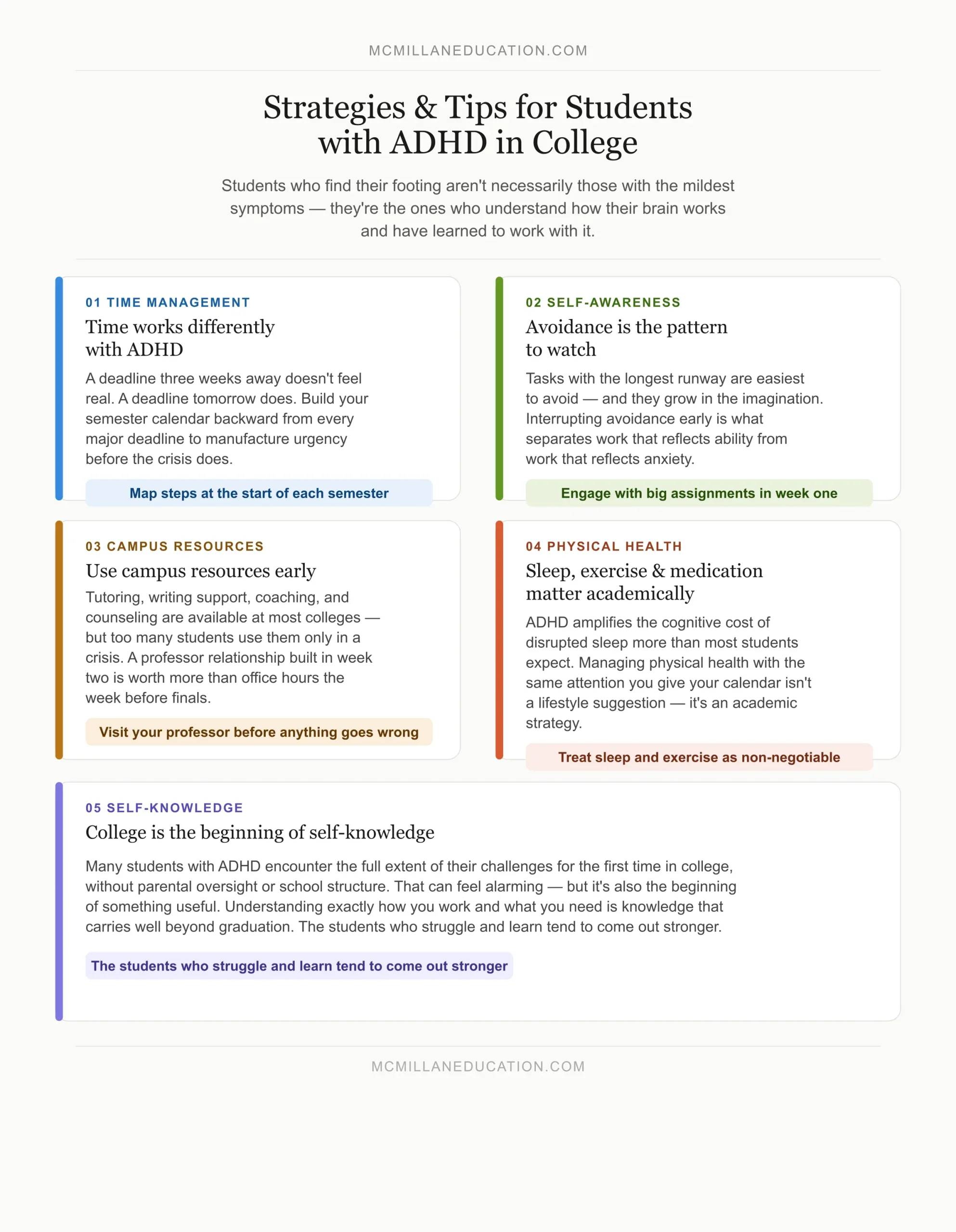
The students with ADHD who find their footing in college are not necessarily those with the mildest symptoms or the most accommodations. They are, more often, the ones who understand how their brain works and have learned to work with it rather than against it.
1. Time Works Differently with ADHD
In most circumstances, a deadline three weeks away does not feel real. A deadline tomorrow does. The students who manage this well have learned to manufacture urgency before the crisis creates it for them. A calendar built at the start of each semester, with intermediate steps scheduled backward from every major deadline, turns the abstract into the immediate. While not complicated on the surface, consistency more than any particular strategy is what tends to hold.
2. Avoidance Is the Pattern to Watch
Students with ADHD often avoid the things that feel overwhelming, and in college, the things that feel most overwhelming are frequently the ones with the longest runway. A paper due in four weeks is easier to avoid than a quiz due tomorrow. Left alone, that avoidance compounds. The assignment grows in the imagination into something far larger than it actually is, and by the time the student engages with it, the window for doing it well has closed. The students who interrupt this pattern early tend to produce work that reflects their actual ability. The ones who wait tend to produce work that reflects their anxiety.
3. Use Campus Resources Early
Most colleges offer tutoring, writing support, academic coaching, and counseling services. Many students with ADHD use them too late, if at all. The student who visits a professor during office hours in the second week of the semester, before anything has gone wrong, leaves with a relationship and a clearer sense of expectations. The student who appears for the first time the week before finals is asking for a different kind of help. The resources are the same. The timing changes everything.
4. Sleep, Exercise, and Medication Matter Academically
For students with ADHD, effective strategies are not lifestyle suggestions. The research on sleep and executive functioning is unambiguous, and ADHD amplifies the cognitive cost of disrupted sleep more than most students expect. A student who is managing ADHD in college successfully is almost always a student who is also managing their physical health with the same attention they give their calendar.
5. College Is Also the Beginning of Self-Knowledge
Students with ADHD often encounter the full extent of their attentional and executive challenges for the first time in college, without the buffer of parental oversight and high school structure. That can feel alarming. It can also be the beginning of something useful. The students who come out of college stronger are often those who learned, in the process, exactly how they work and what they need. That knowledge, hard-won as it sometimes is, tends to carry them well beyond graduation.
Next Steps for Families Navigating College Planning with ADHD
ADHD does not define what a student is capable of in college. What it defines is the kind of preparation that makes a difference. The families McMillan has worked with over the decades include students with ADHD who have gone on to graduate from competitive institutions, build successful careers, and thrive as independent adults.
The families who get there are not those who worry the most. They are those who ask the right questions early, put the right support in place, and understand that the college environment will ask something genuinely new of their student.
McMillan Education has a team of educational consultants specializing in learning differences, with decades of experience placing students with ADHD across college and university programs. If your family is in the process of making these decisions, a free consultation is a good place to start. The earlier the conversation begins, the more options remain open.
Frequently Asked Questions
1. Can a student with ADHD succeed at a competitive college?
Yes. Many students with ADHD attend and graduate from highly selective institutions. What determines their success is rarely the severity of the diagnosis. It is the quality of preparation before arrival, the student’s capacity to self-advocate and consolidate daily living habits, and whether the right support systems are in place from the start.
2. Do IEP and 504 plans transfer to college?
No. Neither document transfers automatically. Both are products of the K-12 system, which operates under IDEA. College operates under the ADA, and the responsibility shifts entirely to the student. To receive accommodations in college, students must register independently with the disability services office and submit current documentation of their diagnosis.
3. What accommodations can college students with ADHD request?
The most commonly approved accommodations include extended time on exams, a reduced distraction testing environment, and priority course registration. Some institutions also offer flexibility around deadlines or attendance. Approval depends on documentation and varies by institution.
4. How does ADHD affect college GPA and graduation rates?
Research consistently shows that college students with ADHD receive lower grades and face higher dropout rates than their peers. A four-year longitudinal study found that students with ADHD earned grades approximately half a grade level below their peers across all four years. Inattention symptoms are the primary driver of these outcomes.
5. What should families ask colleges about ADHD support during campus visits?
The most useful questions go beyond whether accommodations exist. Families should ask whether the disability office offers regular coaching or only processes documentation, whether there is a psychiatrist on campus or whether students are referred off campus for mental health care, and how accessible off-campus care is if needed. The answers reveal the difference between a college that meets the legal minimum and one that genuinely supports students with ADHD.
6. Can ADHD be diagnosed for the first time in college?
Yes. Some students, particularly those with inattentive-type ADHD, are not diagnosed until college. The removal of high school structure often makes symptoms more visible for the first time. A formal diagnosis from a qualified clinician is required before a student can access accommodations through the college disability services office.
7. What is the difference between ADHD accommodations and an ADHD support program?
Accommodations are adjustments to the conditions under which a student demonstrates their knowledge, such as extended time, separate testing rooms, provided at no cost through disability services. Support programs, offered at some colleges on a fee basis, go further: regular coaching sessions, executive function development, and structured academic support. The right fit depends on how much independent structure the student can maintain on their own.