
This past year our team has had the honor of guiding through the increasingly complex college process nearly 200 seniors, representing 25 countries and 22 states. We anticipate these vastly diverse students will choose as wide a range of best fit universities as the previous class: in 2024 our students matriculated to 99 different colleges across the entire US, with some choosing universities in Canada, England, Scotland, Ireland, Italy, Switzerland and Spain. Meeting that full set of needs and priorities keeps us broadly focused on the bigger picture of college admissions and higher education.
2024 was a year that tested many US colleges and universities in terms of enrollment numbers and financial health, and yet the best-resourced colleges and universities continued to become more competitive. The year saw campuses roiled by ongoing protests over the war in Gaza, and multiple Ivy League presidents resigning over discord regarding how those protests were handled. In what was billed as The Year of AI, we worked intently to help students make the most ethical and appropriate use of the tools, while holding our breath waiting to see just how quickly the technology might change admissions as we know it. As disruptive as the last year has been in the admissions world, however, we have continued to find clear purpose in our intentional, student-centered approach, undeterred in our efforts to center authentic growth and fulfilment as we meet each student where they are and guide them thoughtfully through what often feels like a storm. Entering our 70th year of guiding students – founded in Boston’s Back Bay in 1955, we are the country’s original educational consultancy – our focus on their health and on growing their confidence, not just on “the game” of admissions or where they get in, remains our “North Star.”
We begin each year with an examination of some of the prevailing trends in higher ed and admissions from the previous year, and predictions on what’s ahead. We hope these insights are helpful as you keep your own healthy journey centered in 2025!

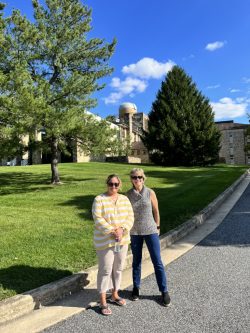
Bill, Kim, and Amy visiting United States Naval Academy
2024 College Admissions Trends of Note
- The “Demographic Cliff” – and the Haves and Have-nots. The admissions world has had their sites set on the next four years as a period when numbers of college-going students would decrease significantly due to low birth rates after the 2008 recession, and that trend is about to begin. The National Association of College Admissions Counseling estimates there will be some 400,000 fewer American high school graduates in 2029 than there were last year. Initially, it is primarily less selective colleges that are likely to enroll fewer students, with some less selective smaller liberal arts college closing their doors as they are already facing a variety of economic pressures. While there’s little doubt that this decrease in applicants will eventually reach even very selective colleges to some degree, for the time being, the most selective colleges and universities are likely to remain highly competitive, creating confusion for those expecting the broader downturn to make these sought-after seats feel more accessible. For now, the gap between the “haves” and “have nots” in admissions continues to widen.
- While there was a great deal of attention paid to highly selective colleges like Dartmouth, Yale, MIT and Harvard reinstating SAT and ACT requirements, the vast majority of test optional colleges remained test optional for 2024-2025, including Columbia, Penn, Princeton, Duke, Michigan, and a wide range of others. There are a number of strategic reasons for welcoming broader applicant pools by waiving testing requirements, and in times of decreasing available applicants, many schools will continue to waive the requirements. Advising students on testing in this climate continues to be a highly individualized process, but any projections that testing would be required by most colleges right away because a few high profile schools had returned to their requirements were premature. It remains a complex landscape.
- AI is impacting admissions and college counseling, but no one would call it a takeover. Yet. At professional conferences this past year, we took great care to speak directly with admissions officers, and to participate in AI-related sessions, focusing on evolving practices both in admissions offices and in our work with students. On the college side, admissions officers are currently using AI for everything from answering phone and chat questions about their schools to sorting transcripts and calculating GPA’s, and the technology’s rapid growth has the industry’s attention. On the student side, AI has some really healthy uses, from assisting with brainstorming essay structure to conducting more specifically focused college research. Being watchful of the rapid advances of AI into all facets of this process is a requirement of the job, and every student’s process is touched by the technology. Educating students about the most effective and ethical uses of the tools available to them is paramount in our work. That said, some of the more extreme predictions of wholescale, immediate AI takeovers of broader admissions practices and decision making were premature, for now.
- After the 2023 Supreme Court decision banning the use of race as a criterion in admissions, college and university responses covered the full spectrum in 2024. Some colleges and universities reacted to the decision with large scale changes to their admissions processes, even eliminating scholarships targeting students of specific races in the past year. Other colleges and universities doubled down on their efforts to enroll the most diverse class possible, dedicating increased resources to active recruitment of underrepresented students in a broader range of high schools and zip codes. As one admissions dean shared in a conversation last year, “what people outside the admissions world often fail to understand is that no admissions decision is ever based solely on race. A ruling banning race-based admissions is outlawing something that doesn’t exist. It’s always a broader range of factors that contribute to a decision to admit an underrepresented student, or any student.” The fallout from the decision, and the subsequent sometimes virulent debate in the public square about this issue continues to impact admissions practices in a wide variety of ways. With public perception often centered on the scarcity of seats in classes of the most selective institutions, and with flames fanned by cries of unfairness and misguided definitions of “merit,” trust in higher education as an instrument of the public good continues to be eroded by this debate.
2025 Predictions – Disruption remains the norm, but creativity and staying focused on kids’ health provides opportunities for progress
- Artificial Intelligence will indeed grow in its impact. AI’s impact on admissions continues to grow at a pace matching its broader reach into academic and administrative facets of the institutional life of colleges. As Missouri State University President Emeritus Michael T. Nietzel writes in Forbes, as AI becomes more a part of university infrastructure, “Expect increased use of AI in admissions and financial aid decisions.” In their excellent “The Truth About College Admissions” podcast, Georgia Tech’s Rick Clark and the Khan Lab School’s Brennan Barnard note that AI is likely to be incredibly helpful in unifying currently byzantine structures for student self-reporting of grades. AI will continue to sort transcript data, and will be used in deeper ways for research about colleges AND by colleges. As noted by University of Oregon admissions counselor Sebastian Brown and Loyola Chicago’s Emily Pacheco in The National Association of College Admissions Counseling’s College Admissions Decoded Podcast, It will shape new recruiting strategies, and will sometimes be the first “person” students and families see or hear when they reach out to a college or university. We will hear more and notice more in the coming year just how deeply AI is beginning to interject itself onto the front lines of admissions.
- Public discussion of the “demographic cliff” will be confusing in the face of ongoing hyperselectivity at the most competitive schools. It would stand to reason that if colleges and universities as a whole are going to see declining numbers in the years ahead, that the most selective schools will be less selective. But that shift is likely to take a while, and a 6% admit rate will not feel much different than a 4% admit rate at schools turning away the most students. Intense public attention focused on colleges that reject the highest number of students, along with those schools’ ongoing efforts to capitalize on all that attention, is likely to delay any noticeable downturn in interest, and students and families will be left trying to understand how 2025 can be “another most competitive year ever” at “elite colleges” while many headlines focus on overall declining enrollment trends.
- Mixed messages and ongoing pressure related to college admissions and the value of college will continue to negatively impact students’ mental health. As Clark and Barnard note in their year-end podcast, “The kids are not all right.” Ongoing emphasis on competitiveness, and a persistent feeling that whatever they do, it might not be “enough” is already contributing negatively to student mental health. Add a broad cultural shift toward eroding trust in higher ed, and it’s never been more important to help kids see that this process is meant to be about and for them, that college is meant to be a place to grow, to learn, to make mistakes, to build lifelong friendships, to continue to build and find who they are and who they want to be. Families, educators, and counselors will have to work hard to help their kids keep seeing the light in what is meant to be a wonderful moment in their lives.
- With test optional policies in place at many schools, and with a perception of increased grade inflation, more students and parents will put pressure on extracurricular and summer choices as a means of differentiating themselves, or “standing out.” The ability to guide students to remain focused on their own authentic path to growth and fulfillment, to be aware of the competitiveness of the landscape while not losing sight of the broader mission they’re on to become a fulfilled, curious, and authentic young adult, will be central to our work, and to the work of every supportive parent and educator.
- More colleges and universities will do away with legacy preferences. A perhaps-unintended consequence of discussions about fairness and merit in admissions after the SCOTUS decision is a brighter spotlight on legacy admissions, and a number of states and a growing number of individual institutions have committed to ending the practice. Ongoing discussions about equity and increased public scrutiny on admissions practices will lead to more colleges and universities ending the practice in 2025.
- While some more colleges and universities may reinstate standardized testing requirements, many will remain test optional. While some more highly selective universities and colleges will decide that testing requirements were useful in building the best class for their school, and will reinstate them, it is likely that many more will remain test optional in order to maintain higher application numbers and to appear more competitive by having higher application numbers and higher average scores.
- Colleges and universities will innovate to maximize enrollment and maintain public interest. As Clark and Barnard note, be prepared to see some colleges considering three-year degrees, more dual enrollment agreements and options, more colleges expanding to other campuses and offering different start terms. Expect also to see continued growth in online graduate degree programs to attract more revenue. Colleges will be more flexible, and will push the boundaries of traditional college experiences. In a climate where an incoming administration openly considers eliminating the Department of Education, and where public perception of their value is under attack, expect colleges to be nimble and creative to maintain revenue and station.
- On that note, we predict that the Department of Education will not be cut altogether, but that it will be greatly reduced in size and scope, and there will be increased political pressure to put more education policy in the hands of the states. Students with complex learning profiles will likely be the most affected by these changes, as federal protections for students with disabilities have a great deal of influence on the resources impacting this group’s educational journeys.
 .
.  .
. 
So, what are we doing at McMillan Education to meet the disruptive times and leverage our years of collective wisdom about admissions, and especially about kids? True to our now-70 year mission, we are refining our best practices to directly address the most poignant issues affecting student wellbeing.
- We are helping students center their enduring qualities and authentic interests and growth in our work with younger students. We guide 9th and 10th grade students through our Early College Program to intentionally develop their academic and intellectual gifts, their self-knowledge, and the values, passions and interests that will, ultimately, inform the candidate they present to admission committees and the person they present to the world. When students are at their best and making the most of every opportunity to learn about themselves, others, and the world around them in meaningful and authentic ways, they naturally create their brightest possible future choices and their healthiest journey.
- We continue to start our research earlier with our sophomores and juniors with our W.I.S.E. Method to keep them a step ahead and ensure they are looking at the substantive differentiators among and between college choices beyond superficial brand recognition, challenging them in a supportive manner to know themselves and to understand what specifically various colleges offer to excite them and to fulfill their potential growth.
- We are refining and deepening our best practices. Our college team is spending the opening months of 2025 in regular collaborative sessions updating and codifying best practices for our industry-leading Owl’s Nest platform, and updating the map of our curriculum for all grade levels, with a singular focus on supporting authentic student development and growth in disruptive times. The best outcomes flow from confident kids on authentically fulfilling paths. With kids feeling so much pressure to differentiate themselves, as noted above, this process will help us ensure we are meeting the needs of the times, while also meeting the very human needs of our kids, rather than merely adding resume building resources.
- We are approaching AI from a number of different angles. We continue to develop best practices for our consultants to utilize the tools available for effective research, and for working with students on essay idea generation while carefully helping students to write essays that only they could write. AI knows everything there is to know about everything on the internet, but it does not know the students like they know themselves, and like we come to know them. We are very much still centering student voice in our writing work, but are also taking advantage of AI to strategize on both personal essays and college-specific supplemental essays. We are incorporating AI effectively into our summer and extracurricular enrichment tools. We are also regularly engaging with our admissions colleagues to stay up to date on the ways in which colleges and universities are engaging with AI technology, and are attending a variety of educational and professional development sessions on the topic through conferences and other programs. We are determined to continue to be early adapters and adopters, and to keep our students thoughtfully informed and engaged with AI in the most intentional and ethical ways. As Mary O’Brien, Dean of Graduate Studies and Vice Provost of Simon Fraser University in Burnaby, British Columbia noted at a conference earlier this year, “Of course a computer can get you information much faster. But it’s about conveying that knowledge in a way that can be transmitted meaningfully, understood and appreciated. That’s where we as humans definitely (still) win out in all this.”
As we turn 70 this year, we have focused both on staying true to the authentic, student-centered wisdom that has long been the hallmark of our practice, and also on industry-leading innovation in service of that goal.. It’s a joyful mission, even in disruptive times. We look forward to meeting both the challenges and the opportunities of 2025 with a steadfast focus on the health and growth of our students, and with gratitude for the trust placed in us to care for them!