
Community service is any unpaid work a student undertakes for the benefit of others or the broader community, whether through an established organization, a school program, a self-initiated project, or a sustained individual commitment. Many high schools in the United States require students to complete between 20 and 60 service hours to graduate, which is often what sets the search for ideas in motion.
For high school students, community service also appears on the activities section of every college application, and it is one of the areas admissions officers examine most closely when building a picture of who the applicant actually is outside the classroom.
In this article, we walk through community service project ideas organized by students’ interest, because the most useful starting point is not a generic list but a question: what does this student actually want to study, and where does meaningful community service connect to that direction? Along the way, we cover what admissions officers are genuinely reading for when they evaluate a service record, and what students should know before committing to any program.
What to Know Before Choosing a Community Service Program
The ideas above are starting points. Choosing well among them, and evaluating any program or opportunity a student encounters outside this list, is where planning for college in high school becomes practical: it comes down to applying a consistent set of questions before committing.
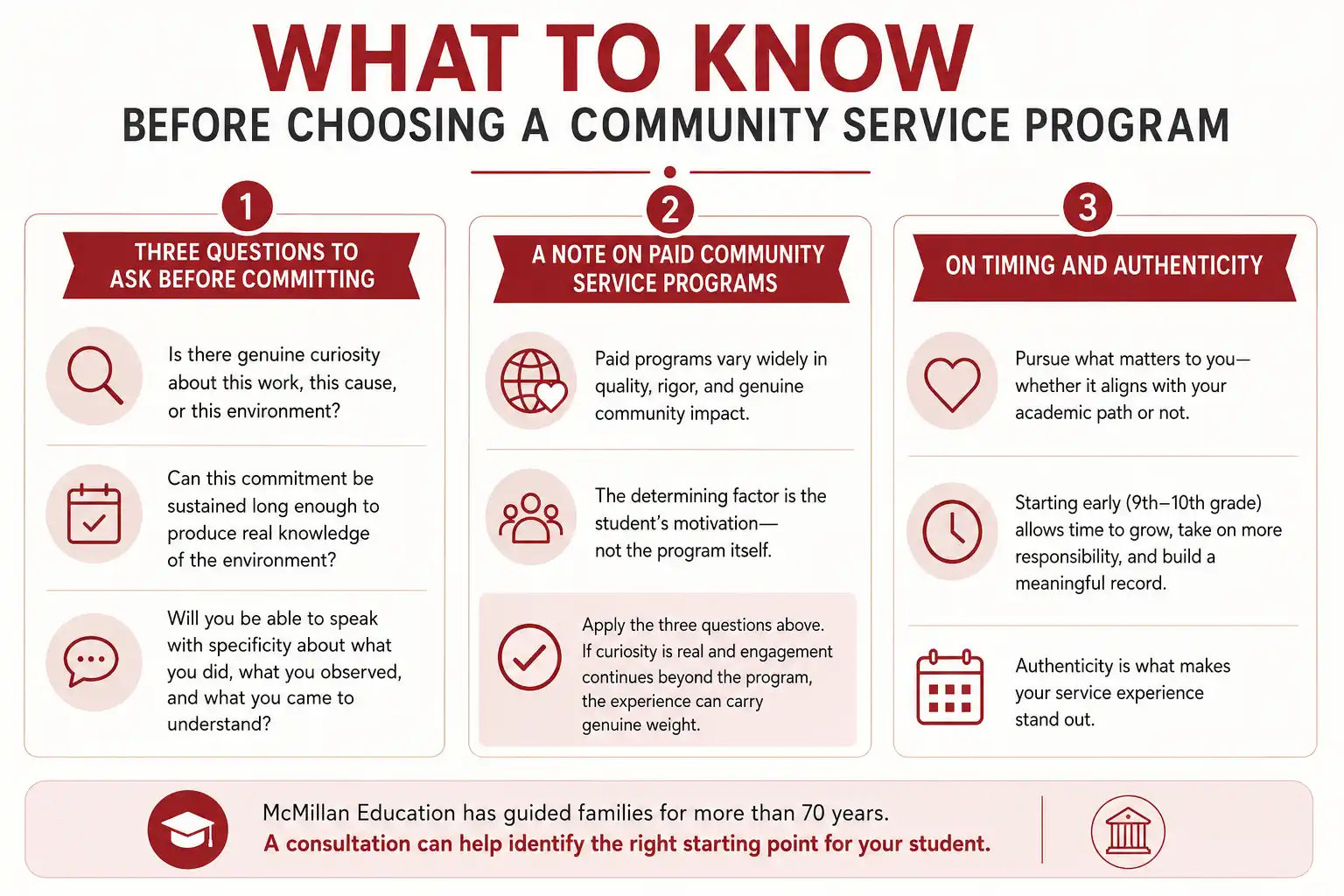
1. Three Questions to Ask Before Committing
Before a student commits to any community service program, volunteer placement, or service project, three questions are worth sitting with honestly.
- First: is there genuine curiosity about this work, this cause, or this environment, or is this the most convenient way to complete a requirement?
- Second: can this commitment be sustained long enough to produce real knowledge of the environment, or is it a bounded experience with a built-in endpoint?
- Third: will the student be able to speak with specificity about what they did, what they observed, and what they came to understand?
If the answer to all three is yes, the opportunity is worth pursuing regardless of the organization’s name or prestige. If the honest answer to the first question is no, the hours logged are unlikely to produce anything an admissions officer will read as genuine, whether on the activities list or in the supplemental essay.
2. A Note on Paid Community Service Programs
Paid community service programs, particularly international voluntourism and structured service travel experiences, are increasingly common and heavily marketed to high school families. These programs vary widely in quality, rigor, and genuine community impact. The determining factor is not the program itself but the student’s motivation for enrolling. A student who enters a paid program with genuine curiosity about the cause and who remains engaged beyond the bounded experience is in a fundamentally different position than a student who enrolled because the program appeared to offer a credible extracurricular activities list entry.
The standard worth applying is the same three questions above. If the primary motivation is the credential, the investment is unlikely to produce the return families expect. If the curiosity is real and the engagement extends beyond the program dates, the experience can carry genuine weight.
3. On Timing and Authenticity
Academic direction organizes most of the high school community service ideas in this article, but it is not the only principle that produces a record worth reading. A sophomore with her sights on business who organizes a beach cleanup because the environment matters to her, or a pre-med student who spends a summer in a cultural exchange program out of genuine curiosity about how other communities live, both are building something an admissions committee can recognize. What holds up under scrutiny is the authenticity behind the choice.
That authenticity, however, takes time to develop. A student who begins in ninth or tenth grade has room to grow within a placement, take on more responsibility, and produce a record that reflects sustained engagement.
McMillan Education has guided families through these decisions for more than 70 years, and a consultation can help identify the right starting point for your student.
Community Service Project Ideas for High School Students
The community service ideas, service project ideas, and professional experiences for high school students below are organized by academic direction, because the connection between a student’s service record and their intended academic path is what admissions officers are often reading for. Hours logged across unrelated organizations tell an admissions committee very little. Six months inside one institution, in a role that grew, tells them something specific.
Over decades of working with families through the college planning process, what we have seen move the needle is not the number of hours a student logs or the name of the program on their activities list. It is whether the student can speak with genuine authority about the work they did, what they observed, and how that experience connects to where they are headed academically. That thread, when it exists, is visible to admissions officers. When it does not exist, that is equally visible.
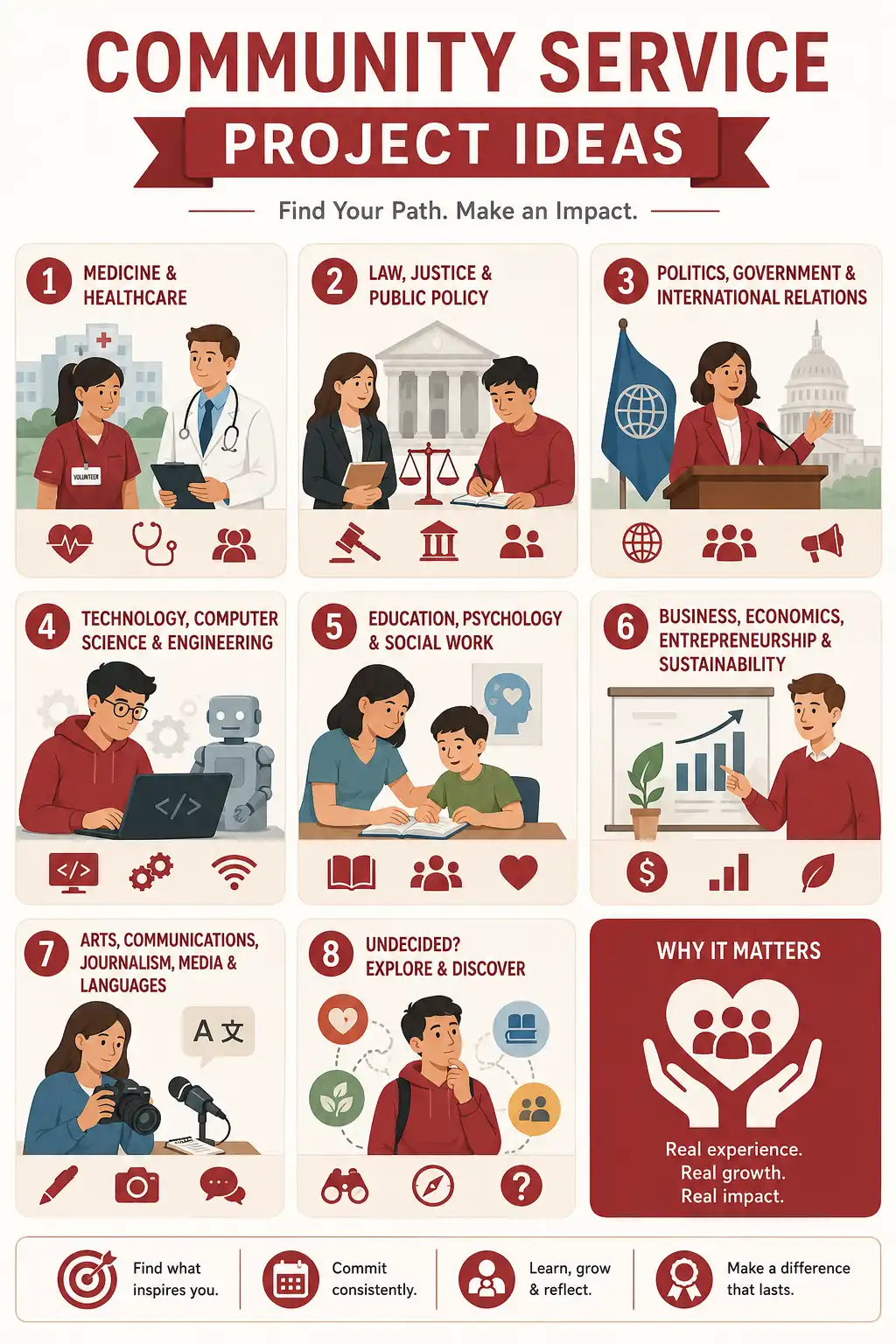
1. Interested in Medicine, Healthcare, or Biological Sciences
For students whose academic direction points toward medicine, nursing, public health, or a pre-med pathway, community service ideas that place them inside clinical institutions carry real admissions weight. Sustained presence in one environment, with a defined and growing role within it, is what produces the kind of specific, grounded knowledge that registers in a college application.
Across decades of college planning work, the community service experiences that have held up in this category share one common feature. Students came away with real observational knowledge of that environment: how decisions get made, how a care team functions, what the work actually looks like from the inside. The service ideas below are worth considering with that standard in mind.
1.1 Volunteer at a Hospital or Clinical Department
Placements that assign students to a single unit or department consistently, over an extended period, produce the institutional knowledge that registers in a college application.
1.2 Apply to a Structured Health Sciences Program
Application-required hospital programs combine a departmental placement with clinical panels and professional exposure across career stages. The selectivity of the process establishes a documented, verifiable record of placement.
1.3 Volunteer at a Veterans Medical Center
VA hospitals place student volunteers as part of the treatment team, providing direct clinical exposure across health disciplines and a patient population with a distinct care context.
1.4 Shadow a Healthcare Professional
Sustained shadowing with a physician or specialist over a semester gives students direct observational access to the actual work of the profession. This may not count toward community service hours but is one of the most valuable professional experiences a student on this track can pursue.
1.5 Support Public Health Outreach
Local health departments and community health centers run outreach programs in disease prevention, nutrition education, and health literacy, each connecting directly to population health and public policy coursework at the college level.
2. Interested in Law, Criminal Justice, or Public Policy
For students considering a law degree pathway, criminal justice, or public policy, the most substantive community service ideas and professional experiences are those that place them directly inside legal, civic, and governmental institutions. The ideas below are a starting point worth pursuing early.
2.1 Volunteer with a Legal Aid Organization
Legal aid offices serve low-income clients across housing, immigration, and family law; high school volunteers support intake, research, and outreach, gaining direct exposure to how civil legal services operate at the community level.
2.2 Support a Criminal Justice Reform Organization
Nonprofits focused on reentry, rehabilitation, and criminal justice reform offer sustained volunteer roles that connect directly to the policy questions students in this track will encounter academically.
2.3 Intern with a Local Government or Elected Official’s Office
City council offices, constituent services departments, and state representative offices regularly place high school students in substantive roles, providing direct access to how policy moves from proposal to implementation.
2.4 Volunteer with a Youth Court or Teen Court Program
Many jurisdictions operate youth court programs where trained high school students serve as jurors, advocates, and clerks in real cases involving teen offenders. These are structured, documented volunteer roles with direct legal system exposure.
2.5 Volunteer with a Community Mediation Center
Community mediation organizations handle disputes outside the court system and accept trained volunteers, including high school students, in observer and support roles that provide early exposure to conflict resolution and restorative justice principles.
3. Interested in Politics, Government, or International Relations
For students headed toward political science, government, or international relations, civic and advocacy work in high school does something specific: it tests whether an intellectual interest in how power operates holds up when the student is inside an institution dealing with the actual constraints of that work. The community service ideas below reflect the range of engagement worth pursuing in this direction.
3.1 Volunteer with an International Advocacy Organization
Human rights organizations, international development nonprofits, and global advocacy groups operate local chapters that accept high school volunteers in research, outreach, and communications roles.
3.2 Work with a Nonpartisan Civic Engagement Organization
Organizations focused on voter registration, civic education, and democratic participation offer structured volunteer roles with a direct connection to governance questions students will encounter academically.
3.3 Found or Lead a Political Advocacy Group
A student who builds a school-level political advocacy organization, grows its membership, and connects it to a local or state-level issue demonstrates initiative, organizational ability, and sustained commitment to civic engagement.
3.4 Support a Refugee or Immigrant Services Organization
Local resettlement agencies and immigrant services organizations accept high school volunteers in tutoring, translation, and community orientation roles, providing direct cross-cultural engagement grounded in sustained, practical work.
4. Interested in Technology, Computer Science, or Engineering
For students headed toward computer science, technology, or engineering degrees, community service project ideas in this track carry a distinctive advantage: the work produces documented, verifiable outcomes. A curriculum delivered, a community program supported, a skill transferred to someone who needed it. These are outcomes an admissions officer can evaluate in concrete terms. With AI tools now accessible to high school students, the barrier to building something functional for a community organization has dropped significantly, which makes this category more accessible than it has ever been.
4.1 Teach Coding or Digital Literacy
Local libraries, community centers, and after-school programs run digital literacy initiatives that need instructors. Students who develop and deliver a curriculum over an extended period build both teaching experience and a record of sustained community engagement.
4.2 Volunteer with an Accessibility Technology Organization
Organizations that connect volunteers with people who have visual, hearing, or other disabilities through technology platforms offer structured remote roles suited to students with genuine interest in human-centered design.
4.3 Volunteer with a STEM-Focused Youth Organization
Robotics leagues, Science Olympiad programs, and coding clubs in community centers actively place high school students in mentoring and coaching roles, providing direct experience working alongside younger students in technical environments.
4.4 Volunteer Through Gaming Programs
Organizations focused on gaming accessibility and community, as well as library and community center gaming programs, accept high school volunteers in coaching, event coordination, and mentorship roles. Students who bring gaming skills into a structured service context accumulate documented hours while working in an area of genuine expertise.
4.5 Participate in a Social Impact Hackathon
High school hackathons focused on civic and social challenges give students with technical skills a structured environment to apply them to real community problems, with outcomes that are documented and verifiable.
5. Interested in Education, Psychology, or Social Work
For students headed toward education, psychology, or social work, the most substantive community service and project ideas in this track are built around direct, sustained work with people, and the quality of the individual relationships and depth of understanding that develop through them over time. The ideas below reflect the range of that engagement.
5.1 Tutor or Mentor Younger Students
Schools, libraries, and after-school programs across the country place high school students in tutoring and mentoring roles with younger children, providing direct experience in educational support and youth development.
5.2 Support a School or Community Mental Health Awareness Initiative
Schools and community organizations run mental health awareness programs that need student volunteers for outreach, event coordination, and peer support roles, directly relevant for students interested in psychology.
5.3 Support Disability and Learning Differences Programs
Organizations focused on social inclusion for people with intellectual and developmental disabilities, as well as programs serving students with dyslexia, ADHD, and other learning differences, offer virtual and in-person volunteer roles that connect directly to psychology, special education, and social work coursework.
5.4 Work with a Youth Development Organization
Sports-based and community-based youth development programs place high school students in coaching, coordination, and leadership roles within structured youth programming.
5.5 Volunteer at a Community Center or After-School Program
Community centers running programming for children, elderly residents, or underserved populations offer some of the most consistently accessible volunteer placements for high school students across the country.
6. Interested in Business, Economics, Entrepreneurship, or Sustainability
For students whose academic direction points toward business, economics, entrepreneurship, or sustainability, the most credible records in this category are built around service projects and initiatives with documented outcomes. A defined scope, a measurable result, and a community that benefited from the work – those are the elements that make this track legible on an application.
6.1 Deliver Financial Literacy Workshops
Junior Achievement and similar organizations place high school students as classroom volunteers delivering structured economics and personal finance curricula to elementary and middle school students, combining community service with direct subject-matter engagement.
6.2 Support a Nonprofit’s Communications or Fundraising
Small nonprofits consistently need support in donor outreach, social media, and fundraising logistics. A student who takes on a defined role in one organization’s communications or development function builds genuine operational experience alongside documented service hours.
6.3 Launch a Community-Facing Initiative with a Documented Outcome
These are among the strongest community involvement examples a student can build: identify a community need, design a response around it, and execute it with a clear goal, for example a food drive with a documented tonnage or a fundraising campaign with a defined beneficiary.
7. Interested in Arts, Communications, Journalism, Media, and Languages
For students headed toward arts, communications, journalism, media, or languages, community service projects in this track generate artifacts: a published article, a documentary, a translated document, a photography series – these are outputs an admissions committee can evaluate directly, and they sit alongside the college application. The community service ideas and projects below reflect that possibility.
7.1 Report and Write for a Community Publication
Local newspapers, neighborhood newsletters, and nonprofit publications accept high school contributors in writing and editorial roles. A student who covers real stories for a real audience builds a bylined, verifiable record of journalistic work.
7.2 Produce Media for a Nonprofit or Community Organization
Photography, documentary film, podcast production, and social media content for community organizations give students with media skills a service context where the output is tangible, documented, and used.
7.3 Teach in a Community Arts Program
Community centers, libraries, and after-school programs run visual art, theater, and music programming that needs instructors. A student who delivers a sustained curriculum in one setting builds a teaching record alongside a creative one.
7.4 Volunteer as an ESL Tutor
Libraries and community organizations run English language programs for adult learners and immigrant communities, placing high school volunteers in tutoring roles that connect directly to linguistics and cross-cultural studies.
7.5 Translate for a Nonprofit or Humanitarian Organization
Organizations that connect bilingual volunteers with nonprofits in health, education, and humanitarian work offer structured remote roles for students with genuine language ability, producing a documented record of applied linguistic skill in a real service context.
8. Community Service Ideas for Undecided Students
For students who have not yet identified a clear academic direction, community service is one of the most practical tools available for genuine exploration. The goal at this stage is not to build a polished record but to find out what kind of environment a student actually wants to spend time inside. The ideas below are structured around that kind of honest discovery.
8.1 Volunteer with a Multi-Sector Placement Organization
Volunteer clearinghouses and community service networks operate in most major metro areas, placing volunteers across dozens of nonprofits in education, health, housing, and community development. A student who tries two or three different placements within one network builds a legitimate service record while testing where their interests actually land.
8.2 Shadow Professionals in Two or Three Different Fields
A summer of arranged shadowing experiences across different professional environments gives students direct observational access to what those careers actually involve, before committing to a longer service placement in any one direction. This does not count toward community service hours but serves as a practical exploration tool for students still identifying their direction.
8.3 Start with What You Already Do
A student who spends time gaming, cooking, building things, or playing sports has a starting point. Community centers, youth programs, and local organizations consistently need people who can bring a specific skill into a service context.
8.4 Try a Structured Service Program with Broad Exposure
Youth Volunteer Corps and similar programs run team-based service across multiple community sectors, giving students structured exposure to different environments within a single committed program.
Start Planning for College Early
Community service is one of the few areas of a college application where a student’s choices, sustained over time, tell admissions officers something that grades and test scores cannot. The earlier a student begins building a service record connected to their genuine academic interests, the stronger that record reads when the application is submitted. Waiting until junior or senior year narrows the options and compresses the timeline in ways that make depth difficult to achieve.
McMillan Education has worked with families on college planning for more than 70 years, guiding students through every stage of the process from early planning for college in high school through application submission. To discuss how community service fits into your student’s broader academic and admissions strategy, speak with an educational consultant.
Frequently Asked Questions
1. Do colleges require community service for admission?
No. No college sets a minimum community service hour requirement for admission. However, community service appears on the activities section of every college application and is one of the areas admissions officers use to evaluate who a student is outside the classroom.
2. How many community service hours do you need for college?
There is no universal number. What registers with admissions officers is sustained commitment to one or two areas over time, with a defined and growing role, not a specific hour count. A student with 80 focused hours in one organization over a year reads stronger than a student with 200 hours spread across a dozen placements.
3. What is the best community service for high school students?
The best community service is the one that connects to a student’s genuine academic interests and can be sustained long enough to produce real knowledge of the environment. The ideas in this article are organized by academic direction for that reason.
4. What defines community service for a college application?
Any unpaid work undertaken for the benefit of others or the broader community. This includes established organizations, school programs, self-initiated projects, and sustained individual commitments.
5. What skills can you learn from community service?
Community centers, libraries, and after-school programs offer some of the most consistently accessible placements for high school students. The more important question is whether the placement connects to something the student genuinely cares about, since easy hours without genuine engagement produce a weak application entry.
6. Can a 14 or 15-year-old volunteer for community service?
Yes. Most community organizations, libraries, hospitals, and youth programs accept volunteers starting at age 14 or 15, though some structured programs have specific age requirements. Starting early gives students time to build the kind of sustained, deep engagement that registers on a college application.
7. What are some community involvement examples for a college application?
Strong community involvement examples include sustained volunteering at a hospital or clinic, tutoring or mentoring younger students through a school or library program, leading a fundraising initiative with a documented outcome, or holding a defined role in a nonprofit’s operations over an extended period. The key element across all of these is sustained presence and a growing role within one organization.