


When we sit down with students at the beginning of the planning process, we do not start with rankings. We start with the student. One of the first questions we explore is what type of college is right for them. The answer depends less on prestige and more on how they learn, what motivates them, and where they are most likely to thrive.
This guide is designed to help you slow down and think clearly about what type of college is right for you. It offers a practical self-assessment so your decision is grounded in who you are and what you need, not outside pressure or assumptions.
Key Takeaways
- There is no single right college type. The right fit depends on how you learn, what your path requires, and what you can realistically afford.
- The college-type question comes before the college list. Understanding what kind of environment works for you is more important than knowing which schools to apply to.
- How you learn matters more than your grades. A strong student in the wrong environment will struggle. Knowing your learning style is the most important factor in finding the right college fit.
- Being undecided is not a disadvantage at many colleges in the US. Some college types are built for exploration. Choosing the wrong structure for your level of certainty is the real risk.
- Published tuition is not necessarily what you will pay. Net cost is the only number worth comparing when choosing a college type that fits your budget.
- This guide will not give you a college list. It will help you build the right one.
What Does “College Fit” Really Mean?
After decades in educational planning, we know that choosing a college that fits is not about a campus ‘vibe’ or a name on a sweatshirt. It means finding a college whose teaching style, level of structure, and academic intensity match the student’s habits and learning style.
We have seen that when those elements are aligned, students settle in more quickly and build confidence early. When they are not, even strong students can begin to question themselves. The issue is rarely ability. More often, it is an environment that assumes a different pace, level of independence, or classroom dynamic than the student expected.
For example, a discussion-based learner may feel lost in large lecture halls where participation is optional and feedback is limited. Another student may seek the energy and range of a large university and feel constrained in a very small academic community. Neither setting is inherently better. The right choice depends on how the student functions day-to-day.
College fit, in practical terms, is about understanding those differences before you apply. Students who skip this step don’t necessarily fail, but they often spend the first year adjusting to an environment that was never quite right for them, which costs time, confidence, and sometimes money.
What Is the Difference Between a College and a University?
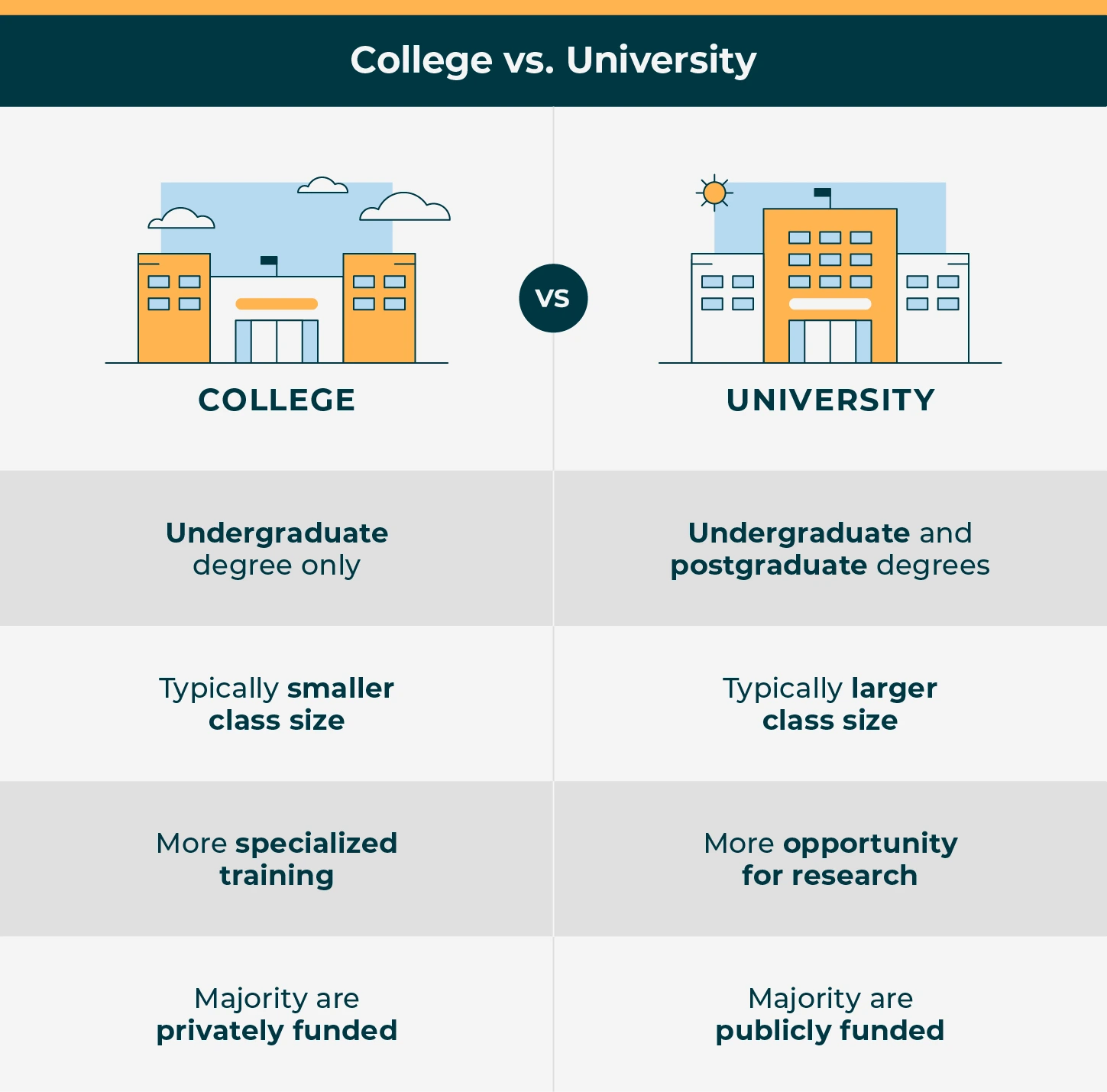
In everyday conversation in the United States, the terms are used interchangeably, and for most students, that is fine. Technically, a college focuses on undergraduate education, while a university also offers graduate programs and tends to emphasize research. But the label rarely determines the student experience. Some universities are small and teaching-focused. Some colleges offer research opportunities.
When deciding what type of college is right for you, what matters is not what an institution is called but how it functions day to day, its class sizes, teaching style, and academic structure.
Types of Colleges You Can Choose From
Before deciding which college is right for you, a natural first question is what types of colleges are there and how they actually differ. Let’s take a closer look at primary categories.
- Community colleges offer two-year associate degrees, certificates, and transfer pathways to four-year institutions. They are often chosen for affordability, flexibility, or as a strategic starting point before transferring.
- Four-year colleges and universities award bachelor’s degrees and represent the traditional undergraduate pathway. Within this group, structures vary significantly in scale and academic intensity.
- Liberal arts colleges are typically smaller, undergraduate-focused institutions centered on discussion-based learning and close faculty engagement.
- Research universities are usually larger institutions that combine undergraduate education with graduate programs and active research environments.
- Specialized or technical institutes focus on specific academic or professional fields such as engineering, business, art, or technology, emphasizing depth within a defined discipline.
For a more detailed breakdown of how these categories are defined within the U.S. system, you can review our guide to the different types of colleges. In this article, the focus is narrower: helping you determine which structure fits you best.
How to Choose the Right College Type for You
Knowing how to choose a college type that actually fits you requires starting with the right question: not “which schools should I apply to” but “what kind of learner am I, and what kind of environment brings out my best work.” Most students skip that step. They build a list first, collect names from rankings and friends, and then try to figure out which ones feel right. The result is often a poor-fit decision driven by pressure or assumption rather than self-knowledge.
This section works differently. Rather than giving you a generic checklist for how to decide which college to go to, it asks you to answer three questions honestly about yourself. Your answers will not produce a single ‘right’ college type, but they will help you identify which structures are likely to support you and which ones are likely to work against you.
1. How to Choose a College Based on How You Actually Learn
This is the question that determines more about college fit than any other factor, and it is the one most students never think to ask.
In our work with students, we have seen strong academic performers struggle in their first year not because the coursework was too demanding, but because the environment assumed a level of independence they were not yet ready for. The reverse is equally common: capable, self-directed students who felt constrained and under-stimulated in environments designed around close guidance and small group work.
College is a significant shift in academic environment. The support systems built into your school day, regular check-ins, structured deadlines, and teacher-led instruction become optional or disappear entirely depending on which type of institution you attend. How you respond to that shift is one of the most important factors in finding the right college fit.
Work through these questions:
- When a course is not going well, do you reach out early or try to work through it alone first?
- Think about the classes where you learned the most. Were they discussion-based or lecture-based?
- How much does regular feedback from an instructor affect your motivation and performance?
If most of your answers pointed toward feedback, discussion, and reaching out early, read the first section below. If they pointed toward independence, self-direction, and lecture-based learning, read the second.
If Your Answers Point Toward Structure and Guidance
You are likely better served by a smaller institution with a low student-to-faculty ratio. Liberal arts colleges and teaching-focused universities are built around frequent faculty access, discussion-based learning, and an academic culture that expects engagement rather than assuming it. These environments tend to produce strong outcomes for students who need regular feedback to stay motivated and on track.
If Your Answers Point Toward Independence and Range
You are likely better served by a large research university or a major public institution. These environments reward self-direction. Resources are abundant but not handed to you. Class sizes are larger, especially in the first two years, and the academic culture assumes you will take initiative. Students who thrive here are energized by options, comfortable building their own structure, and do not need frequent external feedback to stay engaged.
Choosing a college type that conflicts with how you actually learn is one of the most common and most avoidable sources of difficulty in the first year.
2. Which College Type Fits Your Academic Direction?
Your level of certainty about what you want to study shapes which college types are actually appropriate for you, not just which ones appeal to you.
Before you decide, be honest with yourself about these questions:
- How certain are you really about what you want to study? Not what sounds right to say, but what you actually know.
- If you are undecided, how much room to explore do you genuinely need before committing?
- If you have a clear direction, have you confirmed that your target institution has real depth in that specific field, not just a department that covers it?
If your answers reflect genuine uncertainty or a need to explore before committing, the first section below is where to focus. If you have a clear direction and know what your path requires, read the second.
If You Are Undecided or Still Exploring
Structures that allow exploration without penalty are what you need. Large universities with flexible major declaration policies and liberal arts colleges with open or distribution-based curricula both allow students to move through different disciplines before committing. Choosing a specialized institute or pre-professional program before you are ready to specialize can create pressure that forecloses exploration rather than supporting it.
If You Have a Clear Academic Direction
Depth matters more than breadth. A student committed to engineering needs to confirm whether their target institution has genuine strength in that specific field. A student aiming for medical school needs to evaluate research access, advising support, and pre-med program strength. A student focused on art or design should be looking at conservatories and specialized institutes rather than general universities, regardless of rankings.
In our experience, the students who struggle most with major changes mid-college are rarely those who were undecided. More often, they are students who had not yet thought carefully about how to choose a college major before committing to one. If there is any meaningful doubt about your path, build in flexibility rather than locking into a structure that assumes you already know.
3. How to Factor Budget Into Your College Type Decision
This question deserves honesty more than it deserves a long framework. The core issue is that most families evaluate college costs based on published tuition rather than net cost, which is what a family actually pays after grants, scholarships, and institutional aid are applied.
Before you use cost to eliminate college types, work through these questions:
- Are you working from published tuition figures or actual net cost estimates?
- Have you compared in-state public, out-of-state public, and private options on real numbers rather than sticker prices?
- If financial aid comes in lower than expected, which options would still be viable?
If your answers reflect a tight budget with limited flexibility, read the first section below. If you have more room to compare options and want to understand where real value sits, read the second.
If Affordability Is Your Primary Constraint
Community colleges and in-state public universities are your most reliable starting points. They offer the lowest sticker prices and, for in-state students, the most predictable cost structure. This does not mean ruling out other options entirely, but it does mean financial aid research needs to happen before anything else.
If You Have Flexibility and Want to Compare True Cost
Do not remove private colleges from consideration based on published tuition alone. We have seen families rule out strong-fit institutions based on a sticker price, only to find after running the numbers that the actual cost was comparable to their in-state option. A private college with a large endowment may cost significantly less in practice for a student who qualifies for strong need-based aid. Compare net cost across all types before narrowing.
4. Putting It Together: When Your Answers Point in Different Directions
For most students, these three questions will not all point toward the same college type. A student who learns best in small, discussion-based environments may have a tight budget that makes liberal arts colleges seem out of reach. A student who is undecided may be drawn to a large research university for its range of options but uncertain whether they can thrive without more structure.
These tensions are normal. The goal of this self-assessment is not to produce a conflict-free answer. It is to make the trade-offs visible before you commit to a direction.
Here is how to work through it:
- Rank the three questions by which factor you are least able to compromise on.
- Identify which constraint is fixed and which ones have room to move.
- Let the non-negotiable constraint set your range, then use the remaining two to narrow within it.
For some students, budget is non-negotiable and everything else is secondary. For others, the learning environment is the determining factor and cost is something to work around through financial aid research. The ranking will be different for every student, which is exactly why self-assessment matters more than a generic college list.
What we have found, working with students over decades, is that the students who struggle most in college are rarely the ones who chose a school that was too academically demanding. More often, they chose a college type that assumed a different kind of learner than they actually are. Answering these questions first is what makes the rest of the college planning process productive, and it is what separates a confident decision from one driven by pressure or assumption.
Next Steps in Your College Planning
Self-assessment is the foundation, but it is not the whole process. Knowing how you learn and what your path requires gets you to the right questions. Turning those answers into a college list, a realistic budget, and a set of applications that actually reflect your goals requires a different kind of work.
That work is easier when it starts early, before assumptions solidify and before the pressure of senior year narrows your thinking.
If you would like structured guidance at any stage of that process, from identifying the right college types to navigating the full application cycle, our college planning consultants work with students and families at every point in the journey.
Schedule a free consultation to get started.
Frequently Asked Questions
1. What happens if I choose the wrong type of college?
It is more common than most students expect, and it is not the end of the road. Some students adjust once they understand what is not working and find ways to make the environment work for them. Others determine that transferring to a better-fit institution is the right move. A poor-fit choice is most damaging when it goes unexamined. If you are mid-college and questioning whether your institution is the right match, working with college transfer consultants can help you assess your options clearly before making any decisions.
2. How early should I start thinking about what type of college is right for me?
Earlier than most families expect. The college-type question is most useful when it is answered before a student starts building a school list, which ideally happens in 9th or 10th grade rather than junior year, when application pressure is already high, and when you factor in how quickly the college admissions landscape is shifting, starting college planning early matters more than ever.
3. Are private colleges better than public colleges?
Neither is categorically better. The more useful question is which type of institution fits your learning style, academic goals, and financial reality. For a detailed comparison of how public and private colleges differ in structure and cost, see our guide to the different types of colleges in the U.S.
4. How do I know if a community college is right for me?
Community college is worth serious consideration if affordability is a priority, if you want to strengthen your academic foundation before entering a competitive program, if you are undecided and want low-cost exploration, or if you need flexible scheduling around work or family commitments. It is a strategic option, not a fallback. Many students complete two years at a community college and transfer to a four-year institution to finish their bachelor’s degree at significantly lower total cost.
5. Should I go to college if I’m undecided about my career?
Being undecided is not a reason to avoid college. It is a reason to choose the right type of college carefully. Liberal arts colleges and large universities with flexible major declaration policies are specifically designed to support students who need time to explore before committing to a direction. The risk is not indecision. It is choosing a specialized or pre-professional program before you are ready, which creates pressure that limits rather than supports exploration.
6. Can international students use the same college types framework?
Yes. The self-assessment questions in this guide, how you learn, how certain you are of your direction, and what your budget allows, apply regardless of where you are coming from. The college types themselves are specific to the U.S. system, but the decision-making framework is universal. If you are navigating this process from outside the U.S., working with international educational consultants can help you apply this framework within the broader context of your options.