

For many families, the question of whether a student should pursue STEM or the humanities begins to surface well before high school course planning is complete. Students hear that they need to pick a direction early, and parents worry that the wrong choice could limit college options or future opportunities. This pressure is understandable, but it often oversimplifies how strong academic preparation actually works.
The reality is more nuanced. When we work with families at McMillan Education, we find that the most effective academic planning rarely treats these areas as opposing paths, despite how often the STEM vs humanities debate is framed that way. In practice, students who position themselves well for selective college admissions and for the careers that follow tend to develop strengths across both areas.
This integrated approach matters more now than it did a generation ago. As artificial intelligence changes the professional landscape, employers increasingly value capabilities that are less susceptible to automation: ethical reasoning, creative synthesis, and the ability to evaluate complex information from multiple angles. These skills emerge from rigorous study in any discipline when that study is part of a broader education.
The following sections explore the STEM vs humanities question in high school, often framed as a science vs humanities choice, and place it in the context of thoughtful academic planning. We explain how colleges evaluate coursework, why this distinction is often misleading, and how a liberal arts and sciences approach supports a strong and flexible high school academic path.
Key Takeaways
- The STEM vs humanities debate may be common, but it offers little guidance for real high school course planning. Colleges evaluate preparation, not academic labels.
- A liberal arts and sciences approach develops the skills colleges value most: clear writing, quantitative reasoning, and the ability to think across disciplines.
- Admissions readers focus on rigor, progression, and coherence within the context of a student’s school, not on early specialization.
- Strong course planning reflects how a student learns, which academic doors need to remain open, and how coursework fits alongside other commitments.
- Early narrowing, course overload, and prestige-driven decisions often work against long-term outcomes more than they help.
STEM vs Humanities in High School: Key Definitions
Before families can make informed decisions about high school course planning, it is important to clarify what is typically meant by STEM and the humanities. Much of the confusion around STEM vs humanities comes from how these terms are used in everyday conversation, rather than how they function within a strong academic education.
What Is STEM?
STEM stands for science, technology, engineering, and mathematics. In high school, this typically means courses such as biology, chemistry, physics, computer science, and the math sequence from algebra through calculus or statistics.
At their core, however, STEM disciplines develop foundational academic skills. Students learn how to reason logically, work with quantitative information, test hypotheses, and solve complex problems in structured ways. These capabilities are not limited to technical fields. They are essential across a wide range of college majors and future career paths, including those that are not explicitly scientific or technical.
What Are the Humanities?
The humanities include subjects such as English, literature, history, philosophy, languages, and many social sciences. In high school, these courses emphasize close reading, structured writing, and careful analysis of complex ideas. Students learn to interpret texts, evaluate arguments, and communicate their thinking clearly and precisely.
In many schools, humanities coursework includes academically demanding options such as Advanced Placement or International Baccalaureate classes. These courses often require sustained writing, independent analysis, and the ability to engage thoughtfully with abstract and ethical questions. The rigor comes not from technical problem sets, but from intellectual depth, discipline, and clarity of expression.
Alongside the sciences, the humanities are a core component of a liberal arts and sciences education. They develop judgment, reasoning, and communication capabilities essential to any rigorous academic path.
Why “STEM vs Humanities” Is the Wrong Question
The framing of STEM vs humanities as competing paths appears frequently in media coverage, college admissions discussions, and family conversations about high school planning. It persists because it offers a simple structure for thinking about complex decisions. But simplicity is not the same as accuracy, and this particular framing often leads families toward choices that work against a student’s long-term development.
Why This Framing Persists
The STEM vs humanities distinction reflects how schools organize courses and how colleges categorize departments. It also reflects broader cultural anxieties about career security and economic returns on education. When families hear that technical fields offer more stable employment, or that humanities majors struggle to find jobs, the pressure to “pick the right side” feels urgent and real.
But these categories were never designed to guide individual student planning. They are administrative conveniences, not developmental frameworks. A student deciding which courses to take in tenth grade is not choosing between two worldviews. They are building a foundation, and that foundation serves them best when it is broad.
How This Framing Misleads Families
When families treat STEM and humanities as opposing paths, they tend to make decisions that narrow options prematurely. A student who sees themselves as “a STEM person” may avoid the writing-intensive courses that selective colleges expect and that professional success requires. A student who identifies as “a humanities person” may drop mathematics earlier than necessary, closing doors to fields like economics, psychology, or data-informed policy work.
The fields that shape contemporary life do not honor this division. Public health requires scientific literacy and ethical reasoning. Climate policy requires data analysis and persuasive communication. Artificial intelligence raises questions that extend beyond engineering alone. Students who develop capabilities across domains are better prepared for these realities than those who specialize too early.
As Peter Olrich, Director of College and University Planning at McMillan Education, puts it:
“The decision about whether to major in STEM-related fields or in the humanities is best made from the inside-out rather than purely from the outside-in. Your authentic interests and talents are the things that will keep you excited to get out of bed in the morning and get to class, and the forces that will keep you engaged in your major and your career.”
Liberal Arts and Sciences: A More Accurate Framework
If STEM vs humanities is the wrong frame, what replaces it? For families planning high school with college in mind, the more useful concept is liberal arts and sciences.
What Liberal Arts and Sciences Means
In the American educational tradition, a liberal arts and sciences education is not a major or a career track. It is an approach to learning that emphasizes broad intellectual development before specialization. The focus is on how students think, reason, and communicate, rather than on early job preparation.
This framework includes both the so-called STEM courses and subjects in the humanities. Literature, history, and philosophy sit alongside biology, mathematics, and physics. The goal is not to produce specialists in high school, but to develop students who can write clearly, reason quantitatively, analyze evidence, and engage with complex problems from multiple perspectives.
This distinction matters because the term is often misunderstood. Outside the United States, liberal arts is sometimes assumed to mean humanities alone, or to imply a lack of academic rigor. In the American context, liberal arts and sciences refers to an integrated and demanding curriculum that treats scientific and humanistic inquiry as complementary rather than competing.
Why This Framework Matters for High School Planning
Selective American colleges and American-style institutions abroad evaluate applicants with this educational model in mind. They do not expect students to arrive with a fixed academic identity. Instead, they look for evidence of strong foundations, sustained rigor, and meaningful engagement across disciplines.
American undergraduate education is designed to allow students time to explore different fields before narrowing their focus. High school planning that mirrors this structure helps students prepare for the expectations they will encounter later. A student who narrows too early, whether toward STEM or the humanities, may limit their readiness for the kind of integrated academic work colleges actually value.
The goal is not to avoid direction, but to build the intellectual capabilities that make informed specialization possible when the time comes.
This perspective also reflects how academic planning plays out beyond high school, as Don McMillan, CEO of McMillan Education, explains:
“Students should take advantage of the first two years of university in the US, or at American-style liberal arts institutions abroad, to explore both the sciences and the Humanities. Then by junior year, many students lean towards one of the other, though some will major in, say, Economics and minor in English. Longer-term, STEM graduates often enter the job market with a higher earning potential, though in the long run Humanities majors generally earn more.”
What Colleges Actually Look for on a High School Transcript
Once families move past the STEM vs humanities framing, a more practical question follows: how do colleges actually evaluate high school coursework? Seeing how admissions readers approach transcripts can help families better understand how to choose high school courses without getting caught up in labels.
1. Rigor in Context
At selective colleges, transcripts are read in context. Admissions officers look first at the rigor of a student’s course selection relative to what their school offers. This includes the level of challenge within core subjects, progression from year to year, and evidence that a student has taken their academics seriously across disciplines rather than concentrating narrowly in one area.
2. Progression and Growth Over Time
Colleges also pay close attention to coherence and growth. A strong transcript tells a story of development, showing how a student has built skills gradually and taken on more demanding work as they became ready for it. Sudden drops in rigor or uneven preparation, particularly in foundational areas such as writing, mathematics, or laboratory sciences, can raise questions about readiness for college-level work.
3. Breadth With Purpose
Importantly, admissions readers are not looking for perfection or balance for its own sake. They understand that students have different strengths, interests, and school environments. What matters is that students demonstrate intellectual engagement, sustained effort, and the ability to handle complex material. This is why colleges consistently value transcripts that reflect breadth alongside depth, rather than early specialization at the expense of core academic skills.
Seen through this lens, high school planning is less about choosing a category and more about building a foundation that supports future study. Students who develop multiple ways of thinking are better prepared for the demands of college coursework, regardless of the major they eventually pursue.
How to Choose High School Courses: 3 Planning Considerations
Once families understand how colleges read transcripts, the next question is how to choose high school courses in a way that supports long-term success. There is no single formula that works for every student. We encourage families to approach course selection through three lenses. Together, these lenses provide structure without forcing premature specialization or rigid paths.
1. Strengths and Learning Profile
The first consideration is how a student actually learns. Interest matters, but so does the ability to manage workload, absorb feedback, and persist through difficulty. A student who enjoys history but struggles with extended writing will need support structures in place before committing to multiple writing-intensive courses in a single year.
This lens also includes learning differences. Students with processing speed challenges, attention difficulties, or other learning profiles may need to sequence courses strategically rather than loading their schedule with maximum rigor all at once. The goal is steady growth, not burnout. Course planning that accounts for how a student learns, not just what they want to study, produces stronger outcomes over time.
2. Doors to Keep Open
The second consideration is optionality. Some academic paths require early preparation; others allow more flexibility. Families benefit from understanding which sequences matter and when.
If engineering, computer science, or pre-medical studies might be in play, students should protect their math and lab science progression early. Gaps in these sequences are difficult to recover from later. If law, policy, or graduate study in the humanities might be relevant, students should maintain strong writing-intensive coursework and, where possible, continue with a foreign language.
This is not about committing to a path. It is about avoiding decisions that close doors unnecessarily. A student who keeps multiple options open through 10th and 11th grade has more freedom to specialize meaningfully when the time comes. For families weighing pre-professional programs against a broader liberal arts and sciences approach, we have written more about how specialists and generalists each find their way.
3. Life Outside the Classroom
The third consideration is sustainability. High school students are not only students. Many have athletic commitments, arts involvement, family responsibilities, or jobs. Course planning that ignores these realities often backfires.
A schedule that looks rigorous on paper but leads to chronic stress, declining performance, or withdrawal from meaningful activities does not serve a student well. Colleges value sustained engagement over impressive-looking overload. A student who maintains depth in a few areas while managing a realistic course load often presents a stronger profile than one who attempts everything and struggles to follow through.
Common Mistakes Families Make When Planning High School Courses
Even thoughtful families can make decisions that work against their long-term goals. Most mistakes are not dramatic. They are small choices, made early, that compound over time.
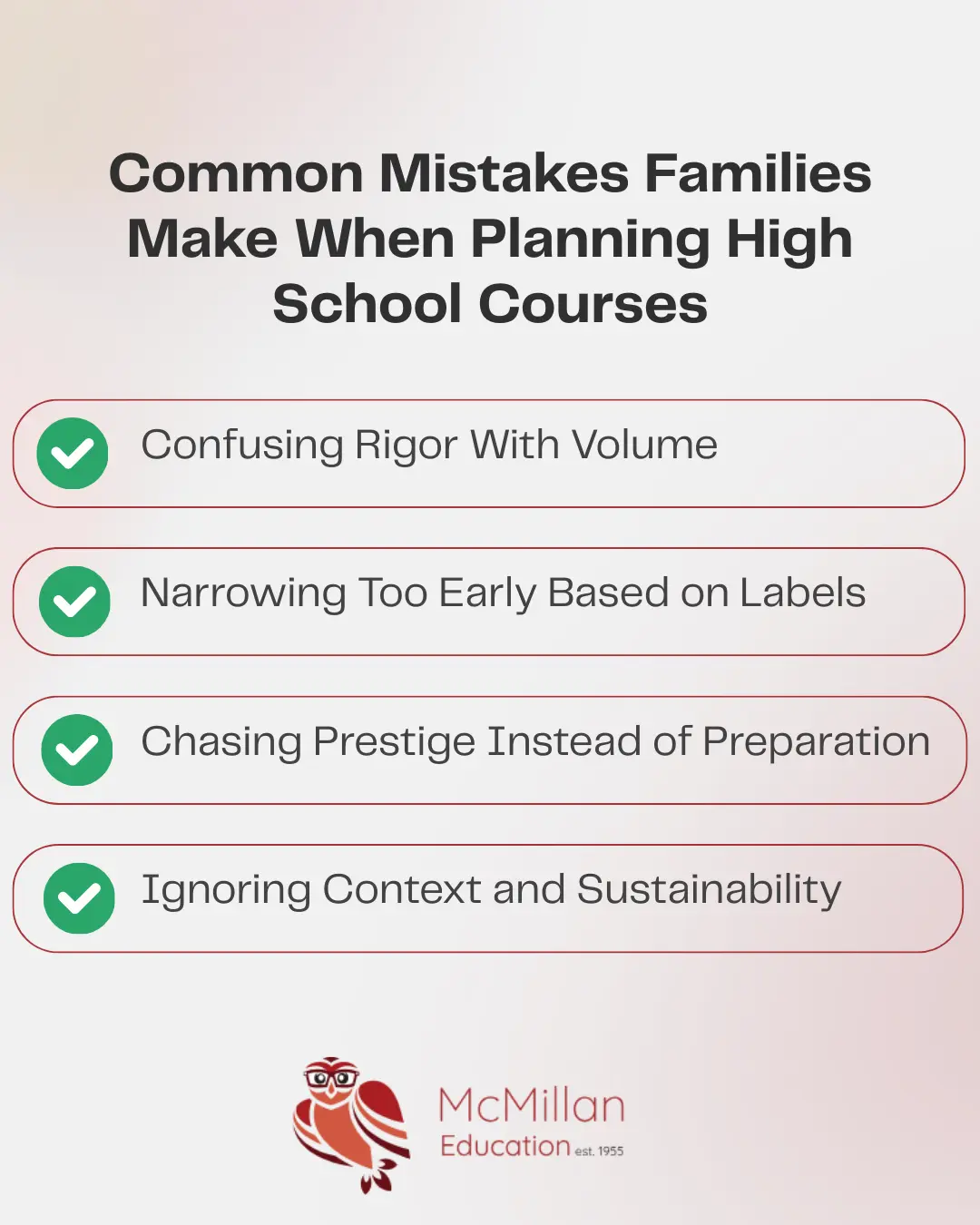
1. Confusing Rigor With Volume
One common mistake is equating rigor with the number of advanced courses on a schedule. Taking the maximum load may look impressive, but overload often leads to shallow learning, inconsistent performance, or burnout. Colleges are more persuaded by sustained engagement and steady progression than by a transcript crowded with courses a student struggles to manage well.
2. Narrowing Too Early Based on Labels
Another mistake is narrowing too early based on academic identity. When students begin to see themselves as “a STEM student” or “a humanities student,” they may quietly abandon foundational skills they will need later. Dropping writing-intensive courses or discontinuing mathematics before readiness can limit options in ways that are difficult to reverse.
3. Chasing Prestige Instead of Preparation
Families also sometimes plan around perceived prestige rather than actual preparation. Choosing courses because they sound impressive, rather than because they build necessary skills, can leave gaps in writing, quantitative reasoning, or scientific understanding. Admissions readers notice inconsistency more than ambition.
4. Ignoring Context and Sustainability
Finally, some families underestimate the importance of context. Course choices that make sense for one school, schedule, or learning profile may not translate well to another. Ignoring how a student actually performs under pressure, or how coursework fits alongside other commitments, often leads to plans that look strong on paper but falter in practice.
Planning With Purpose
The STEM vs humanities debate may appear in discussions about education, but it does not reflect how strong academic planning actually works. What matters more is building a foundation that develops multiple ways of thinking, keeps meaningful options open, and reflects how a student actually learns and lives. This is what a liberal arts and sciences approach provides, and it is the model that selective colleges expect.
For families who want structured support in navigating these decisions, working with an experienced educational consultant can make the process clearer and less stressful. At McMillan Education, we help students develop course plans that align with their strengths, goals, and the realities of college admissions.
Schedule a consultation to begin planning with intention.
Frequently Asked Questions
1. Is STEM better than the humanities for college admissions?
No. Colleges do not evaluate applications based on whether a student appears more STEM- or humanities-oriented. What matters is the rigor, progression, and coherence of the student’s coursework within the context of their school. A student with strong preparation across disciplines is generally better positioned than one who specializes narrowly too early.
2. Do I need advanced science to get into a good college?
Not necessarily. Colleges expect students to take science seriously, but expectations vary by institution and by a student’s broader academic profile. Strong preparation usually includes multiple years of laboratory science, with increasing rigor where possible. Advanced science becomes more important if a student plans to pursue science-heavy fields later.
3. If I want engineering, what math and science do I need in high school?
Students considering engineering should maintain a continuous math sequence through calculus if available, along with rigorous laboratory sciences such as physics and chemistry. Gaps in these areas are difficult to address later. Even so, colleges do not expect absolute certainty in high school, only that students have preserved the necessary foundations.
4. If I’m humanities-focused, should I still take math in my senior year?
In most cases, yes. Continuing math supports quantitative reasoning and keeps options open for fields such as economics, social sciences, or data-informed policy work. Colleges often view an early end to math as a missed opportunity rather than a sign of focus, unless there is a clear and well-supported reason.
5. What is a liberal arts and sciences approach in high school?
A liberal arts and sciences approach emphasizes broad intellectual development alongside increasing depth. Students build skills in writing, quantitative reasoning, and scientific analysis before narrowing their focus. The goal is preparation for college-level thinking, not early career training.
6. What if my school offers limited STEM or humanities courses?
Admissions readers evaluate transcripts in context. Students are not penalized for offerings their school does not provide. What matters is that they pursue the most rigorous and coherent program available to them, that they show commitment to finding whatever challenge they can, and that they show progression over time.