


The college transfer essay is one of the most consequential pieces of a transfer application, and one of the most misunderstood. Unlike the first-year Common App personal statement, which addresses who you are as a person broadly, the college transfer essay has a narrower purpose: to give admissions committees the academic context they need to evaluate your application.
This guide covers how to write a college transfer essay section by section, how to revise it effectively, and what admissions officers are evaluating when they read it – drawing on the W.I.S.E.® methodology for college transfer planning, refined across decades of admissions work.
How to Start a Transfer Essay: Questions to Work Through Before You Draft
Working through the reflection questions below is an effective starting point. The strongest transfer essays are grounded in genuine self-examination rather than an attempt to anticipate what admissions committees want to hear, and these questions are designed to draw that out.
1. About Your Current College Experience
- Why did you choose your current institution, and what were your expectations when you arrived?
- What has your experience been since then, academically and personally, and what surprised you?
- What has gone well, what has been challenging, and what is missing?
- If you have struggled academically, what contributed to those challenges and what has changed since?
2. About Your Reasons for Transferring
- What specific academic programs or opportunities are you seeking that your current institution does not offer?
- Has your intended college major or academic direction shifted since you started college, and if so, what prompted that shift?
- What would be meaningfully different at your target institutions?
3. About Your Growth and Direction
- What have you accomplished in college that reflects who you are as a student?
- How have your academic priorities or perspectives shifted?
- What kind of learner and community member are you now, and what do you want to contribute to a new institution?
Approach these questions as a thinking exercise and write your answers without editing yet. What surfaces is the material you will shape into a transfer essay later.
How to Write a College Transfer Essay: Section by Section
Most college transfer essays follow a clear narrative arc across four sections, though structure and word count vary by institution and prompt. Total length typically ranges from 250 to 750 words. Here is how to write each section of a college transfer essay, with recommended word counts for each in a draft that will be cut to fit individual schools in subsequent drafts.
Use the section breakdowns below as a drafting framework, working through each part in sequence.
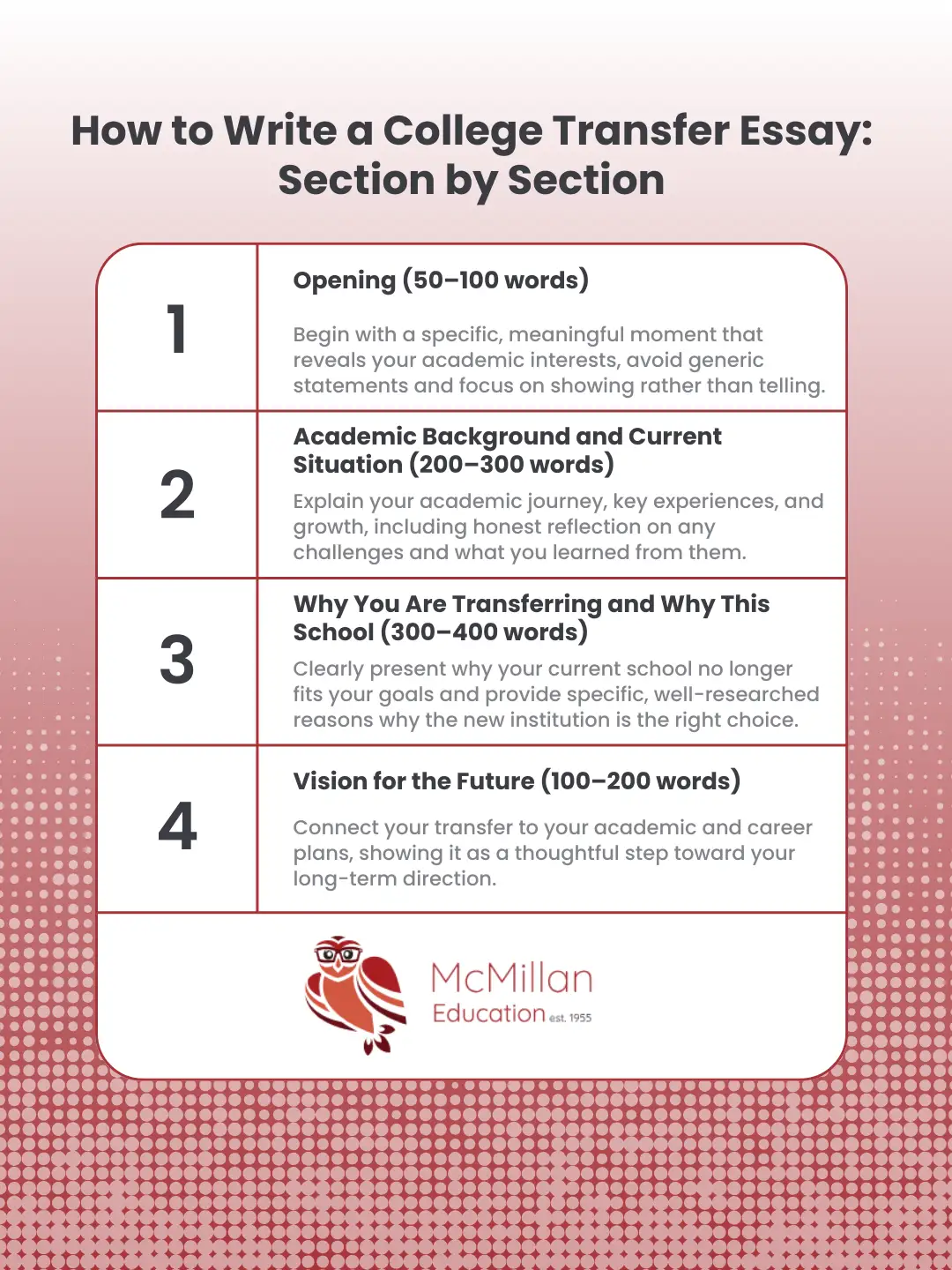
Section 1: Opening (50–100 words)
The opening of a transfer essay is not the place for broad declarations about academic passion or long-term ambition. Admissions committees have read thousands of essays that begin that way.
A more effective opening grounds the reader in a specific moment, a class that reoriented your thinking, a conversation with a professor, or a realization that clarified your academic direction. The detail does not need to be dramatic. It needs to be concrete and specific enough to show something true about how you think and what drives you academically.
Rather than writing “I have always been passionate about environmental science,” place the reader in a moment that made that interest real. That specificity is what distinguishes an opening that holds attention from one that does not. Show, don’t tell!
Section 2: Academic Background and Current Situation (200–300 words)
This section of the transfer essay establishes the academic context. What brought you to your current institution? What were you expecting to find, and what has your experience been since arriving?
If your record reflects strong academic engagement, this is where you identify specific achievements, courses that shaped your thinking, and the intellectual growth that demonstrates readiness for the next step. Be concrete: academic history written in general terms tells a committee very little.
If your record is uneven, this section carries particular weight. An uneven academic record does not disqualify a transfer application, but it requires honest and self-aware treatment. Acknowledge what went wrong without centering it or making excuses for it. Explain what contributed to the difficulties and, more importantly, what changed and what you learned from that period.
Admissions committees are evaluating academic maturity as much as academic performance. A student who can reflect critically on a difficult semester and articulate what shifted demonstrates exactly the kind of growth selective institutions are looking for.
Section 3: Why You Are Transferring and Why This School (300–400 words)
This is the most important section of the transfer essay and the one that requires the most careful planning. It has two parts: an honest account of what is not working at your current institution, and a specific, well-researched case for why this particular college is the right next step academically.
The first part is straightforward in principle but can be challenging to execute thoughtfully. You are not writing a critique of your current institution. You are establishing, in academic terms, what your current institution cannot offer academically. The framing is forward-facing: you are moving toward something specific, not away from a situation that has not worked. Both things may be true, but the essay locates the reason in academic opportunity rather than dissatisfaction.
The second part is where many transfer essays lose ground. Generic statements about a college’s reputation, campus culture, or academic quality do not serve this section. Admissions committees can identify recycled language immediately, and an essay that could apply to any institution will not demonstrate the research this section requires.
What this section requires is research: named programs, specific courses, faculty work that connects to your academic direction, opportunities your current college does not offer. The more precisely you can answer why this college and not another, the stronger the case. This should be a piece that could only be written by you, only about this institution.
This section also carries a tone risk. Criticizing your current institution at length raises a concern for admissions committees: a student who frames a transfer primarily around what has gone wrong may bring the same dissatisfaction to a new environment. Keep the account of what is not working concise and grounded in academic terms, then give the majority of this section to what you are moving toward.
Section 4: Vision for the Future (100–200 words)
The closing section connects your transfer to your larger academic and professional direction. What do you intend to study, and why does that course of study matter to you? What comes after your degree, and how does this transfer advance that trajectory?
You do not need absolute certainty about a career path, but you do need to demonstrate that you have thought seriously about what this transfer is for and why this college is the right place to pursue it.
Keep this section brief and purposeful. It is not a summary of what you have already written. A closing that gives the committee a clear, specific sense of where you are headed, grounded in the programs and opportunities you have already identified in the reasons-for-transferring section, leaves a stronger impression than one that restates your reasons or ends on a general note about academic growth.
The goal is to leave the reader with a sense that the college transfer is purposeful, well-considered, and the logical next step in a coherent academic direction, and that you will contribute to the liveliness of your major and community.
Transfer Essay Revision: What to Check Before You Submit
Writing a college transfer essay and revising it are separate tasks, and revision is a step many applicants rush. Once you have a complete draft, put it aside for a day or two before coming back to it. Unclear passages and errors that are easy to miss in the moment become much more visible with fresh eyes.
When you return to the draft, work through these questions:
- Does the essay answer the prompt fully?
- Is every sentence necessary?
- Do the reasons for transferring come across as genuine, or does the transfer essay read as a complaint?
- Are there specific details and examples throughout, or does it rely on general statements?
- Would someone who does not know you understand who you are as a student from reading this?
- Is every claim supported by concrete evidence?
- Does it read as something that could only be written by you, only about that school?
Seek feedback from a counselor, teacher, or mentor who can assess whether the college transfer essay achieves what you intended.
One principle worth keeping in mind: revise to clarify your thinking and strengthen your writing, not to rewrite the essay in someone else’s voice. The goal is a more precise version of what you have already written.
What Admissions Officers Look for in a Transfer Essay
Transfer applications are reviewed differently from first-year applications. A committee reading a first-year file is largely working from potential: grades, test scores, extracurriculars, and a personal statement that speaks to character and promise.
A committee reading a transfer application file has more to evaluate. There is a college record, a demonstrated pattern of academic engagement, and a set of choices the applicant has already made. The essay is read as context for all of those pieces.
1. How Committees Read a Transfer Application
The GPA is the first thing a committee sees. The essay is the context that explains it. A strong GPA with a weak essay raises questions about whether the student understands what they are transferring toward. A modest GPA with a well-constructed essay can shift a committee’s read of the entire file, because it demonstrates the self-awareness and academic maturity that the numbers alone do not show.
2. What the Transfer Essay Is Actually Doing in the Review Process
What committees are looking for is evidence of a student who has thought seriously about their academic direction, understands what their current institution cannot offer, and has identified a specific program or academic environment that advances that direction.
3. The Pattern Behind Weak Transfer Essays
The most common pattern in weak transfer essays is not poor writing. It is a student who has diagnosed what is missing from their current situation without articulating what comes next. A committee reading that essay has no basis for imagining the applicant contributing to their academic community. The essay has explained a departure but not made a case for an arrival.
4. What a Strong Transfer Essay Signals
A strong transfer essay gives a committee a clear picture of an applicant who knows what they want to study, why it matters to them academically, and why this institution is the right place to pursue it. That combination, academic clarity, institutional specificity, and evidence of genuine engagement, is what moves a transfer application forward.
Common Transfer Essay Mistakes to Avoid
1. Opening With What Went Wrong
Opening with academic struggles or reasons for leaving your current institution is one of the most common structural errors in transfer essays. A committee’s first impression of you as an applicant should be grounded in your academic direction and what you are moving toward, not in what has gone wrong. Save that context for the academic history section, where it best fits a compelling narrative.
2. Making a Case for Prestige Instead of Program
Transferring to attend a more selective or well-known institution is rarely a compelling case on its own. Admissions committees are looking for evidence that the transfer is academically motivated and that the applicant has identified specific programs, courses, or opportunities that their current institution cannot offer. If the case for a school rests primarily on its reputation, the essay has not done the work the reasons-for-transferring section requires.
3. Dwelling on What Is Not Working
There is a difference between establishing what is not working academically and dwelling on it. A committee reading an essay that centers on the failures of a current institution will question whether the same dissatisfaction will follow the applicant to a new one. Keep that account concise and redirect to what you are moving toward.
4. Writing the Same Transfer Essay for Every School
A college transfer essay that could apply to any institution will not serve the reasons section. Each school on a transfer list requires specific research, including named programs, courses, faculty work, and that research has to be reflected in the essay itself. A generic essay signals that the student does not fully understand the school they are applying to for transfer.
5. Describing Instead of Demonstrating
Statements like “I am hardworking, intellectually curious, and dedicated to my studies” tell a committee far less than sharing a course that changed how you think, a problem you pursued beyond the classroom, or an academic experience that clarified your direction. Show the committee what those qualities look like in practice.
Plan Your College Transfer
Writing a college transfer essay is one part of a well-planned transfer application. Your research, your academic record, the school list, the timing, your supporting documents and recommendations, and the essay all need to work together. McMillan Education has successfully guided transfer applicants into institutions for over 70 years, applying a structured planning methodology to every stage of the process.
For students working through the transfer application independently, the W.I.S.E.® Transfer Admissions Playbook is a self-guided online course covering every component of the transfer application, including the personal statement.
For one-on-one guidance, schedule a free consultation with college transfer planning consultants to bring transfer planning expertise directly to your application.
Frequently Asked Questions
1. How long should a transfer essay be?
Most college transfer essays range from 250 to 750 words, though word counts vary by institution and application platform. Always check the specific requirements for each program before you begin drafting.
2. Can I reuse my Common App personal statement for a transfer application?
There may be occasions where some schools will include the freshman Common App prompts as one of multiple transfer essays. When that’s the case, make sure your insights and experiences are updated to fit you in the current moment. The transfer essay, centered in most transfer applications, serves a different purpose from the first-year personal statement and requires college-level experience and reflection that a high school essay cannot demonstrate. If you previously applied to a transfer institution as a first-year applicant, committees will expect to see academic growth and development since your original application.
3. Should I address a low GPA in my transfer essay?
Yes, if the record requires context. The academic history section of the transfer essay is the appropriate place to acknowledge a difficult academic period honestly, explain what contributed to it, and demonstrate what changed. A committee reading an uneven record without context has no basis for evaluating the application favorably. Self-awareness and a clear account of what shifted is more compelling than silence on the subject.
4. What is the difference between a transfer essay and a personal statement?
The first-year Common App personal statement broadly addresses who you are as a person. The college transfer essay is narrower and more specific: it covers your academic record since starting college, your reasons for transferring, what you have gained from your current institution, why a specific college is the right next step, and where you are headed academically.
5. How many schools should I write transfer essays for?
There is no fixed number, but each application requires a reasons-for-transferring section that is specific to that institution. If you cannot articulate what is specifically available at a given institution that your current college does not offer, that school may not be the right transfer target.
6. Can I use the same transfer essay for every school?
The core essay, your academic history, reasons for transferring, and future goals can serve as a foundation across applications. The section that makes the case for a specific institution must be adapted for each school. An essay that could apply to any institution will not demonstrate the research and planning that transfer committees are looking for.
7. Do I need to know my major before writing my transfer essay?
You do not need absolute certainty, but you need enough academic direction to make a credible case in the reasons-for-transferring and closing sections. Committees are not expecting a fully formed career plan. They are looking for evidence that the transfer is purposeful and that you have thought seriously about what you want to study and why this institution is the right place to pursue it.
8. What if I took time off, should I explain that in my transfer essay?
Yes. Time away from college is part of your academic record, and committees will have questions about it. The academic history section is the appropriate place to address it directly, what the circumstances were, what you did during that period, and what brought you back to pursuing a degree.