
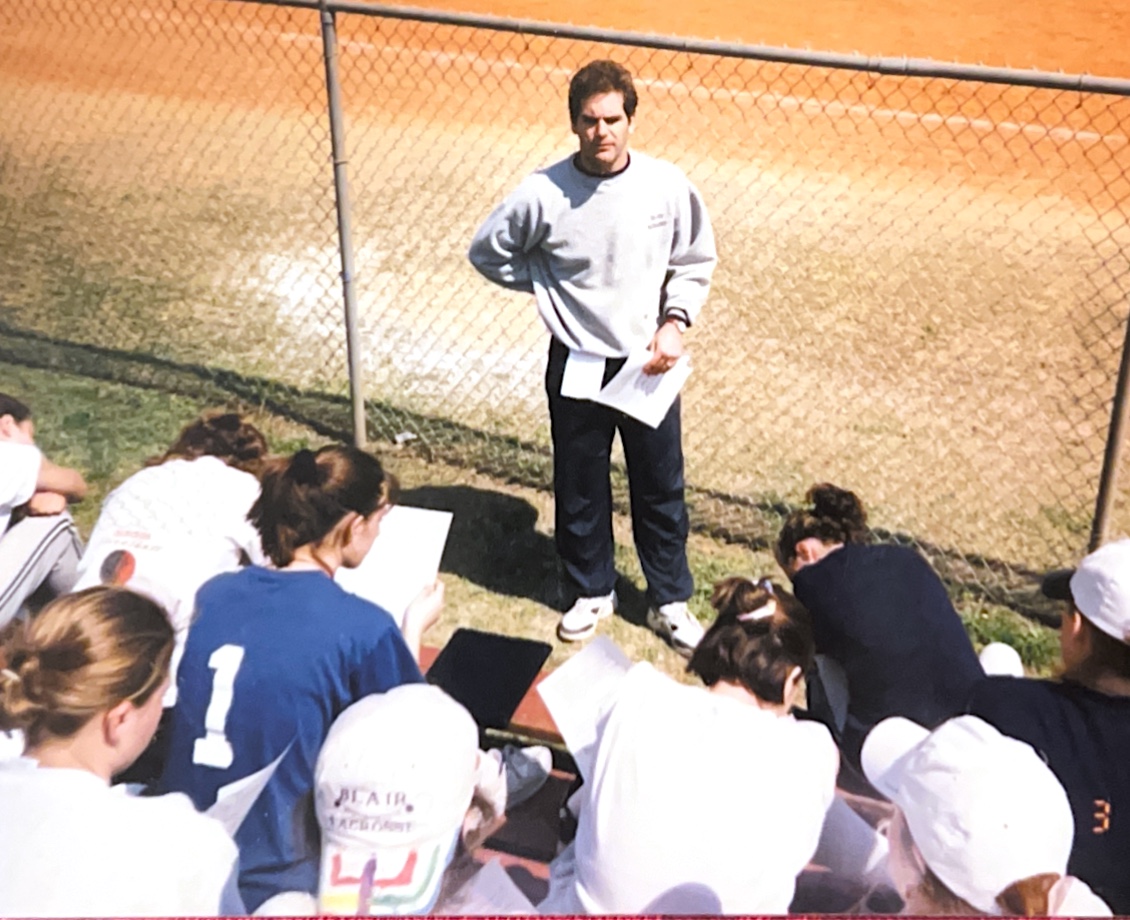
I walked into Room 212, where the world language department had gathered. They had been my colleagues for almost a year. I taught Phys Ed, Driver’s Ed, and CPR & First Aid, while serving as the head coach of football in the fall and girls’ basketball in the winter.
“Why do you think you should be considered for the Spanish opening?” asked the department head.
It was a legitimate question. None of them knew my background.
I couldn’t blame them for not knowing my classroom experiences. To them, I was the guy in the gym, wearing a sweatsuit and twirling a whistle (I loved being able to wear sweatpants to school!). What they didn’t know was that I had spent a decade at boarding schools teaching Spanish. What they couldn’t see was that I had taught in a dual-language program in Hartford, CT. The real question was why I had kept that part of myself in the background. The answer was that I enjoyed the anonymity: the freedom of being seen as one thing while also being something else entirely. I had become an expert at being underestimated. I learned long ago to lead with my presence, my work ethic, and my willingness to show up.
That approach served me well in high school, but my parents had bigger expectations. Given that they never had the opportunity to attend college, their purpose was to give my siblings and me that chance. It wasn’t until I was older that I understood that I hadn’t grown up watching my parents hold down jobs. I had grown up watching them do more than just hold down jobs. My father left before sunrise. My mother returned in the late afternoon, after we had already come home and supposedly finished our homework. Their days were filled with problem-solving, engineering, and the invisible infrastructure that made everything else possible.
My first glimpse into my father’s work occurred during the summer after I graduated from high school. I knew he worked in the maintenance department of the meatpacking plant, but I had no idea what to expect. My father didn’t repair machines. He resurrected them. There, he solved equations with metal and physics. If a replacement part didn’t exist, he built it. When a system failed, he engineered it back to life. I had never viewed my father as an artist, but he created every day. By college, I had come to understand what that work meant. I remember the walks from the gravel parking lot toward the light of the smokestack. I dreaded it because of the early-summer hailstorms and the harsh winter blizzards (winter break before studying in Spain). I have covered the same distance on the football field in fifteen seconds. I would not, however, suggest running on this cracked, uneven blacktop, filled with potholes and patches of gravel, especially while wearing heavy work boots. I could distinguish the time of year only by the type of precipitation I dodged on that walk.
My mother worked at City Hall in the Law Director’s Office. While listed as a secretary, she was the one who kept the office running. She wasn’t taking dictation. She was translating between worlds, taking the lawyers’ language and making it understandable to the citizens who needed help, bridging the gap between legal complexity and human reality. She didn’t go to law school, but she knew the law because she watched it in action every single day, in every single case.
She made things happen in that office, even without a title (eventually named an administrative assistant) or elected position. My mother, Elaine Carmen Lopez, possessed a kind of knowledge that doesn’t show up on a diploma. She knew, and still understands, how systems actually worked. I learned from her that the most important people in any institution are often the ones no one sees. Most importantly, she showed me that expertise doesn’t always announce itself: how to be indispensable without being visible. I watched her make others’ work possible, never needing credit for herself.
She carried a Spanish heritage in her surname, a Spanish-speaking grandfather I never met, a cultural inheritance that lived in our home but was only apparent in certain foods. That part of our family’s story was there, present, real, part of us, but it was quiet. It was waiting. It wasn’t until I studied in Spain that I understood. I came home speaking the language my mother’s surname promised, but her generation had left behind (it took a few more years before my Spanish cooking skills matched my language skills).
I realized I had become a teacher who builds bridges, just like my mom, and solves problems, just like my dad. Coaching and teaching Spanish weren’t different paths. They were the same path, expressed differently. I learned how to meet people where they are and help them become who they need to be: building their confidence, celebrating their identity, seeing the whole person.
“Why do you think you should be considered for the Spanish opening?” I paused and thought about what she was really asking. The question wasn’t only about credentials (though I did share my educational experiences). It was about whether I could see what needed to be seen and do what needed to be done.
I had learned from experts—my parents. I had learned how to see beneath titles, to recognize competence when the world calls it something else. A student is the same person whether they’re conjugating verbs, catching a touchdown pass, or learning to merge onto a highway. And because I knew what it meant to carry a silent heritage, I knew how to help students find their own voices—to take risks, to question, to explore who they are meant to be.
That’s what my parents did. That’s what I’ve spent my career doing: seeing the whole person, recognizing the potential others miss, the competence that hasn’t been given a voice. And that’s what we do at McMillan Education. That’s my North Star.