


AP classes, or Advanced Placement classes, are college-level courses offered in high school and developed by the College Board. They are designed to be more rigorous than standard high school courses and give motivated students the opportunity to engage with material at a pace and depth closer to what they will encounter in college. For many college-bound students, AP classes are an important part of academic planning, but they are also widely misunderstood.
This guide explains what AP classes are, how they work, how colleges evaluate them, and how students can choose AP courses strategically based on their goals, strengths, and school offerings, especially for families making decisions about high school courses and college preparation.
Key Takeaways
- AP participation can strengthen college applications when it reflects genuine academic challenge and strong performance, evaluated in the context of what your school offers.
- There is no “right number” of AP classes. A sustainable schedule with strong grades is more effective than taking more APs and struggling.
- College credit is not guaranteed. AP exam scores may earn credit, placement, or neither, and policies vary widely by institution and subject.
- AP classes can affect weighted GPA and class rank, but many colleges recalculate GPA, so rigor and performance matter more than the weighted boost alone.
- AP vs honors vs dual enrollment depends on fit and availability. The best choice is the most rigorous path you can succeed in, given your school options and overall workload.
What Are AP Classes?
AP classes are part of a standardized curriculum framework created by the College Board, a nonprofit organization that also administers the SAT. Each AP course is designed to reflect the scope and academic expectations of an introductory college course in the same subject. While individual teachers have flexibility in how they teach the material, the core content and skills assessed are standardized nationwide, meaning an AP Biology course in California is built around the same academic expectations as AP Biology in New York or Texas.
Source: Veritas Education
1. How Are AP Courses Structured?
Most AP classes follow a standardized structure. Students take the course over the full academic year and may choose to sit for a corresponding AP Exam administered nationally each May. Since 2025, many AP exams transitioned to a digital format using the Bluebook testing application, though the content and difficulty remain unchanged. While many students associate AP classes primarily with exam performance, the coursework itself plays a significant role in demonstrating academic rigor on a high school transcript.
2.How Are AP Exams Scored?
AP exams are scored on a scale from 1 to 5, with 5 representing the strongest performance. The College Board considers a score of 3 to be passing, but what that score means in practice depends on the college and the subject. Some institutions award college credit or advanced placement for a 3, while others, especially more selective universities, require a 4 or 5 or limit how AP credit can be applied.
3.How Do AP Classes Differ From Regular High School Courses?
AP classes differ from standard high school courses in both pace and depth. They move more quickly, cover more material, and expect students to engage with ideas at a higher level. For students who are used to earning high grades in regular classes, the jump in rigor can feel significant at first. Success in AP courses depends less on memorization and more on sustained effort, critical thinking, and the ability to manage time independently, skills that closely mirror what students will need in college.
4. How Many AP Courses Are Available?
As of 2026, the College Board offers 40 AP courses across a wide range of subjects, but not every high school offers the same options. Course availability depends on factors like school size, resources, and student demand. Some schools may offer only a few AP classes, while others offer many more. Colleges take this context into account when reviewing applications, which is why students are evaluated based on what was realistically available to them.
Complete Guide to AP Courses by Subject
The College Board offers AP courses across multiple subject areas, though not every high school offers the same selection. Understanding how AP courses are grouped by subject helps students choose classes that align with their academic strengths, interests, and long-term goals, rather than selecting APs at random.
1. AP Arts
AP Arts courses focus on creative development, critical interpretation, and sustained, portfolio-based or performance-based work. Colleges typically view these courses as evidence of artistic commitment and discipline, particularly when paired with strong performance in core academic subjects.
- AP 2-D Art and Design
- AP 3-D Art and Design
- AP Drawing
- AP Art History
- AP Music Theory
2. AP English
AP English courses develop advanced reading, writing, and analytical skills that are foundational across nearly all college majors. Because these skills are broadly transferable, colleges often consider AP English performance a strong indicator of overall academic readiness.
- AP English Language and Composition
- AP English Literature and Composition
3. AP History and Social Sciences
AP History and Social Science courses emphasize analytical thinking, evidence-based argumentation, and the ability to synthesize complex information. These courses are commonly taken by students interested in humanities, social sciences, business, law, or public policy, and they play a central role in demonstrating academic rigor.
- AP African American Studies
- AP Comparative Government and Politics
- AP European History
- AP Human Geography
- AP Macroeconomics
- AP Microeconomics
- AP Psychology
- AP United States Government and Politics
- AP United States History
- AP World History: Modern
4. AP Math and Computer Science
AP Math and Computer Science courses emphasize quantitative reasoning, problem solving, and logical thinking. These courses are often central for students interested in STEM fields, business, economics, or data-driven disciplines. Colleges typically look closely at math progression and rigor when evaluating academic preparation.
- AP Calculus AB
- AP Calculus BC
- AP Precalculus
- AP Statistics
- AP Computer Science A
- AP Computer Science Principles
5. AP Sciences
AP Science courses focus on conceptual understanding, data analysis, and scientific reasoning, often combined with lab-based work. These courses are especially relevant for students considering majors in science, engineering, health, or environmental fields, and are often perceived as demanding due to workload and pace.
- AP Biology
- AP Chemistry
- AP Environmental Science
- AP Physics 1: Algebra-Based
- AP Physics 2: Algebra-Based
- AP Physics C: Electricity and Magnetism
- AP Physics C: Mechanics
6. AP World Languages and Cultures
AP World Language courses emphasize advanced language proficiency, cultural understanding, and communication skills. Students typically succeed in these courses after several years of prior language study. Colleges often view strong performance as evidence of long-term commitment and academic consistency.
- AP Chinese Language and Culture
- AP French Language and Culture
- AP German Language and Culture
- AP Italian Language and Culture
- AP Japanese Language and Culture
- AP Latin
- AP Spanish Language and Culture
- AP Spanish Literature and Culture
7. AP Capstone Program
The AP Capstone Program is a two-year sequence focused on research, analysis, collaboration, and academic writing. Unlike subject-specific AP courses, Capstone emphasizes interdisciplinary skills that apply across disciplines. Students who complete both courses and earn qualifying scores on AP Seminar, AP Research, and four additional AP exams can earn the AP Capstone Diploma.
- AP Seminar
- AP Research
Benefits of AP Classes: Are They Worth It?
AP classes can offer meaningful advantages when chosen strategically and paired with strong performance. Their benefits are not automatic and depend on how well AP coursework aligns with a student’s academic goals, school context, and overall workload. Understanding what AP classes actually do, and what they do not do, helps families make better decisions.
1. Do AP Classes Help with College Admissions?
AP classes can strengthen a student’s college application when they reflect genuine academic challenge and strong performance. Taking rigorous coursework signals readiness for college-level study and a willingness to go beyond minimum requirements.
Admissions committees evaluate AP participation in context, focusing on what was available at a student’s school and how the student chose among those options. A student who takes 5 AP classes at a school offering 6 is often viewed more favorably than a student who takes 8 at a school offering 25. Quality matters more than quantity, and consistent performance matters more than volume.
2. Can AP Classes Earn College Credit or Save Money?
AP classes can sometimes lead to college credit or advanced placement, which may reduce both time and cost in college. A single AP exam currently costs $99, while a three-credit college course can cost $1,200 to $3,000 or more depending on the institution.
However, AP credit policies vary widely. Some colleges accept scores of 3 for credit, while others require 4s or 5s, limit how credit applies toward graduation, or offer placement without credit. Because of this variability, AP classes should be chosen for their academic and admissions value first, with potential credit treated as a secondary benefit.
3. What Skills Do AP Classes Teach?
AP classes help students develop the academic skills needed to succeed in college-level coursework. These include managing heavier reading loads, completing longer assignments, and preparing for cumulative assessments.
Students also build stronger time management, analytical thinking, and independent study habits. The shift away from memorization and toward deeper reasoning better reflects college expectations and often makes the transition to college coursework smoother.
4. How Do AP Classes Affect Your GPA?
AP classes can affect GPA at schools that use weighted grading systems. Many high schools add 0.5 to 1.0 points to AP grades, meaning an A in an AP class may count as a 5.0 instead of a 4.0.
This weighting can influence class rank, which still matters for admissions or scholarships at some schools. However, many selective colleges recalculate GPA using their own methodology and evaluate academic rigor separately. As a result, the weighted GPA boost is often less influential than families expect.
5. Can AP Classes Help You Choose a College Major?
AP classes can help students explore potential college majors before committing to a field of study. Advanced coursework allows students to assess whether a subject aligns with their strengths and interests.
For example, a student considering engineering might take AP Physics or AP Calculus, while a student interested in psychology or economics can explore those subjects at a deeper level. This exploration supports more informed decisions about academic direction and future study.
How to Choose Which AP Classes to Take
Choosing AP classes works best when you start with decision criteria rather than benchmarks. Numbers and patterns can provide context, but the real question is how to select AP courses that match your strengths, goals, and capacity while still demonstrating appropriate academic challenge. The frameworks below are meant to help you make those choices deliberately.
Instead of asking “How many APs should I take this year?”, it’s more useful to ask what each year of high school is meant to accomplish academically.
1. Freshman Year: Build Readiness Before Rigor (Often 0–1 APs)
Many students do not take AP classes in their freshman year, and that is completely appropriate. Ninth grade is primarily about adjusting to high school expectations and developing study habits. If AP options are available, choose courses that introduce AP-style workload without overwhelming you, such as AP Human Geography, AP Environmental Science, or AP Computer Science Principles. This is a year to assess how you handle increased reading, writing, and independent work, not to prove intensity.
2. Sophomore Year: Test Capacity and Interests (Often 1–3 APs)
Taking one to three AP classes in the sophomore year allows students to test their ability to manage more demanding coursework while maintaining strong grades across their full schedule. Typical AP classes include AP World History, AP European History, AP Psychology, or AP Seminar. Performance during this year is often the best indicator of whether adding more APs later makes sense.
3. Junior Year: Prioritize Core Academic Challenge (Often 3–5 APs)
Junior year is usually the most academically demanding and carries significant weight in college admissions. When deciding which AP classes to take, students should prioritize core subjects such as English, math, science, and history, especially those aligned with potential college majors. While some students take several AP courses this year, the focus should remain on performance and balance rather than chasing a number. Five AP classes done well are more effective than a heavier load with uneven results.
4. Senior Year: Maintain Rigor Without Overload (Often 3–4 APs)
In senior year, colleges expect continued academic engagement, but they also recognize the demands of applications and transitions. Many students continue with a few AP classes, often AP English Literature, AP Government, AP Calculus or Statistics, or advanced courses related to their intended study. Dropping rigor entirely can raise questions, but overloading senior year often affects grades, essays, and well-being.
| Feature | AP Classes | Honors Classes | Dual Enrollment |
|---|---|---|---|
| Credit Potential | College credit with exam score 3+ | High school credit only | Guaranteed college credit with passing grade |
| GPA Weight | Typically +1.0 | Typically +0.5 | Varies by school |
| Cost | $99 per exam | None | Often free, varies by district |
| Admissions Value | Highly valued, nationally recognized | Valued but less than AP | Valued, transfer varies by college |
| Best For | Competitive college applications | Building foundation before APs | Guaranteed credits, in-state publics |
AP Classes vs Honors Classes vs Dual Enrollment
Students have multiple options for challenging coursework beyond standard high school classes.
The national consistency of AP Classes gives them strong admissions value, and exam scores can earn college credit at many institutions. AP courses typically add 1.0 points to weighted GPA.
- Honors Classes are advanced high school courses designed by individual schools that move faster and go deeper than standard classes. They typically add 0.5 points to weighted GPA and cost nothing beyond regular tuition. While they demonstrate academic challenge, they vary by school and carry less admissions weight than AP courses at selective universities. Many students use honors classes to build skills before attempting AP-level work.
- Dual Enrollment allows high school students to take actual college courses, often at community colleges or through university partnerships. Students earn guaranteed college credit with passing grades, and costs are often covered by school districts, though policies vary. How that credit transfers depends on where you ultimately enroll. Dual enrollment works especially well at in-state public universities.
We often see students combine all three options strategically. A typical pattern includes honors courses in ninth and tenth grade, AP classes in core subjects during junior year, and a mix of AP courses plus dual enrollment for electives or general education requirements senior year.
How AP Classes Earn You College Credit
AP exam scores can translate into college credit, advanced placement, or both, but policies vary significantly by institution. Understanding how different colleges handle AP credit helps you set realistic expectations and make informed decisions about which exams to take.
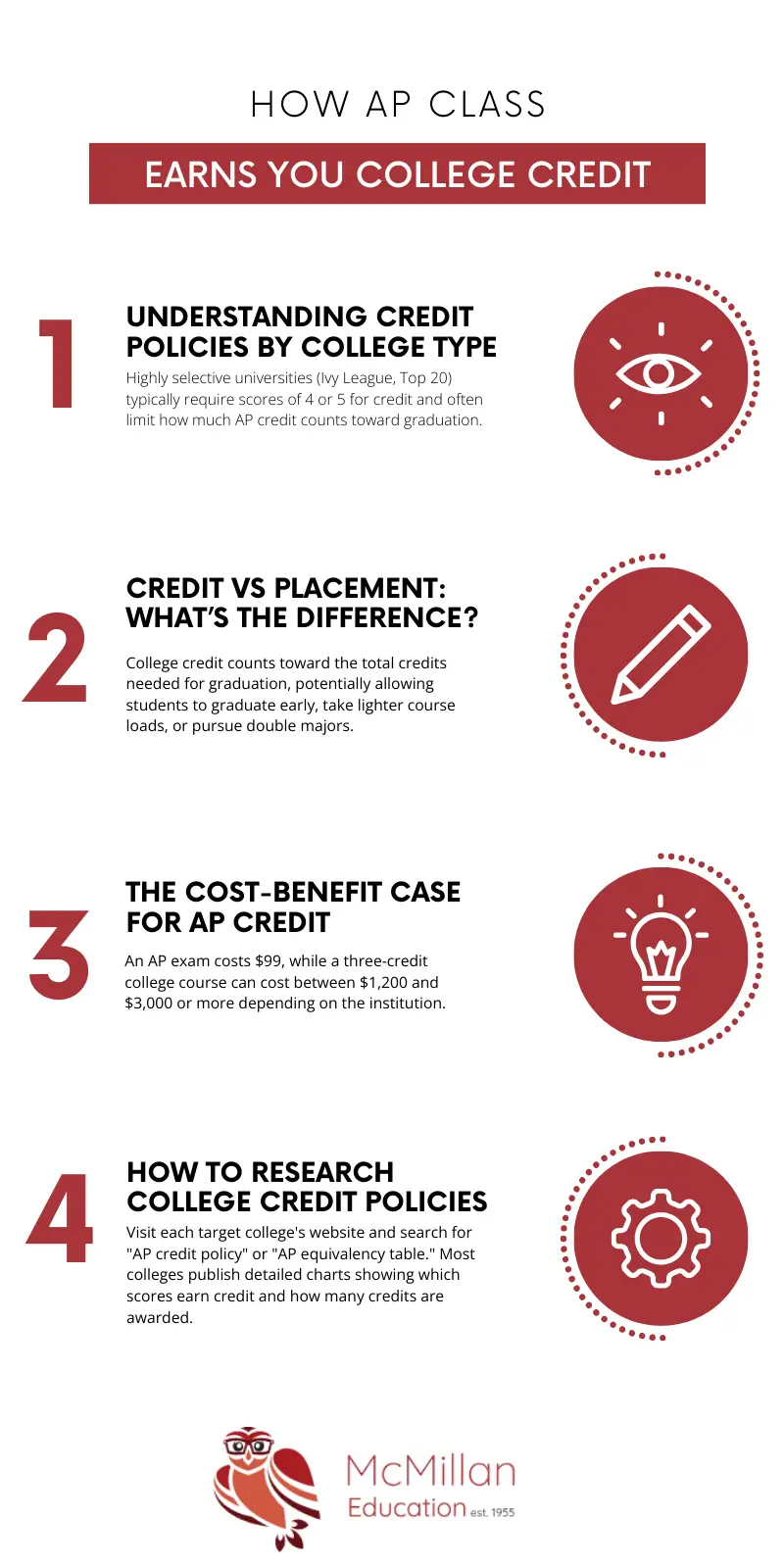
1. Understanding Credit Policies by College Type
Highly selective universities (Ivy League, Top 20) typically require scores of 4 or 5 for credit and often limit how much AP credit counts toward graduation. Some institutions, like MIT and Harvard, offer placement into advanced courses but restrict the number of credits students can apply. For example, MIT accepts 5s on certain STEM exams but does not grant credit for all subjects.
State universities and liberal arts colleges generally have more generous and transparent policies. State flagships often accept scores of 3 or higher for credit and award 3 to 4 credits per exam. Many allow students to fulfill general education requirements or prerequisites with qualifying scores.
Liberal arts colleges vary more widely, some accept 3s for credit, while others require 4s or 5s depending on the subject. In-state public universities typically offer the most favorable and predictable credit transfer policies.
Regional universities and less selective institutions often follow similar patterns to state schools, accepting scores of 3 or higher and applying credits toward degree requirements.
2. Credit vs Placement: What’s the Difference?
College credit counts toward the total credits needed for graduation, potentially allowing students to graduate early, take lighter course loads, or pursue double majors. Placement allows students to skip introductory courses and enroll in advanced classes but does not reduce the total number of credits required for a degree. Some colleges offer both credit and placement, while others offer only one.
3. The Cost-Benefit Case for AP Credit
An AP exam costs $99, while a three-credit college course can cost between $1,200 and $3,000 or more depending on the institution. In cases where AP exam scores replace required college courses, earning credit on multiple exams can result in meaningful tuition savings.
However, the financial benefit depends entirely on whether your target colleges accept your scores and how those credits apply toward degree requirements. Some colleges limit AP credit or apply it only to electives, reducing potential savings. Additionally, some students, particularly in pre-med or highly structured programs, choose to retake introductory courses even when AP credit is available. For most students, the academic preparation and admissions value of AP classes matters more than potential credit alone.
4. How to Research College Credit Policies
Visit each target college’s website and search for “AP credit policy” or “AP equivalency table.” Most colleges publish detailed charts showing which scores earn credit and how many credits are awarded. Check the registrar or admissions office pages, as policies are typically updated annually. If information is unclear, contact the admissions office directly. Keep in mind that policies can change, so verify current requirements rather than relying on outdated information.
Making AP Classes Work for Your Academic Path
AP classes offer genuine academic and admissions value when chosen strategically and aligned with your strengths, interests, and college goals. The key is making informed decisions rather than following formulas or comparing yourself to peers. Success comes from thoughtful course selection, strong performance, and maintaining balance between challenge and well-being.
For families who want guidance navigating these decisions, working with experienced educational consultants can provide clarity and perspective.
If you would like personalized guidance on AP planning, course selection, or broader college preparation, you can schedule a free consultation with McMillan Education.
Frequently Asked Questions
1. When should I start taking AP classes?
Most students begin taking AP classes in sophomore or junior year, though some schools allow limited options in ninth grade. The right timing depends on readiness, school offerings, and academic goals. Colleges care more about steady progression and performance than starting early.
2. What are considered the easiest AP classes?
AP Environmental Science, AP Psychology, AP Human Geography, and AP Computer Science Principles are generally considered more accessible than other AP courses. These classes typically require less prerequisite knowledge, have less intensive workloads, and cover material that many students find more intuitive or relatable.
3. What are considered the hardest AP classes?
AP Physics 1, AP Chemistry, AP Biology, AP U.S. History, AP Calculus BC, and AP English Literature are reported as the most challenging AP courses. They often require strong foundational skills and consistent study habits. However, difficulty varies by student, teacher, and preparation, so a class considered hard for one student may be manageable for another.
4. Do AP classes boost my GPA?
AP classes can boost your GPA if your school uses a weighted grading system, often adding 0.5 to 1.0 points to the grade. This can affect class rank at some high schools. However, many colleges recalculate GPA and evaluate course rigor separately, so taking an AP that significantly lowers your grades may do more harm than good.
5. Can I take AP exams without taking the class?
Yes. Students can register for AP exams without enrolling in the corresponding AP class, a process known as self-studying. This option works best for students with strong subject knowledge and disciplined study habits, but it is not required or expected by colleges.
6. Do I have to take the AP exam if I take the class?
No. Taking an AP class does not require taking the AP exam. The course grade still appears on your transcript, and colleges value the rigor of the class even if you do not sit for the exam.
7. What happens if I fail an AP exam?
There is no official “failing” score on AP exams. Scores range from 1 to 5, and while a 3 is generally considered passing, colleges set their own standards for credit. If you earn a score lower than what your target colleges accept, you simply will not receive college credit for that exam. You choose which AP scores to send to colleges, so low scores do not need to be reported. The main consequence is simply not earning credit or placement.
8. Can I retake AP exams?
Yes. Students may retake AP exams in future years if they want to improve their score. Colleges typically consider the highest score submitted, though policies vary by institution.
9. What’s a good AP score for college credit?
A score of 3 is generally considered passing, but many colleges require a 4 or 5 for credit. Less selective institutions often accept 3s, while highly selective colleges may limit credit or offer placement instead. Always check individual college policies.
10. Are online AP classes legitimate?
Yes, online AP classes are legitimate if they follow the College Board’s approved AP curriculum. Colleges evaluate online AP courses similarly to in-person ones, focusing on rigor, performance, and context. Quality and structure matter more than delivery format.
11. What if my school doesn’t offer many AP classes?
Colleges evaluate students in the context of what their school offers. Taking the most rigorous courses available to you is more important than the total number of AP classes. Limited AP availability does not disadvantage students when course selection is appropriate for their environment.