

Parents constantly tell us, “The college process has become so much harder than when I applied! I just submitted a couple applications – and I don’t think I’d even be accepted at my alma mater nowadays…”
And that was BEFORE last year: 2025’s disruptive storms led even the most seasoned college counsellors to grapple with an array of complex questions. Understanding current college admissions trends has become essential for guiding young charges through these uncertainties and choosing the right college:
- Never has the federal government had such a heavy hand in impacting educational policy and university admissions. How is the anti-woke movement fundamentally altering the college experience?
- Far fewer teenagers are set to be of college-applicant age in the US. So why is it still even more crazily competitive to gain an acceptance at certain universities?
- The post-COVID SAT and ACT world continues to confuse applicants. How much do tests really count?
- AI challenges the intimately human element of holistic admissions. How do students authentically present their true profile to earn a fair evaluation in 2026 – and beyond?
In this guide, we break down the major college admissions trends shaping 2025 and what families should expect heading into 2026. So, in the spirit of demystifying the current college admissions landscape, here is our annual synthesis of trends and projections.
Major College Admissions Trends in 2025
The Demographic Cliff and the College Enrollment Decline of 2025
For many years, the Higher Ed world has had its sights set on 2025-2026 as the beginning of a steady decline in applicant numbers at US colleges and universities. Due to a decline in domestic birth rates after the 2008 recession, the number of US 18 year-olds is expected to decline by nearly 400,000 between 2025 and 2029, and by nearly 600,000 by 2039. Especially at smaller, more tuition-driven colleges, planning in advance for these enrollment headwinds have been central to strategic planning for years. Added to that long-anticipated challenge, however, is the impact of the ongoing public debate about the state of higher education in the United States.
In a widely cited Pew Research Center study this past October, nearly 7 in 10 Americans said they felt that higher education in the US was heading in the wrong direction, citing lack of preparation for today’s job market and a lack of commitment to keeping costs and tuition affordable, but also revealing nearly half felt that colleges were failing to account for a wide range of opinions on campus. That finding echoes a view widely amplified by the right in US political dialogue, reflecting an eroding trust in the value and quality of a college education. While the impacts of these trends are likely to be most visible at less selective colleges this year, there were already several highly selective schools that extended their application deadlines this January to leave time to hit their application targets.
DEI in College Admissions: What Changed in 2025
What Is DEI in College?
Diversity, Equity, and Inclusion (DEI) has shaped college admissions for over 40 years. It’s the framework colleges use to build diverse student bodies and evaluate merit beyond grades and test scores alone, considering resilience, perspective, and ability to contribute to campus community.
What Happened to DEI in Higher Education?
The Trump administration followed through on rhetorical threats to dismantle the US Department of Education, but it was a few policies and actions related to Diversity, Equity and Inclusion (DEI) initiatives and handling of campus protests that shook up higher education the most. The administration cancelled thousands of research grants to over 600 colleges and universities, totalling several billion dollars, and leveraged hundreds of millions of dollars each at some of the US’ best-known and most highly regarded universities in order to gain assurances that they would meet administration demands regarding the dismantling of inclusion and belonging initiatives, and changes to academic content.
More broadly, the administration also tied federal funding to efforts to remove admissions preferences focused on race and insisted on GPA and test scores being the foundation of any judgment of “merit” of applicants. Decades of nuanced policy considerations were flushed as colleges rushed to show the administration they were “playing ball,” and steering away from any policy the government might view as discriminatory against the majority groups.
International Student Impact
International student visa policies were tightened to include vetting of applicants’ social media to keep out students who were critical of the US government or its policies. There were very public cases of international students being detained and stripped of their visas for speaking out about Gaza or US policy. All of this had an intentionally chilling effect on international interest in the US and caused many universities and colleges to rethink their levels of reliance on international student enrollment.
SAT and ACT Requirements: What Changed and What Didn’t
The SAT and ACT, and efforts to reinstate their requirement, gained a lot of media attention as part of the “merit” debate, but with a few highly selective exceptions, test-optional policies largely remained in place. Test-optional admissions policies have largely held steady despite News stories like this one and the simple appeal of the idea of a standardized test as a great equalizer across income levels, school districts, and student backgrounds.
While Stanford and the entire Ivy League except for Columbia have reinstated their testing requirements, joining MIT who was one of the first to reinstate back in 2021, a number of the best-known colleges and universities in the US continue to enjoy the benefits of increased application numbers and remain committed to test optional policies as a way to see more talented applicants and maintain high score averages as the market begins to become tighter with the approach of the “demographic cliff” outlined above.
AI in College Admissions: What’s Changing and What Isn’t
AI in college admissions is here. What exactly that will mean is still to be determined. At professional conferences this past year, we took great care to speak directly with admissions officers, and to participate in AI-related sessions, focusing on evolving practices both in admissions offices and in our work with students. On the college side, admissions officers are currently using AI for everything from answering phone and chat questions about their schools to sorting transcripts and calculating GPA’s, and the technology’s rapid growth has the industry’s attention. On the student side, AI has some healthy uses, from assisting with brainstorming essay structure to conducting more specifically focused college research. Being watchful of the rapid advances of AI into all facets of this process is a requirement of the job, and every student’s process is touched by the technology.
Educating students about the most effective and ethical uses of the tools available to them is paramount in our work. That said, some of the more extreme predictions of large-scale, immediate AI takeovers of broader admissions practices and decision-making were premature, for now. When our Director of College Planning Peter Olrich presented to educational consultants with a few great colleagues on the best uses of AI tools at a conference this past spring, you’d have thought Taylor Swift was performing in the room; needless to say, everyone in the field, on both sides of the desk, is paying careful attention to best practices for the use of AI as it develops.
 .
.  .
. 
Don and Samantha visit Tufts, Babson, and Wellesley College.
2026 Predictions: More Disruptions Ahead:
College Applications Will Shift South and Abroad as Enrollment Declines Continue
Fewer College Applicants and Enrollment Pressure Across the U.S.
As we explained above, the demographic dip in terms of the number of college-age applicants, combined with the drop in international candidates deterred by governmental policies, means fewer students will be available to fill the classrooms at the country’s 2,800+ four-year colleges. As this supply and demand dynamic shifts, we predict even more colleges will struggle to reach enrollment goals, and some will close. We hope some will merge to stay afloat, as some have already done.
Early Decision Expands as Colleges Compete for Students
More private, small liberal arts schools are likely to try to fill over half their freshman class via Early Decision – though this economically wise strategy can disadvantage those needing financial assistance and can also abridge the process for students who need more time to develop their profiles – and opinions. Some schools’ aggressive Early Decision tactics also drew indignation as Enrollment Directors earned CEO-like compensation.
Southern Universities Attract More College Applicants
Meanwhile, we predict the presidential administration’s attack against elite, liberal Northeastern universities, especially the Ivy League, will lead to a rise in applications at the more conservative Southern universities, both the “Southern Ivies” like Vanderbilt, Duke, Georgia Tech, University of Virginia and UNC Chapel Hill, as well as universities such Clemson, Georgia and U Miami, which will draw more students due to their vibrant campus life, “Game Day” football cultures, and relative lack of political upheaval.
English-Speaking Universities Abroad Gain Interest
This coming year should also bring increased interest in English-speaking universities abroad. In 2025, while we continued to see a high volume of students placed at universities such as McGill and the University of Toronto in Canada, and Imperial, UCL, St. Andrews, and others in the UK, we also saw a considerable increase in student interest and active applications to university degrees in Ireland, Spain, Italy and the Netherlands, which led us to launch McMillan Education International, with consultants in England, France and Italy.
The new reality is that the backlash against the government’s intervention in American educational policy and its anti-international stance have boosted applications abroad, both from our American students and from the students we work with in Europe, the Middle East and internationally.
At the same time, during our visits with our international families, and with university counselors at American and international schools, we also are underscoring how, despite the governmental policy shifts, American campuses are actually continuing to seek out students of all nationalities. We certainly can continue to find the right fit for international students searching for strong academics and lively campuses – and safe, welcoming communities that match a family’s cultural and political values.
AI Is Changing College Essays and Applications
AI tools are very capable of writing a well-crafted college essay. We are very careful to remind our students that AI may know everything there is to know about everything on the internet, but that it knows very little about them. That said, as college admissions offices watch their essay responses become more and more similar and less authentic, added layers like 90-second introductory videos are appearing on more applications, and shorter, college-specific writing prompts that are coded for specific traits are replacing broader personal essays on some applications. While AI checking tools are not widely trusted in the industry, the widespread use of AI technology by students is already driving colleges and universities to find new ways to tap into authentic student voices and insights.
College Acceptance Rates Will Mirror a K-Shaped Admissions Landscape
Let’s now take on this riddle: With fewer American and international applicants, how can it be so incredibly hard to get into a top college?
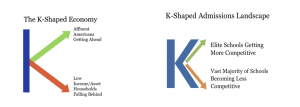
We draw a parallel between recent economic trends to the general movement of college admissions. Economists describe the recent financial picture as one that takes on the shape of a K on a graph: the very rich are getting richer, so a small axis points up, while the vast majority are struggling, with a large axis pointing down.
This K-shaped economy mirrors our current K-shaped admissions trend: the most elite are getting even more selective, while all the rest are experiencing difficulty. Indeed, the keyhole is getting even smaller for those seeking entry to the top tier of colleges – Ivy-Plus, NESCAC, Southern Ivies (see above), Public Ivies (U Michigan, Texas, UVA…) and a couple dozen others that high-flying students all seem to be applying to. But on the bottom of this same acceptance graph, over 2,000 colleges accept most of the students who apply, and direct admissions – a newer phenomenon where students are accepted simply by entering basic data like grades and scores on the Common App – has taken off. Many colleges simply need the tuition revenue to survive.
Indeed, check out the admissions rates at three very different types of universities from this past year, compared to when Mom and Dad applied in 1995.
- Northeastern: approximately 75% in 1995, 5.6% in 2025
- UCLA: approximately 37% in 1995, 9.4% in 2025
- Vanderbilt University: approximately 65% in 1995, 6% in 2025
How can the admissions keyhole be so tight given the demographic dip? The top tier of selective colleges still benefit from ambitious international students who have always considered US colleges the paragon of universities worldwide. At the same time, the anxiety surrounding admissions means students are applying to more and more colleges, which is facilitated by the efficiency of using the streamlined Common Application. Whereas their parents can count the apps they submitted on one hand, many students now submit to over 10 colleges, and sometimes double that. Colleges love this trend since they collect more application fees and increase their perceived selectivity.
Diversity in College Admissions After Affirmative Action
In the face of the 2023 Supreme Court Decision stomping out Affrimative Action, and the ensuing political effort to end DEI, college admissons officers will become more and more creative in their efforts to recruit students whose diversity reflects that of the nation and who will contribute to the range of perspectives that have historically made US university campuses so renowned. No longer can candidates simply check a box marking their race, for example. But they can explain the diversity of their background and their views in response to new, probing prompts that pass legal muster, such as these from the university most famously in the government’s crosshairs:
- Harvard has long recognized the importance of enrolling a student body with a diversity of perspectives and experiences. How will the life experience that shaped who you are today enable you to contribute to Harvard?
- Describe a time when you strongly disagreed with someone about an idea or issue. How did you communicate or engage with this person? What did you learn from this experience?
How We Are Leveraging Wisdom During Disruptive Times:
Encouraging International Study – US and Abroad
We’re doubling down on encouraging international students to study in the US – while at the same time urging more students to consider the cultural and academic benefits in English-speaking universities in Canada, the UK, and Europe
At the same time that we are confident we can still find safe, inclusive American campuses that match each student, we’re also poised to find great English-speaking universities outside of the US. What’s exciting is that the American Liberal Arts model, which emphasizes broad-based skills development, critical thinking and innovation, has taken root in many parts of Europe, including Ireland, Scotland and The Netherlands. Classes are taught in English but students can experience historical European cities and easily travel to many nearby countries.
In England, laser-focused students can pick a single discipline and earn a degree in three years at a fraction of the cost – business at the London School of Economics and Political Science, or engineering at world-renowned Imperial College. Or for those who want to split equal time between the Old and New Worlds, a handful of dual degree programs exist for gifted students. We also envision more of our graduate students asking us for support in studying outside of the US; Europe should continue to rise in popularity for graduate programs.
Guiding Students Toward Authentic Leadership
We’re guiding students towards authentic avenues of leadership and growth rather than pricey, pay-to-play extracurriculars.
As scarcity continues to define the admissions landscape of the most selective colleges and universities, parents and students increasingly look to extracurricular activities as a potential opportunity for students to separate themselves from others in the applicant pool. An entire industry has developed around expensive service trips, research projects and internships with paid mentors, and many families with means latch on to these “pay-to-play” opportunities to try to secure experiences that will advantage them in the admissions process. We are doubling down in our work with students to help them make extracurricular choices from the inside-out, rather than from the outside-in.
We guide students not just in anticipating what admissions officers might find compelling, but in making extracurricular choices that are aligned with their authentic interests and talents, and in working toward leadership and enrichment in areas that spring from who they actually are, in ways that will align with the broader arc of their journey of becoming. We are prioritizing authenticity in our guidance, letting the selectivity of the landscape be an inspiration, but not something that becomes its own scripting influence of a student’s story. We are working to help students understand themselves, and to let authentic growth stem from intentional choices, rather than merely “checking boxes.”
The Human Factor: Personal Connection in the Age of AI
We’re underscoring the Human Factor by increasing personal touchpoints with our students – and coaching them through the extra drafts of authentic, teenage POV essays.
As anyone who has tapped into our tech tools like The Owl’s Nest knows, we’re all about embracing innovation, both to facilitate certain tasks and to enable our consultants to have even more time to devote to the heart and soul of college counseling: probing discussions that guide adolescents to explore new areas of growth. Our craft involves the utterly low-tech skill of earning the trust of a naturally skeptical teenager and providing accurate advice, appropriate structure and unwavering support. We see this same Human Factor as critical as the intoxication of Artificial Intelligence grows exponentially, and we will urge our students to ask questions on their campus visits like: How do the professors greet their students? What types of clubs are highlighted on the Student Commons? Do members of the campus community appear healthy and happy? AI can only do so much; it’s the relationships we make with peers and professors at college that resonate when we become alums.
Final Thoughts
These trends highlight the increasing complexity and unpredictability of college admissions, and the need for informed guidance. Shifting demographics, policy changes, and new technologies are reshaping how students are evaluated year to year.
At McMillan Education, we help families make sense of this evolving landscape and translate insight into a clear, student-specific strategy. Talk with an experienced college admissions consultant about how these changes may affect your student.
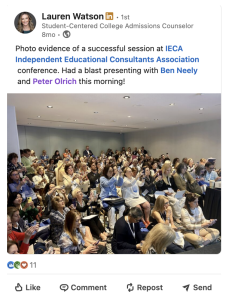
The crowd at an AI session at the national IECA conference, co-led by Director of College Planning, Peter Olrich.