

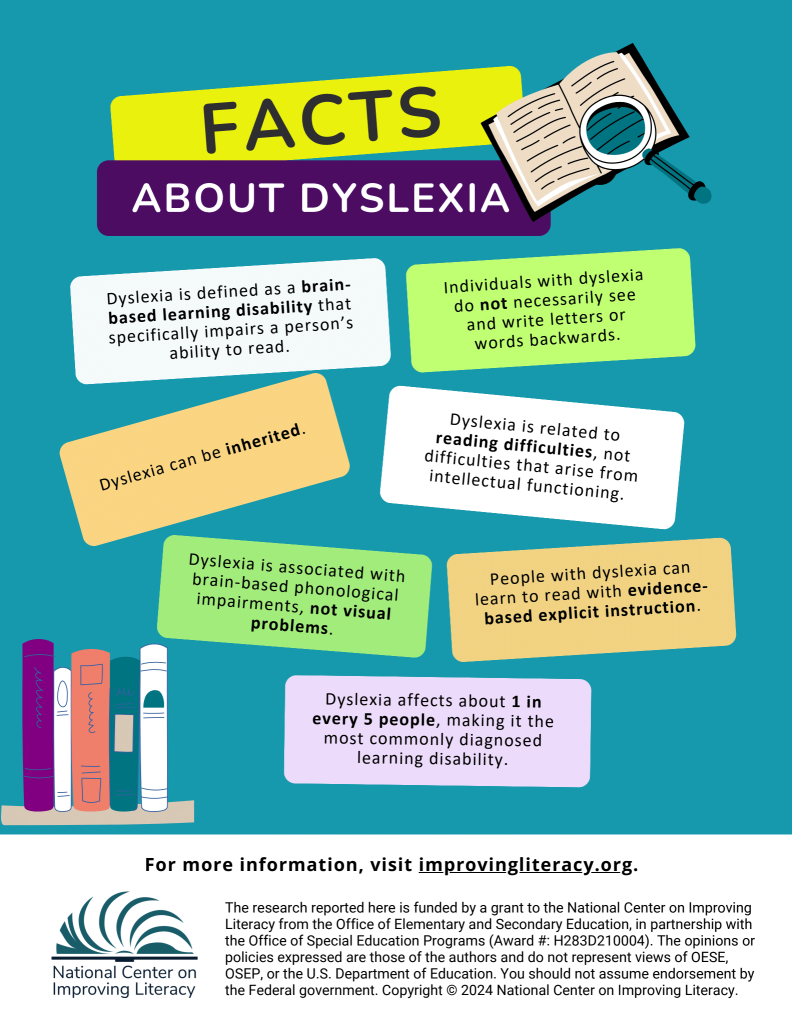
Dyslexia affects roughly one in five people, yet the college admissions process offers no single pathway for families navigating it. The right planning approach depends on where a student’s dyslexia actually stands, how early it was identified, how well it responded to intervention, and what level of academic infrastructure a college will need to provide. Dyslexia and college admissions planning are not the same conversation for every family.
This article covers the full planning process for students and families navigating dyslexia and college admissions: how to establish an accurate picture of where a student stands before planning begins, how remediation level shapes the college list, what the testing and accommodation process requires, how to evaluate institutional support, and what the application itself looks like.
Key Takeaways
- Dyslexia is a spectrum disorder. Where a student falls, from unremediated to fully remediated, determines the college list, the support required, and the application strategy.
- Structured literacy intervention started early can substantially expand college options. The remediation level at senior year reflects decisions made years before.
- Dyslexia-specific technologies, text-to-speech, speech-to-text, human reader access, are a primary factor in evaluating whether a college’s support is substantive or procedural.
- IEP and 504 plans do not transfer to college. Accommodation responsibility shifts entirely to the student.
- SAT and ACT accommodation requests are submitted through the school, not the family, and require significant lead time.
- Disclosure is a strategic decision, most valuable when it explains something in the transcript that would otherwise read negatively.
What Dyslexia Means for the College Admissions Process
Families managing dyslexia and college admissions often have a diagnosis on file, but not a current picture of where their student actually stands. That distinction matters because dyslexia is a spectrum disorder, and intervention outcomes vary considerably.
- A student whose dyslexia was identified early and addressed through structured literacy instruction may, by high school, be reading and writing with a level of fluency that places few constraints on college options.
- A student who has made real progress but retains processing differences that require accommodation sits in a different position.
- A student whose dyslexia was identified late or did not respond fully to intervention may continue to rely on assistive tools and technologies to manage academic demands.
These are meaningfully different situations. Where a student falls on that spectrum is the first question college planning has to answer. A current psychoeducational evaluation is what establishes that answer accurately. An educational consultant with specialist experience in learning differences can help families interpret those results in the context of college planning.
Why College Admissions Planning for Dyslexic Students Starts Early
The remediation level a student arrives at by senior year is largely determined by decisions made years earlier. That is why dyslexia and college admissions planning are connected to K-12 decisions in ways families do not always anticipate.
1. Early intervention and what it can achieve
Structured literacy intervention, when introduced early and sustained consistently, can produce substantial gains in reading fluency, decoding, and written expression. For some students, intervention begun in the early elementary years results in academic skills that place few practical constraints on college options by high school. The students who arrive at college planning with the widest range of options are typically those whose dyslexia was identified and addressed before the academic demands of middle and high school made the gap harder to close.
2. IEP and 504 plans: what changes when students apply to college
Families who have relied on an IEP or 504 plan through K-12 should know that neither document applies at the post-secondary level. Federal law shifts the framework entirely at college: reasonable accommodations are still required, but the process becomes the student’s responsibility, documentation requirements change, and nothing from the K-12 record carries over automatically. Starting that process before senior year gives families the time to understand what colleges actually require and assemble the right documentation.
3. High school course selection for dyslexic students
Course selection in high school shapes how colleges read a transcript, and for dyslexic students, the question is more specific than it is for most. A transcript that shows consistent academic rigor, supported by a documented history of the learning difference, reads as evidence of capability. One where course choices appear to avoid challenge, without explanation, can read as the opposite.
Standardized Testing Accommodations for Dyslexia
Standardized testing is one of the most time-sensitive planning decisions in the college admissions process for dyslexic students. The accommodation approval process has its own timeline, and missing it has consequences that are difficult to reverse.
1. What accommodations dyslexic students qualify for
The most common testing accommodations for dyslexia are extended time, a separate testing room, and text-to-speech or human reader access. Extended time is the most frequently approved, and typically means 50 percent additional time, though some students qualify for 100 percent.
Eligibility is determined by documentation, specifically a current psychoeducational evaluation that establishes the functional impact of the learning difference on timed reading and written tasks. The accommodation must also be in active use at school before the College Board or ACT will approve it for standardized testing.
2. How to apply for SAT and ACT accommodations for dyslexia
SAT accommodations for dyslexia are submitted through the student’s school, not directly by the family. The school’s testing coordinator initiates the process through the College Board’s Services for Students with Disabilities.
ACT accommodations for dyslexia follow a similar school-based process. Families should begin well in advance of the intended test date, earlier if a psychoeducational evaluation needs to be updated first, as the evaluation itself can take weeks to complete, and the review process adds additional time.
3. Using the PSAT to practice with accommodations in place
The PSAT serves a practical function beyond its role in National Merit consideration. For many dyslexic students, it is an early opportunity to sit a timed standardized test with approved accommodations in place under real testing conditions. Using the PSAT this way means the logistics are confirmed and functioning before the SAT or ACT results count toward college admissions.
4. AP exam accommodations: a separate process families often miss
AP exam accommodations are administered through the College Board, and students already approved for accommodations on the SAT or PSAT do not need to submit a new request for AP exams. However, how some accommodations are administered on AP exams can differ. College Board’s submission deadlines apply, and families should confirm the current timeline with their school’s AP coordinator each academic year.
5. Test-optional policies and dyslexic students
Test-optional policies remain widespread, but the landscape is shifting, and families should verify each school’s current policy carefully. For dyslexic students, the strategic question at test-optional schools is whether submitting scores strengthens the application. An educational consultant experienced with learning differences can help families make that determination college by college, weighing scores against the full application profile rather than applying a blanket approach across the list.
Building a College List for Students with Dyslexia
Building a college list for students with dyslexia requires a different set of filters than a standard college search. Remediation level determines which colleges belong on a realistic list, and the sections above establish where a student stands. This section addresses what to look for once the search begins.
1. How remediation level maps to college type
For students whose dyslexia is fully remediated, the college list is shaped primarily by academic interest, selectivity, and major considerations. The relevant planning question is which programs will place high reading and written output demands, and whether that aligns with the student’s documented profile.
For students who are partially remediated, the list narrows around institutional infrastructure. These students need colleges that provide documented, substantive accommodation services, not just a disability services office that approves extended time. The quality and accessibility of that support are the primary filter.
For students who continue to rely substantially on assistive technologies, the list narrows further to specialized institutions and colleges with comprehensive LD programs where assistive tools are integrated into the academic environment. General disability services at a standard institution may not provide the level of support these students require.
If you are weighing which colleges can genuinely serve your student, McMillan’s LD educational consultants have placed dyslexic students across the full spectrum, from specialized LD institutions to competitive mainstream colleges, and know what separates programs that deliver from those that look good on paper.
2. Designated LD programs vs. general disability services
Most colleges provide some form of disability services, but for dyslexic students, the relevant question is what those services actually deliver. A general disability services office manages accommodation approvals, but typically has no specialist expertise in language-based learning differences and no infrastructure for the ongoing academic challenges dyslexia creates at the college level.
A designated LD program is structurally different. It employs staff trained in language-based learning differences, provides access to dyslexia-specific technologies, and offers structured support for the reading volume and written output demands that college coursework places on dyslexic students.
Here you can check the list of colleges for students with learning differences, including programs with designated LD infrastructure.
3. The additional cost of LD programs
Designated LD programs carry supplemental fees beyond standard tuition. These fees vary by institution and program intensity, and families should not assume program fees are covered by standard financial aid packages. They should research program costs early in the college search, before financial constraints narrow options that were never fully evaluated.
4. Assessing dyslexia support at colleges
When evaluating a college’s support for dyslexic students, families should ask:
- Does the program have staff specifically trained in dyslexia and language-based learning differences?
- What text-to-speech, speech-to-text, and reading support technologies does the program provide?
- How does the program support students in reading-heavy courses or majors with high written outputrequirements?
- How are extended time and reader accommodations coordinated for exams?
- What happens when a faculty member does not follow through on an approved accommodation?
- How often does a student meet with a specialist, and is that contact mandatory or self-initiated?
The answers to these questions reveal whether a college’s support for dyslexic students is substantive or procedural.
Applying to College with Dyslexia
Once the college list is built, the application itself requires several planning decisions specific to students and families navigating dyslexia and college admissions, from what to disclose and where, to how the transcript is contextualized for admissions officers.
1. Disclosing dyslexia: whether to and where
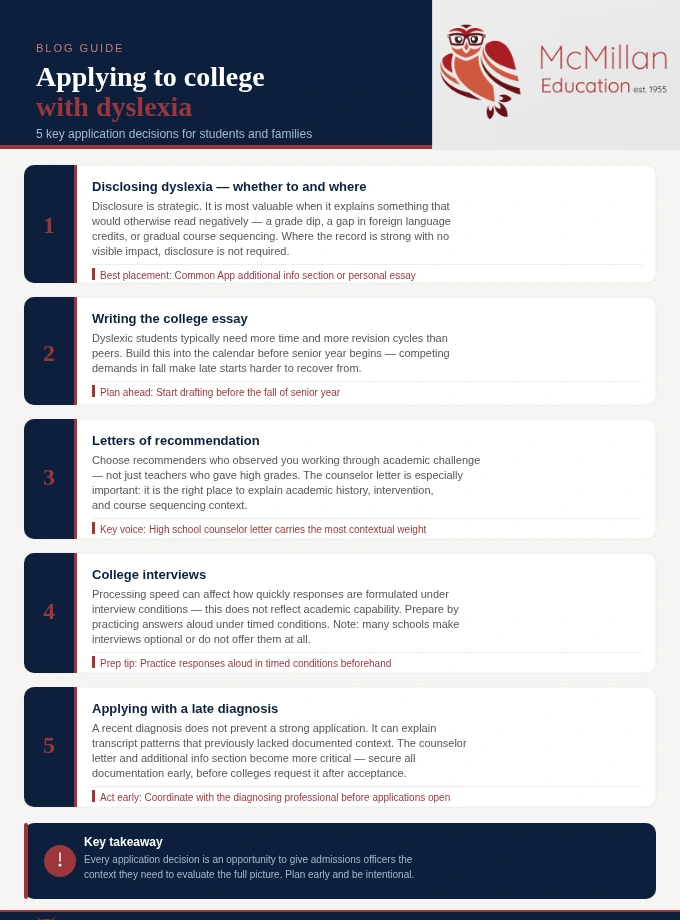
Disclosure is a strategic decision, and the right answer depends on what the record shows. Where dyslexia explains something that would otherwise read negatively, a gap in foreign language credits, a course sequence that builds rigor gradually, a year where grades dipped before intervention took effect, disclosure provides context that admissions officers need to evaluate the record accurately. Where the record is strong, and dyslexia has no visible effect on the transcript, disclosure is not required, though some families choose to disclose regardless, and that is a reasonable choice.
When disclosure is appropriate, the additional information section of the Common Application is the most direct placement. The essay carries disclosure when dyslexia is genuinely central to the student’s academic story.
2. Writing the college essay with dyslexia
For dyslexic students applying to college, the essay requires more time and more revision than most students anticipate. Building that time into the application calendar is a planning decision that should be made early, before the fall of senior year, when other application demands compete for the same time.
3. Letters of recommendation for students with dyslexia
The most useful letters for dyslexic students come from teachers who have observed the student working through academic challenge, not simply teachers who awarded high grades. A recommender who can speak to how a student approaches difficult reading, organizes written work, or has developed academically over time provides more relevant context than one who can only confirm strong performance. The high school counselor’s letter carries particular weight in college applications for dyslexic students. It is the appropriate place to explain the academic history, the role of intervention, and the context behind any course sequencing decisions the transcript does not explain on its own.
4. College interviews and dyslexia
Processing speed can affect how quickly a student formulates and delivers responses under interview conditions, and that does not always reflect academic capability. Interview preparation for dyslexic students looks different than standard practice, specifically, practicing responses to common questions aloud and in timed conditions before the interview itself.
Families building a college list should also note that many colleges make interviews optional or do not offer them at all, and that interview weight in admissions decisions varies considerably by institution.
5. Applying with a late dyslexia diagnosis
A late dyslexia diagnosis changes the application timeline but does not prevent a student from presenting a strong college application. A recent diagnosis can explain patterns in the transcript that previously had no documented context. The counselor letter and additional information section become more important in this scenario, and families should work with the diagnosing professional early so documentation is ready when colleges request it after acceptance.
Start College Admissions Planning with Experienced Guidance
Dyslexia and college admissions planning have many moving parts, and the variables are specific to each student. What a student’s psychoeducational evaluation reveals, how remediation level shapes the college list, what the testing and documentation process requires – these decisions build on each other, and the complexity compounds as planning progresses. Families navigating this process often find that the questions multiply faster than the answers.
For families who want experienced guidance, McMillan Education’s learning differences educational consultants have worked directly with dyslexic students across the spectrum, understand how the condition presents in practice, and draw on a placement history built over decades of that work.
Schedule a free consultation with one of McMillan’s consultants to discuss the planning process for your student.
Frequently Asked Questions
1. Can a student with dyslexia get into a competitive college?
Yes. Remediation level is the determining variable. Students whose dyslexia has been fully or substantially remediated through structured intervention apply to competitive colleges on largely the same terms as any other student. The planning process accounts for where the student actually stands, not the diagnosis itself.
2. Does dyslexia need to be disclosed on a college application?
No. Disclosure is a strategic decision. It is worth making when it explains something in the record that would otherwise read negatively. Where the record is strong and dyslexia has no visible effect on the transcript, disclosure is not required.
3. What accommodations are available for dyslexic students taking the SAT or ACT?
The most common are extended time, a separate testing room, and text-to-speech or human reader access. A history of school-based accommodations strengthens the request. ACT requires that requested accommodations reflect what the student currently receives at school. The College Board’s standard is less absolute, but documented school use remains an important supporting factor. Requests are submitted through the school, not the family directly.
4. What happens to a student’s IEP or 504 plan when they go to college?
Neither document applies at the post-secondary level. Colleges operate under a different legal framework, and the student takes on full responsibility for initiating and managing accommodation requests.
5. How early should families start planning college admissions for a dyslexic student?
The earlier the better. Remediation level in the senior year is largely determined by decisions made years earlier. Families with students in middle school or early high school have the most planning options available to them.