


Even with so many colleges still adhering to test-optional admissions policies, SAT scores remain a key factor in college admissions and can significantly expand scholarship opportunities amid evolving college admission trends. With so much at stake, it’s important to know how to prepare for the SAT.
That’s why many students take SAT practice tests in hopes of improving their scores; they can be an important piece of a plan to gain confidence, show what they’re capable of, and reinforce good study habits.
This guide offers clear insights into how to use SAT practice tests effectively. It explores free SAT practice test resources, explains how to build an effective study plan, and highlights common mistakes students make.
Key Takeaways
- An SAT practice test measures more than just content knowledge. It reveals strengths, timing challenges, and skill gaps across reading, writing, and math.
- Practice tests should be taken strategically, not excessively. Most students benefit from four to six full-length exams, typically scheduled every two to three weeks throughout their preparation.
- Practice tests are tools, not the entire study plan. Their purpose is to guide a focused SAT study plan that targets specific weaknesses.
- Official resources provide the most reliable preparation. Free SAT practice tests from the College Board and Khan Academy reflect the current digital exam format.
- Reviewing mistakes is more important than simply taking more tests. Careful analysis and targeted adjustments lead to steady, measurable score improvement.
- Common mistakes can reduce the effectiveness of SAT practice tests. Taking tests too close together, skipping review, ignoring timing, or neglecting weak areas can limit real score improvement.
What an SAT Practice Test Is and Why It Matters
An SAT practice test is a full-length simulation of the real exam. It includes timed sections covering math, reading, and writing, mirroring the structure, format, and pacing students experience on test day.
For students wondering how to prepare for the SAT, these practice tests are usually the first approach that comes to mind. However, they shouldn’t be confused with score guarantees, as they are diagnostic tools designed to help you understand the real testing environment and identify areas for improvement.
How SAT Practice Tests Fit into an Effective SAT Study Plan
SAT practice tests should be used as part of a structured SAT study plan, not taken randomly. Without a clear review process, these tests are often ineffective.
With a practice–review–adjust cycle, students can truly learn from these tests. Here’s how it works:
- Diagnostic test: A diagnostic test is a test students take at the beginning of their SAT prep to establish a baseline score and identify strengths and weaknesses.
- Practice tests: Practice tests help students build familiarity with the SAT’s format, timing, and question types while measuring improvement over time.
- Review and adjustment: The initial diagnostic test and following SAT practice tests should be carefully analyzed to identify patterns of mistakes and areas of weakness. Students can then adjust their study plan and track progress to steadily improve their overall score.
This structured approach ensures every practice test moves students closer to their target score.
Free Practice Test Resources to Help You Prepare for the SAT
There are many online SAT prep tools available, but students must know how to choose a reliable source for proper preparation. Trustworthy tests include resources that are official, full-length, and reflect the current digital SAT format. Two reliable resources students can use include:
- College Board: The College Board is the official nonprofit organization that develops and administers the SAT exam. Their SAT Suite of Assessments provides information regarding dates and deadlines, testing rules, and full-length SAT practice tests through the Bluebook™ testing app.
- Khan Academy: Khan Academy is an official partner of the College Board, making it another reliable source. It offers a library of thousands of practice questions, videos, and lessons to help students prepare for the SAT exam.
How to Prepare for the SAT: Building a Study Plan with Practice Tests
There are five key steps to building an effective SAT study plan:
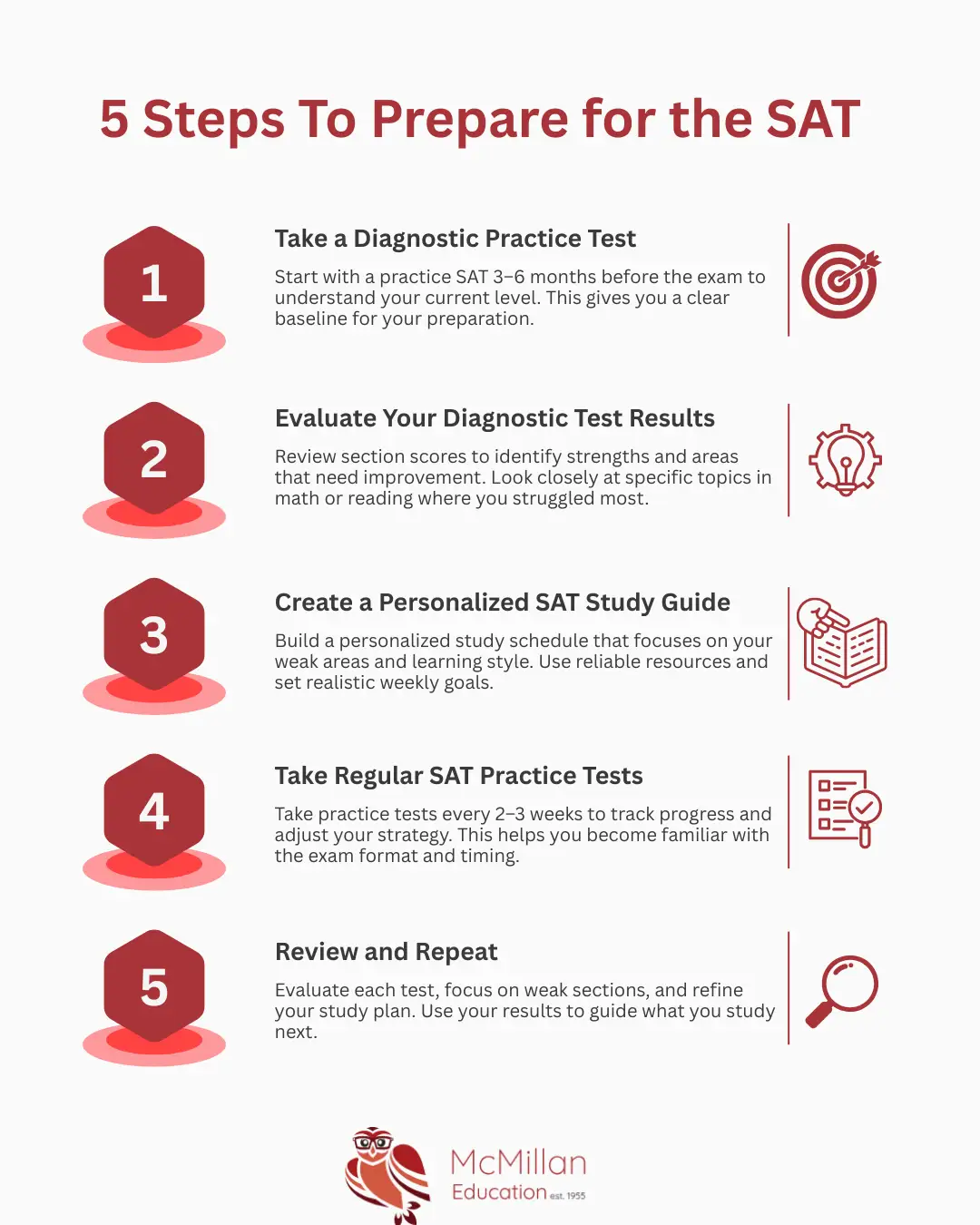
Step #1: Take a Diagnostic Practice Test
The first diagnostic test should be taken around 3 to 6 months before the real exam. This means students should start the preparation process as early as the summer going into junior year or early in their junior year.
Step #2: Evaluate Your Diagnostic Test Results
The results of your diagnostic SAT test should be the foundation of your preparation strategy. Effective SAT score analysis goes beyond reviewing the total score; it involves evaluating the scores of different sections to better understand which areas require more attention, such as SAT English (Reading and Writing) or math.
You can then dissect these sections even further. For instance, if you receive a low score in math, you can identify specific areas like core math concepts across algebra, geometry, trigonometry, and data analysis to better identify skill gaps.
Step #3: Create a Personalized SAT Study Guide
After identifying your strengths and weaknesses, you can start creating an SAT study plan. Resources like Khan Academy’s Free SAT Tutoring with Schoolhouse separate prep into SAT Math and SAT Reading and Writing across three difficulty levels to help you focus on the specific areas where you need to improve.
Each student’s study schedule will depend on their personal preferences. Since everyone has a different learning style, we encourage you to find a routine that works for you.
What’s important is that you stay consistent and follow a schedule that keeps you on track.
Step #4: Take Regular SAT Practice Tests
Regular practice tests help you track progress and determine whether your study plan is effective or needs adjustment. However, tests should not be taken too often, as this can be counterproductive and cause burnout.
Instead, they should be taken every 2 to 3 weeks so you have time to review your results and continue studying between tests.
Step #5: Review and Repeat
Similar to how students must analyze the diagnostic test, they should also evaluate the results of their practice exams. These results will help them determine what to study next and which sections need more focus.
Online SAT Prep vs. Self-Guided Practice Tests
Students preparing for the SAT typically choose between self-guided practice and online prep tools. Both approaches can be effective, depending on a student’s learning style and level of discipline.
Self-guided practice involves using free official resources, such as College Board’s Bluebook practice tests, to take full-length exams, review results, and adjust study plans independently.
One advantage of this approach is its flexibility. Students can study on their own schedule and focus on the areas they believe need improvement. However, without structured guidance, some students may struggle to accurately identify patterns in their mistakes or create a consistent study routine.
Structured online SAT prep, on the other hand, typically includes organized lessons, skill-based practice, study schedules, and progress tracking. The benefit of structured prep is built-in direction and accountability. However, it may require students to follow a more defined system, which may not suit those who prefer complete independence.
Ultimately, self-study can be effective for motivated students who are comfortable analyzing their own performance, while structured online prep may be helpful for those who benefit from additional organization and guided support.
Common Mistakes Students Make with SAT Practice Tests
Although SAT practice tests are essential for preparation, students often make avoidable errors when using them. This includes:
- Taking too many tests too close together: Taking SAT practice tests back-to-back does not allow enough time to see meaningful improvement. Since many students start preparing for the SAT as early as 6 months before the test, they have sufficient time to review results carefully, focus on key skill gaps, and strengthen weak areas before testing again. By taking a practice test every 2 to 3 weeks, students avoid burnout and prioritize skill development over repetition.
- Not reviewing incorrect answers: Failing to review incorrect SAT practice test answers is a missed opportunity, as it increases the risk of repeating the same mistakes on the real exam. In addition to reviewing each wrong answer, students should understand why the correct answer works and identify patterns in recurring mistakes.
- Ignoring timing and endurance: The SAT is 2 hours and 14 minutes, not including breaks. Students have 64 minutes to complete the Reading and Writing section and 70 minutes to complete the Math section. Practice tests should mirror these exact timing conditions. Skipping timed practice or pausing frequently can prevent students from building the stamina and pacing skills required on test day. This makes time management and endurance a critical part of SAT preparation.
- Neglecting weaker sections: A common mistake students make is focusing only on the areas where they perform best. For instance, if a student is strong in math, they may concentrate on improving math because it feels more comfortable. This approach neglects weaker sections, which can reflect poorly on the day of the real exam.
- Treating practice tests as score predictors: Students who believe practice tests guarantee a specific score risk developing false confidence before the exam. Instead, practice tests are diagnostic tools that help students improve weaknesses, enhance time management, and build familiarity with the test’s structure and format.
Is an SAT Practice Test Enough to Prepare Successfully?
Yes, no, and maybe.
An SAT practice test is an important part of preparation, but for most students, it isn’t enough on its own. Simply taking practice exams without reviewing mistakes or following a clear SAT study plan can limit how much you actually improve.
What SAT practice tests can do is show you where you stand. They help you identify weak areas, get familiar with the structure and timing of the exam, and build stamina for a test that lasts over two hours. When used consistently, they also help you track progress over time.
What they can’t do is automatically teach you the content you don’t understand, guarantee a specific score, or fully recreate the pressure of test day. If you’re not reviewing your answers carefully or adjusting your study approach, your score may not change much, even after multiple tests.
All things considered, these practice tests tend to work best for independent students who feel confident with most of the core concepts and are comfortable reviewing their own errors.
However, some students may need more structured support, especially if they struggle with certain concepts, time management, or staying consistent. In those cases, additional guidance through structured SAT prep, through one-on-one work with a tutor, or a group class through a trusted program can provide accountability and direction. A tutor can also help you weigh the ACT vs. SAT and recommend the right level of support based on your goals.
Conclusion
An SAT practice test is a powerful tool for students preparing for the exam. However, achieving strong results requires more than practice alone. Students need a strategic study plan that targets weak areas and builds the confidence necessary to perform at their best on test day.
Although SAT scores play a key role in admissions decisions, they do not define an application. Effective university planning goes beyond test preparation. It involves identifying colleges that align with a student’s personal and academic goals, selecting extracurricular activities that strengthen their profile, and staying ahead of important deadlines and application requirements.
Schedule a free consultation to discuss your family’s unique educational needs.
Frequently Asked Questions
1. How many SAT practice tests should I take?
Students should aim to take between four and six SAT practice tests. However, the exact number will depend on the length of their preparation period. As a general guideline, students should plan to complete one full practice test every two to three weeks while studying.
2. Are free SAT practice tests accurate?
Official SAT practice tests, such as those provided by the College Board and Khan Academy, accurately reflect the current digital SAT format. Less reliable resources, however, may be outdated and fail to represent the structure and content of the actual exam.
3. How should I review an SAT practice test?
Start by carefully analyzing every missed question to identify patterns, recurring mistakes, and underlying knowledge gaps. Determine whether errors stem from content weaknesses, time management issues, or misreading the question. Then, use these insights to create an SAT study plan that targets specific areas for improvement before your next practice test.
4. Can I prepare for the SAT using only practice tests?
One common mistake students make is relying solely on practice tests. While practice exams are valuable, they should be used to identify weak areas and guide focused study. By targeting specific gaps in knowledge and skills, students can build a stronger foundation and improve their scores gradually.
5. When should I start taking SAT practice tests?
Many students begin preparing for the SAT three to six months before their test date. Students should take an initial diagnostic test at the start of their preparation to establish a baseline score and then continue taking full-length practice exams periodically to track progress and adjust their study plan as needed.