
The NCAA recruiting calendar determines when a coach can call, visit, evaluate, and host a recruit. It also determines when none of those things are possible. The dead period is that designation, the most restrictive window on the calendar, and it operates on dates that shift annually based on sport, division, championship schedules, and coaches association obligations.
This article covers what the dead period is, when it occurs by division and sport, what recruits can and cannot do during it, how it interacts with the transfer portal, and how to position effectively for the contact periods that follow.
Key Takeaways
- The dead period prohibits all in-person contact and campus visits. Phone, text, and email remain open.
- Dates vary by sport and division and shift annually. Division III has no designated dead periods.
- For Division II, Dead periods are limited and tied to signing periods (often called “signing date dead periods”).
- The dead period restricts coaches, not recruits. Recruits can initiate communication throughout.
- Transfer recruits face greater consequences. Compressed portal windows leave no recovery time when evaluation days are lost.
- Coaches use the dead period to consolidate recruiting boards. Recruits who communicate effectively during this window influence those decisions.
What Is the NCAA Dead Period?
A dead period is a defined window on the NCAA recruiting calendar during which authorized athletics department staff may not make any in-person recruiting contacts or evaluations with a prospective student-athlete, on or off the institution’s campus. The same restriction blocks official and unofficial campus visits. However, coaches and recruits remain free to communicate by phone, text, email, or direct message. The constraint is physical access, not contact itself.
The NCAA places dead periods around moments where recruiting activity would otherwise concentrate intensely:
- the week of national signing dates
- the days surrounding the major coaches association conventions
- the window of the NCAA championship for a given sport
- the opening days of transfer portal windows.
Each of these is a stretch where uncontrolled in-person activity would either disadvantage coaches attending professional obligations or create coercive pressure on recruits making consequential decisions.
The four standard periods on the NCAA recruiting calendar are defined as follows:
- Contact period. Authorized athletics department staff may make in-person, off-campus recruiting contacts and evaluations. This is the most permissive window and includes home visits, school visits, and off-campus meetings.
- Evaluation period. Coaches may assess recruits at competitions, practices, or schools, but off-campus contact with the recruit or family is not permitted. Watching is allowed; talking is not.
- Quiet period. In-person contact is permitted only on the institution’s campus. Coaches may host official and unofficial visits, but cannot travel to meet the recruit.
- Dead period. No in-person contact or evaluations on or off campus. No campus visits permitted. Phone, text, and digital communication remain open.
Two additional designations appear on the latest D I calendars and are worth recognizing:
- Recruiting shutdown functions as an enhanced dead period in certain sports, most notably basketball, during which no form of recruiting contact is permitted.
- Signing date dead period is the term Division II uses for its narrower signing-tied restrictions. Both operate under the same core principle: no in-person contact, no visits.
NCAA Dead Period Dates and Schedules by Division
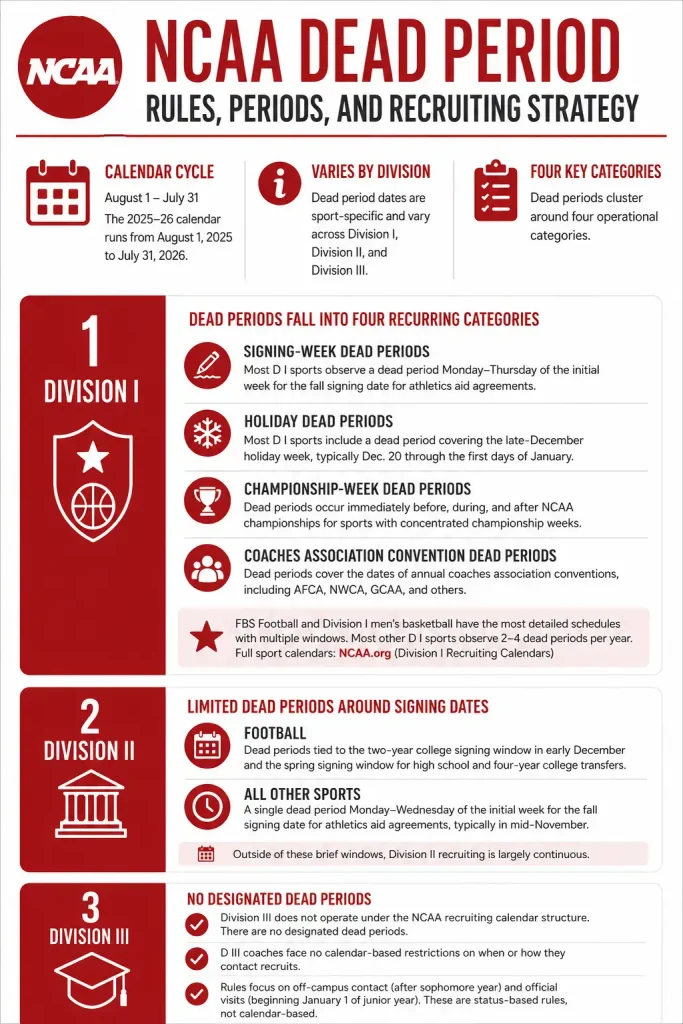
Dead period dates are sport-specific and vary across Division I, Division II, and Division III in both frequency and scope. D I publishes a full annual calendar covering every NCAA-sponsored sport. D II operates almost entirely as a contact period, with dead periods limited to the days surrounding initial signing dates. D III does not operate under this calendar at all.
The NCAA publishes its recruiting calendars on a cycle that runs August 1 through July 31. The 2025–26 calendar covered the period from August 1, 2025 to July 31, 2026. The 2026–27 calendar has not yet been published and is typically posted on NCAA.org during the summer preceding the new cycle.
The structural pattern is consistent year to year. Dead periods cluster around four operational categories, and recognizing the categories matters more than memorizing specific dates, since the dates shift annually based on the NCAA championship schedule and coaches association meetings.
1. Division I Dead Period Dates
Division I dead periods fall into four recurring categories across all sports:
- Signing-week dead periods. Most D I sports observe a dead period from Monday through Thursday of the initial week for the fall signing date for athletics aid agreements. This window protects the integrity of the signing process itself.
- Holiday dead periods. Most D I sports include a dead period covering the late-December holiday week, typically from December 20 through the first days of January.
- Championship-week dead periods. Sports tied to NCAA championship weeks observe dead periods immediately before, during, and after the championship. This applies to men’s and women’s ice hockey, gymnastics, wrestling, soccer, and other sports with concentrated championship windows.
- Coaches association convention dead periods. Annual coaches association conventions trigger dead periods covering the convention dates, including the AFCA Convention for football, the National Wrestling Coaches Association Convention, the Golf Coaches Association of America Convention, and others.
- FBS Football and Division I men’s basketball publish the most detailed dead period schedules of any NCAA sport, with multiple discrete windows across the recruiting year. Most other Division I sports observe two to four dead periods per year. The current calendar for each sport is available at NCAA.org under Division I recruiting calendars.
2. Division II Dead Period Dates
Division II recruiting isn’t structured around the calendar the way Division I is. Instead of a dense sequence of dead, quiet, and evaluation periods, activity is shaped primarily by individual coaches’ needs and roster cycles.
Division II football observes signing-date dead periods tied to both the two-year college signing window in early December and the spring signing window for high school and four-year college transfers. Most other Division II sports observe a single signing-date dead period covering Monday through Wednesday of the initial week for the fall signing date for athletics aid agreements, typically in mid-November. Outside of these brief windows, Division II recruiting is largely continuous.
3. Division III
Division III does not operate under the NCAA recruiting calendar structure. There are no designated dead periods. D III coaches face no calendar-based restrictions on when or how they contact recruits. The rules governing D III recruiting concern off-campus contact eligibility, which begins after a recruit’s sophomore year, and official visit timing, which begins January 1 of junior year. These are status-based rules, not calendar-based.
What Changes for Recruits During the NCAA Dead Period
The dead period restricts what coaches can do, not what recruits can do. This asymmetry is the most misunderstood feature of the recruiting calendar. Coaches are blocked from in-person contact and from hosting visits. Recruits face no equivalent restriction and retain full ability to initiate communication, submit materials, and advance their candidacy throughout the window.
1. What You Cannot Do During the Dead Period
The following are prohibited for all parties during a dead period:
- Official visits to a college campus
- Unofficial visits to a college campus
- In-person meetings with coaches on campus
- In-person meetings with coaches off campus, including at the recruit’s high school, club competition, home, or any neutral location
- Off-campus evaluations by coaches at games, practices, showcases, or tournaments
- Incidental in-person contact is permitted but cannot include recruiting discussions.
The restriction is comprehensive on the physical-contact side. A coach who recognizes a recruit at a public event is required to decline conversation about recruiting. The institution carries the compliance burden.
2. What You Can Do During the Dead Period
The following remain permitted at all times during a dead period:
- Phone calls between recruits and coaches
- Text messages and direct messages
- Email correspondence
- Sending highlight film, transcripts, and test scores
- Submitting and updating an NCAA Eligibility Center profile
- Virtual tours and video meetings with coaches
- Communication with current student-athletes at the institution, where permitted under standard recruiting rules
- Reviewing written offers of athletic aid already extended
Recruits also retain full ability to initiate contact. Coaches may respond to athlete-initiated communication at any time. The recruit who emails three programs during a dead period gets three responses; the recruit who waits for the period to end gets none.
Dead periods are typically scheduled around windows when coaches are off the road and managing correspondence between travel obligations. A well-constructed email reaches a coach with more focused attention during this period than during a contact week when evaluations are running concurrently. Recruits who account for the recruiting calendar in their communication strategy are better positioned than those who do not.
NCAA Dead Period and the Transfer Portal
The NCAA transfer portal has never operated on generous timelines, but recent trends in athletic recruiting, particularly the regulatory changes, have compressed the windows further. Division I football now runs a single 15-day transfer window in January. Men’s and women’s basketball run 15-day windows in April. The spring football window was eliminated entirely. These are not administrative adjustments. They reflect a deliberate NCAA effort to reduce the instability that unrestricted transfer movement created for program planning and roster management.
What the compressed windows did not eliminate is the dead period. The January 12–14 football dead period sits inside the 15-day football transfer window. The same rules that apply to high school recruits apply here without modification. Visits are prohibited, in-person contact is prohibited, and coaches cannot evaluate transfer recruits at games or practices. Three days inside a 15-day window represents roughly twenty percent of the available evaluation time, and unlike a high school recruit who can reschedule visits in the following contact period, a transfer recruit has no recovery window once the portal closes.
The structural implication is straightforward. A transfer recruit who enters the portal expecting to discover and evaluate programs inside the window is already behind. The portal is where commitments are made, not where research begins. Program fit, roster availability, academic transferability, and athletic aid, the core components of any structured college transfer planning process, need to be assessed before the window opens. The dead period embedded in that window does not create problems for transfer recruits who have done that work. For those who have not, it removes the time they were counting on to catch up.
How to Use the NCAA Dead Period Strategically
The dead period is often misread as a pause in the recruiting process, but the activity simply shifts rather than stops. While coaches stop traveling, they do not stop recruiting. They use this window as a consolidation phase to refine their recruiting boards, compare position groups, and decide which recruits to prioritize when contact resumes. A recruit who reaches out with substantive correspondence during this phase can influence those decisions.
Effective communication during this window requires strategy rather than volume:
- Be Specific: Generic templates signal a lack of effort. Emails should reference a recent game, a specific position need, or a program development to show genuine institutional knowledge.
- Be Complete: Include updated highlight film, current transcripts, and recent measurables in the initial outreach, so coaches have everything they need to evaluate your candidacy.
- Manage the Cadence: Two or three contacts across the dead period is appropriate. More than that reads as pressure rataher than interest.
1. Division II Recruiting and the Dead Period
1.1 The “always open” environment changes behavior
Because Division II has minimal dead periods, coaches recruit continuously rather than in short bursts tied to specific calendar windows. There is less urgency around particular dates, and timing is driven more by roster needs, budget availability, and admissions timelines than by the formal NCAA calendar. For example, a Division I athlete might wait for a contact period to schedule a visit; a Division II athlete can often arrange a visit almost anytime outside a short signing-date dead period.
1.2 Communication cadence matters more than exact timing
In Division II, consistent, thoughtful outreach over months is more important than hitting precise calendar openings. Recruits who provide periodic updates with new film, academic information, and measurable improvements stay on a coach’s radar in an environment where recruiting decisions are made steadily rather than clustered around a few key weeks.
1.3 Visits are a primary evaluation tool
With so few restrictions on in-person contact, unofficial and official visits play an outsized role in Division II recruiting. Getting on campus early and, when possible, more than once allows coaches to evaluate athletic fit, character, and academic seriousness in person, often accelerating offers and roster decisions.
1.4 Scholarship and roster cycles drive opportunity
Because Division II operates under equivalency scholarship rules in most sports, aid packages are built and adjusted over time. Coaches use short signing-date dead periods and the weeks around them to finalize allocations, respond to late roster changes, and close remaining spots. Recruits who understand where a program is in its roster and budget cycle can better interpret the timing of communication and offers.
2. How to Prepare for the Contact Period That Follows
The contact period that follows a dead period is when offers are extended, visits are scheduled, and commitments are pursued. One of the most common mistakes in athletic recruiting is treating the dead period as downtime rather than preparation time. Recruits who arrive at the start of a contact period without their materials in order lose the first week to administrative work that should have been completed during the dead period. The following items belong on the dead period checklist:
- NCAA Eligibility Center profile complete and current, including amateurism certification
- Official transcripts requested from the recruit’s high school registrar
- Current test scores submitted where required
- Updated highlight film posted and accessible at a stable link
- Verified measurables documented from a recent combine or independent evaluation
- A current list of programs ranked by realistic interest, academic fit, and athletic role
- Visit scheduling drafted for the first available contact period dates
The recruit who completes this list during a dead period enters the contact period ready to convert. The recruit who has not done this work spends the contact period catching up.
Take the Next Step in the Recruiting Process
The dead period is one part of a recruiting calendar that also includes contact periods, evaluation windows, signing dates, and transfer portal timelines, each with its own rules and strategic implications.
If the recruiting calendar raises questions that go beyond what published rules answer, McMillan Education’s athletic recruiting consultants work with families across every major sport and division to build a plan around the full process. Families can explore the W.I.S.E. Admissions Playbook™ or schedule a consultation directly.
Frequently Asked Questions
1. What is the difference between the NCAA dead period and quiet period?
A quiet period permits in-person recruiting contact only on the institution’s campus. Coaches may host official and unofficial visits, but cannot travel off campus to meet recruits. A dead period prohibits all in-person contact, on or off campus, and prohibits all official and unofficial visits. Digital communication remains permitted during both.
2. Can coaches text or email recruits during the dead period?
Yes. Phone calls, text messages, emails, and direct messages remain permitted during dead periods. The restriction applies only to in-person contact and to official or unofficial campus visits. A recruit who emails a coach during a dead period can expect a response.
3. Does the dead period apply to college transfers?
Yes. Dead period rules apply uniformly to all prospective student-athletes, including transfers in the NCAA transfer portal. The 2026 calendar deliberately positions dead periods inside several compressed transfer windows, including the January 12–14 dead period inside the Division I football transfer window. Transfer recruits operate under the same calendar restrictions as high school recruits.
4. Can a recruit visit a campus during the dead period?
No. Both official and unofficial visits are prohibited during a dead period. A recruit who travels to a campus during a dead period cannot meet with coaches and cannot participate in any organized recruiting activity. Self-directed visits to publicly accessible parts of a campus are not technically prohibited, but cannot involve coach contact.
5. What happens if a visit is accidentally scheduled during a dead period?
The institution carries the compliance burden. Programs typically catch scheduling errors before the visit date and reschedule. A visit that proceeds during a dead period generates a Bylaw 13 violation, typically classified as Level III, with a 2-for-1 contact reduction penalty applied to the institution’s permissible off-campus contacts with that recruit. Football and basketball violations can result in more significant penalties.
6. Do all sports have the same dead period dates?
No. Each NCAA sport publishes its own recruiting calendar with sport-specific dead period dates. FBS football and Division I men’s basketball maintain the most extensive dead period schedules, with multiple discrete windows across the year. Most other Division I sports observe two to four dead periods per year, typically tied to signing dates, championship weeks, holiday breaks, and coaches association conventions.
7. Can a recruit still commit to a school during the dead period?
Yes. A verbal or written commitment can occur during a dead period. Athletic aid agreements that have been previously delivered can be signed and returned. The restriction is on in-person recruiting activity, not on the decision-making process itself. The 2024 elimination of the National Letter of Intent at Division I and Division II means that commitments are now finalized through written offers of athletic aid rather than through a centralized signing instrument.
8. What happens if a coach violates the dead period?
Most dead period violations are classified as Level III under NCAA Bylaw 13; this triggers a 2-for-1 penalty, reducing the institution’s permissible off-campus contacts with the affected recruit. More serious violations, particularly in football and basketball, can be classified as Level II or Level I and result in show-cause orders against the coach, multi-year suspensions, financial penalties against the institution, reductions in official visits, and program probation. Recent enforcement precedent during the COVID-19 dead period included four-year show-cause penalties for head coaches and three-year show-cause penalties for assistant coaches.