

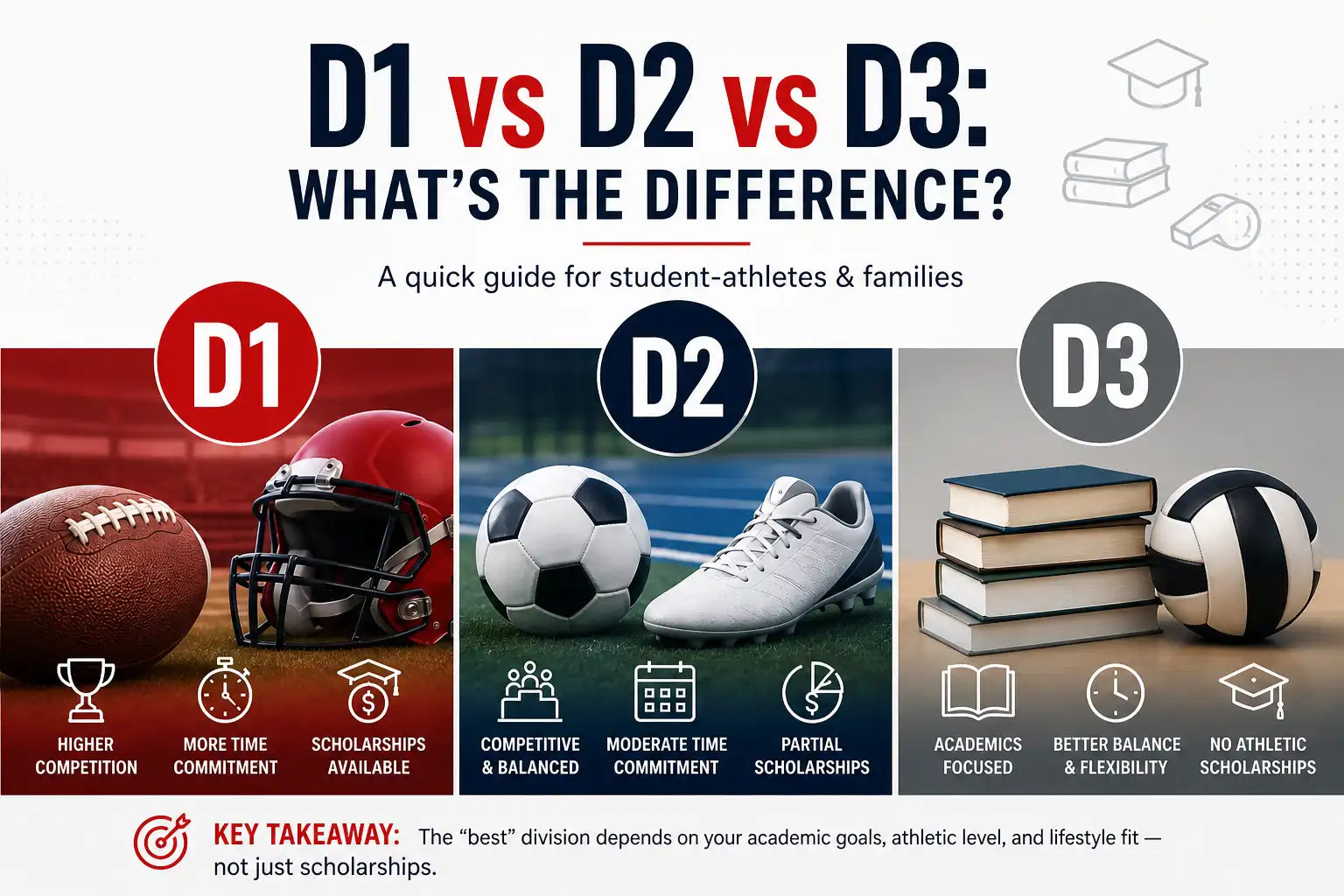
For student-athletes just entering the college recruiting process, few decisions carry more structural weight than understanding what each NCAA college division actually requires. Division I, Division II, and Division III differ in the level of athletic competition, the academic demands placed on student-athletes, and the daily time commitment the sport requires.
At every level, collegiate athletics and academic life run simultaneously, and the division a student-athlete targets shapes what that combination looks like for four years or more.
This article covers the full landscape of Division I, Division II, and Division III, comparing each division across competition level, time commitment, scholarships, eligibility requirements, academic environment, and the recruiting process.
D1, D2, and D3 at a Glance
| Category | D1 | D2 | D3 |
|---|---|---|---|
| Member Schools | 355 (2025–26) | 293 (2025–26) | 422 (2025–26) |
| Student-Athletes | Over 180,000 (approximate) | More than 120,000 (approximate) | Over 200,000 student-athletes |
| Athletic Scholarships | Full & partial, sport-dependent | Mostly partial (equivalency model) | None (no athletic scholarships) |
| Financial Aid | Athletic + academic/need-based | Partial athletic + academic/need-based | Academic/need-based only (no athletics aid) |
| Competition Level | National & international | Regional & national | Primarily regional; some national powers |
| Time Commitment | Heaviest; year-round model | Substantial; similar structure, fewer demands | Lightest; shorter and more regional seasons |
| In-Season Hours (NCAA cap) | 20 hrs/week (countable activities) | 20 hrs/week (countable activities) | 20 hrs/week (countable activities); shorter seasons |
What Are the NCAA College Divisions?
The National Collegiate Athletic Association is the governing body for college athletics in the United States, overseeing eligibility, scholarships, recruiting, and competition for more than 500,000 student-athletes across over 1,000 colleges and universities. To promote competitive balance and group institutions with comparable resources and program scope, the NCAA organizes its member schools into three divisions: Division I, Division II, and Division III.
1. What Is Division I?
NCAA Division I is the highest level of collegiate athletic competition in the United States, comprising generally larger institutions with the most extensive athletic programs and institutional investment in NCAA sports.
- 355 member schools as of the 2025–26 academic year
- More than 180,000 student-athletes across all sports
- Athletic scholarships available in every sport, with aid structured differently by sport
Year-round competitive model with 20 hours per week of countable activities in season and 8 hours in the offseason
2. What Is Division II?
NCAA Division II is the second tier of collegiate athletic competition, grouping institutions that are typically smaller than Division I schools and emphasizing “life in the balance” between athletics, academics, and campus involvement.
- 293 member schools in 2025–26
- A partial-scholarship (equivalency) model in all sports
- Competitive regional and national play with a somewhat more flexible overall schedule
3. What Is Division III?
NCAA Division III is the largest division by school count and student-athlete population, comprising predominantly smaller institutions that prioritize academic achievement and campus engagement alongside competitive athletics.
- 422 member schools in 2025–26
- Over 200,000 student-athletes
- No athletic scholarships; financial aid is based on academics or demonstrated need
- Shorter seasons and reduced nontraditional-season requirements to protect academic time
D1 vs D2 vs D3: All the Differences Explained
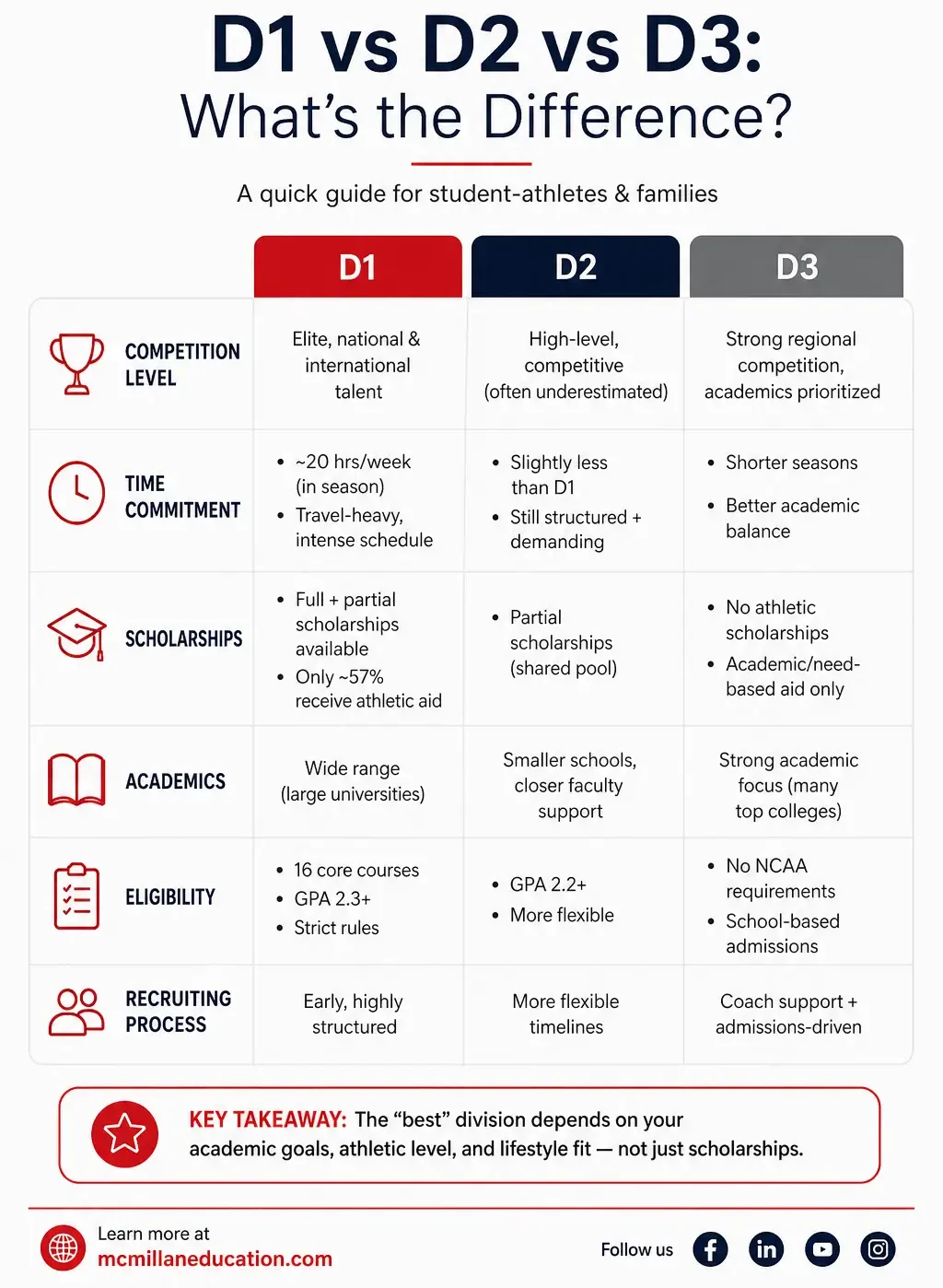
Division I, Division II, and Division III are distinct systems, and the variables that separate them, covering competition level, time commitment, scholarships, eligibility requirements, academic environment, and recruiting process, are each examined below.
1. Competition Level
1.1 D1
Division I draws from national and international talent pools across the major athletic conferences, and physical thresholds, size, speed, strength, and position-specific athleticism, are evaluated at their most demanding. In- and out-of-season athletic accomplishments, measurable performance metrics, and tournament-level competition history are standard evaluation criteria at this level, and the margin between roster spots is narrow.
1.2 D2
Division II usually draws athletes who meet rigorous competitive standards across speed, size, and sport-specific skill, competing at both regional and national levels. Families who approach it as a diminished version of Division I misread the division; the athletic caliber across rosters is serious, and the competitive standard demands equivalent preparation from recruits.
1.3 D3
Division III competition operates predominantly at the regional level, though competitive standards vary considerably by conference and sport, and certain Division III conferences maintain levels that compare favorably with higher divisions. The division comprises accomplished athletes, many of whom were standout competitors at the high school level, who have prioritized an academic environment alongside continued athletic competition.
The athletes competing for Division III roster spots are accomplished competitors, and student-athletes who approach the division without that context find the recruiting process more demanding than expected.
2. Time Commitment
2.1 D1
Division I student-athletes commit to strength and conditioning, individual skill sessions, film study, team practices, travel to competitions (including weekends and academic breaks), and institutional community engagement. The NCAA limits countable athletically related activities to 20 hours per week in season and 8 hours per week out of season, with at least one day off per week in season and two days off per week out of season.
The full demands of a Division I program, including non-countable obligations such as travel and training room time, frequently extend beyond those formal limits in practice. Many student-athletes are also required to attend a study hall or use academic support services to keep coursework on track around travel and competition.
2.2 D2
Division II student-athletes carry many of the same structural time obligations that exist at the Division I level, including structured practice schedules, strength and conditioning requirements, and competitive travel. Seasons are generally somewhat shorter than at Division I, and while the time commitment is still substantial, it is often more compatible with a wider range of campus involvement.
2.3 D3
Division III minimizes conflicts between athletics and academic life through shorter practice and playing seasons and regional competition schedules that reduce time away from campus. Like other NCAA divisions, Division III programs are subject to limits on countable athletically related activities in season (20 hours per week), but the division structures shorter playing and practice seasons and more limited nontraditional season activity. The result is a meaningful reduction in required athletics time relative to Divisions I and II.
3. Scholarships
Scholarship structures differ across the three NCAA divisions, and the assumptions families carry into the recruiting process about what each division offers are often inaccurate in both directions. McMillan Education athletic recruiting specialists advise families to evaluate the total cost of attendance across all three divisions before making scholarship designation the deciding factor in the recruiting decision.
3.1 D1
Division I is the only NCAA division in which every sport may offer athletic scholarships, but the assumption that a Division I offer means a full ride is accurate for only a small subset of sports.
- In a limited number of sports (for example, FBS football and men’s and women’s basketball), scholarships have traditionally functioned as headcount awards where each athlete receiving athletics aid typically receives a full grant-in-aid.
- In all other sports, programs operate under equivalency limits, meaning a defined number of scholarship equivalents can be divided among many athletes as partial awards.
Only about 57% of Division I student-athletes receive some form of athletics aid; many others fund their education through academic scholarships, need‑based aid, and other institutional resources. Beginning with the 2025–26 academic year, some Division I schools that opt into new NCAA models will have additional flexibility in how they structure athletics aid, but the fundamental distinction between Division I (athletics aid permitted) and Division III (no athletics aid) remains.
3.2 D2
Division II institutions offer athletic scholarships in all sports but rely on a partial-scholarship (equivalency) model. Coaches distribute a total scholarship allocation across their roster in partial amounts, with individual award sizes determined by program funding, roster size, and competitive priorities. A partial Division II athletic scholarship and the academic merit or need-based aid available at another institution (including some Division III schools) can, in practice, produce comparable net costs; families must examine total cost of attendance rather than scholarship labels alone.
3.3 D3
Division III institutions do not offer athletic scholarships. Financial aid is awarded on the basis of academic merit or demonstrated financial need under the same criteria applied to the general student body, although coaches can identify candidates who are likely to be competitive for institutional aid. The absence of an athletic scholarship designation does not automatically translate into a higher net cost of attendance, particularly at institutions with strong need-based aid policies.
4. Academic Standards and Institutional Type
The division a student-athlete targets determines the type of colleges and academic environment in which four years will be spent.
4.1 D1
Division I includes the largest athletic programs in the NCAA, spanning major research universities, mid-sized regional institutions, and smaller private colleges. Academic expectations for recruited athletes vary considerably by program, conference, and institutional selectivity.
The Ivy League operates as a distinct category within Division I: these eight schools award no athletic scholarships and provide financial aid based exclusively on demonstrated financial need. Recruited Ivy League athletes are evaluated using an Academic Index (a league-administered metric combining GPA, test scores, and class rank where available) to ensure that recruited athlete cohorts remain academically comparable, on average, to the general student body.
Other Division I institutions that are not part of the Ivy League apply their own internal academic thresholds for recruited athletes, which vary significantly across conferences.
4.2 D2
Division II institutions are generally smaller than many Division I schools, with a high proportion enrolling fewer than 8,000 students. Many D2 campuses feature smaller class sizes and closer faculty relationships, though academic culture still varies across the division and requires program-by-program evaluation.
4.3 D3
Division III includes a high concentration of liberal arts colleges, regional universities, and specialized institutions. Many of the most academically selective colleges in the country compete at this level, and academic expectations for recruited athletes track the standards of the overall student body.
The practical implication: divisional level and academic selectivity are not the same variable. A Division III placement at a selective liberal arts college can represent a more demanding academic environment than a Division I placement at a less selective program.
5. NCAA Eligibility Requirements
Meeting NCAA eligibility requirements: core course record, GPA thresholds, and registration timelines, starts in high school, and gaps identified late in the process can be difficult to repair. The requirements differ by division and shape how much flexibility a student-athlete retains when coaches come calling.
5.1 D1
Division I has the most structured eligibility requirements:
- Graduate from high school
- Complete 16 NCAA-approved core courses in English, math, natural/physical science, social science, and additional approved subjects
- Earn a minimum 2.3 core-course GPA on a 4.0 scale
- Complete 10 of the 16 core courses, including at least 7 in English, math, or science, before the start of senior year (the 10/7 rule)
- Register with the NCAA Eligibility Center and obtain an amateurism and academic certification
Core courses completed after the start of senior year cannot be used to raise the core-course GPA calculated from the first 10 courses for initial eligibility. Standardized test scores are no longer required for NCAA Division I initial eligibility, though individual institutions may still require them for admission.
5.2 D2
Division II eligibility requirements follow the same core-course framework with key differences:
- 16 NCAA-approved core courses required
- Minimum 2.2 core-course GPA
- NCAA Eligibility Center registration and amateurism certification required
- No 10/7 timing rule, providing greater flexibility in when core courses can be taken
- Standardized test scores not required for NCAA Division II initial eligibility
5.3 D3
Division III operates outside the NCAA core-course and sliding-scale framework for initial eligibility. The NCAA does not set core-course or GPA thresholds for Division III student-athletes; each institution establishes its own admissions and continuing eligibility standards. Domestic Division III student-athletes are not required to register with the NCAA Eligibility Center.
6. Recruiting Process
The recruiting process differs structurally across divisions, and recent trends in athletic recruiting have added complexity to an already demanding landscape. The timeline, contact rules, and formal offer mechanisms at each level carry direct consequences for how and when a student-athlete’s recruiting plan takes shape.
McMillan Education’s W.I.S.E. Admissions Playbook™ for Athletic Recruiting addresses each stage of this process, from initial exposure through formal commitment, across all three divisional levels.
6.1 D1
Division I recruiting operates on the most structured and sport-specific calendar in the NCAA. For many sports, coaches may begin initiating direct recruiting contact with prospects on June 15 after sophomore year or September 1 of junior year, with specific dates set in sport-by-sport recruiting calendars.
The Division I recruiting calendar defines four primary period types:
- Contact period: All in-person, on- and off-campus communication between coaches and recruits is permitted.
- Evaluation period: Coaches may observe recruits compete in person but may not have off-campus face-to-face contact.
- Quiet period: In-person recruiting contact is permitted only on the institution’s campus.
- Dead period: No in-person contact on or off campus; no official or unofficial visits permitted.
In October 2024, the NCAA Division I Council voted to eliminate the National Letter of Intent program; formal commitments now occur through written athletics financial aid agreements and institutional admissions processes rather than the NLI. Ivy League institutions follow a distinct process, issuing likely letters from the admissions office (rather than athletic scholarship offers), as these schools do not offer athletics-based financial aid.
Division I recruiting demands early and consistent visibility. Coaches identify prospects early, evaluate them across multiple competition contexts, and build recruiting classes on timelines that are often accelerated compared to the lower divisions.
6.2 D2
Division II recruiting is more standardized across sports than Division I and generally features more permissive contact rules, while still operating under NCAA-defined recruiting calendars and periods. Coaches’ ability to call, text, email, or direct message recruits is governed by Division II legislation and sport-specific calendars, and off-campus contact and official-visit timing are defined by NCAA rules rather than left entirely to individual programs.
Formal offers at the Division II level are typically communicated through athletics financial aid agreements and, in many cases, through participation in the National Letter of Intent program, which remains in use for Division II. In practice, many Division II programs build their recruiting classes through the late junior and senior years and also attract international student-athletes whose profiles align more closely with D2 competitive thresholds.
6.3 D3
Division III recruiting is less formally structured than Division I or Division II and places more emphasis on institutional admissions processes. Coach communication with prospects by phone, text, and email is broadly permissible under NCAA rules, but D3 institutions still follow recruiting calendars and contact guidelines set in the Division III bylaws.
Division III recruits typically receive a verbal offer or strong indication of support from the coaching staff, followed by a formal application and review by the admissions office, which makes the final determination under the same academic standards applied to all applicants. Many D3 programs use pre-reads or early academic reviews to give prospective student-athletes a clearer sense of their admissibility before asking for a commitment.
How to Choose the Right College Division: D1, D2, or D3?
Selecting the right division requires evaluating four variables simultaneously:
- Athletic viability: At which level is the student-athlete genuinely recruitable, given current and projected development?
- Scholarship structure: What financial support is realistically available, accounting for equivalency models, institutional aid, and total cost of attendance?
- Institutional type: Does the type of institution that the division produces align with the student-athlete’s academic and campus environment goals?
- Academic culture: Does the rigor and academic profile of target institutions match the student-athlete’s record and ambitions?
These variables do not resolve together automatically. A recruit qualified for Division I competition may be better served academically at a selective Division III institution, while a student-athlete drawn to a small liberal arts environment may find that Division I opportunities are concentrated in mid-major conferences or specific sports. Treating the “division question” and the “college question” as synonyms is one of the most common planning errors McMillan Education athletic recruiting consultants see.
What the process requires above all is patience with ambiguity. The right divisional placement is not visible at the outset; it emerges through a structured recruiting plan that accounts for athletic development, academic profile, and institutional priorities simultaneously. For families who want to build that plan independently, McMillan Education’s W.I.S.E. Admissions Playbook™ covers each stage of the athletic recruiting process in detail, including a dedicated module on divisional placement across all three levels.
In the meantime, the most productive posture for a student-athlete is straightforward: keep developing athletically, prepare academically, and trust a structured process to produce the outcome.
Build Your Recruiting Plan With McMillan Education
Determining the right division requires more than research. It requires a structured recruiting plan that accounts for multiple variables simultaneously, built and executed by specialists who understand how each piece interacts across all three divisional levels.
McMillan Education brings that expertise directly: more than 1,500 collegiate athletes guided across 20+ NCAA sports, with athletic recruitment consultants averaging 20 years of direct experience.
Schedule a free consultation with a McMillan Education recruiting specialist and begin building your recruiting plan.
Frequently Asked Questions
1. How many NCAA divisions are there?
The NCAA has three divisions: Division I, Division II, and Division III. Each division operates under its own set of rules governing scholarships, recruiting, eligibility, and competition.
2. How are NCAA divisions determined?
Division membership is based on a combination of institutional characteristics, including sport sponsorship, financial aid policies, and compliance with NCAA membership criteria for each division. Schools must meet specific NCAA requirements to compete at each divisional level, and transitions between divisions follow multi-year reclassification processes defined in NCAA legislation.
3. Can a student-athlete switch divisions?
Yes. Student-athletes may transfer between institutions competing at different divisional levels under NCAA transfer rules. Transfer eligibility requirements, including the use of the transfer portal and year-in-residence or immediate-eligibility provisions, vary by division and sport, and students considering a divisional transfer should verify current rules with the compliance office at their target institution.
4. What is the difference between headcount and equivalency sports?
Historically, headcount sports have been those in which each student-athlete receiving athletics aid counts as one full scholarship, and awards are typically full grants-in-aid, while equivalency sports allow coaches to divide a set number of scholarship equivalents into partial awards spread across the roster. In Division I, only a small number of sports, such as FBS football and men’s and women’s basketball, have been treated as headcount sports; all others operate under equivalency limits. Ongoing changes to Division I financial-aid structures give institutions additional flexibility in how they package aid, but the core distinction remains useful in understanding how scholarships are distributed.
5. Can college athletes go pro?
Yes, but with significant caveats. NCAA rules permit student-athletes to explore professional opportunities, enter drafts, and, in some cases, work with agents under specific conditions without automatically losing collegiate eligibility. However, signing a professional contract or competing on a professional team typically exhausts NCAA eligibility in that sport, and the exact rules and exceptions are sport- and division-specific. Student-athletes considering professional options should work directly with their institution’s compliance office to understand current NCAA legislation and maintain eligibility where possible.
6. What is NIL, and does it apply to all divisions?
NIL stands for Name, Image, and Likeness. Effective July 1, 2021, the NCAA adopted an interim policy that allows student-athletes in all three divisions to earn compensation for the use of their name, image, and likeness, consistent with applicable state laws and institutional policies.
NIL opportunities can include endorsements, appearances, social media partnerships, and other commercial activities, but athletes must follow school and conference guidelines and may not receive pay-for-play or recruiting inducements under NCAA policy.
7. What division is the Ivy League?
NCAA Division I level. These institutions are distinct within Division I in three key ways:
- They do not offer athletic scholarships.
- They award financial aid exclusively on the basis of demonstrated financial need.
- They use a league-administered Academic Index to ensure that the academic profile of recruited athletes remains comparable to that of the general student body.
Families often incorrectly equate “Ivy” with a separate division; in reality, these are Division I institutions whose athletic and financial aid policies are shaped by league agreements and institutional priorities rather than distinct NCAA divisional rules.